49 works in this view — arrow keys or swipe to move between them.
Dance in Art
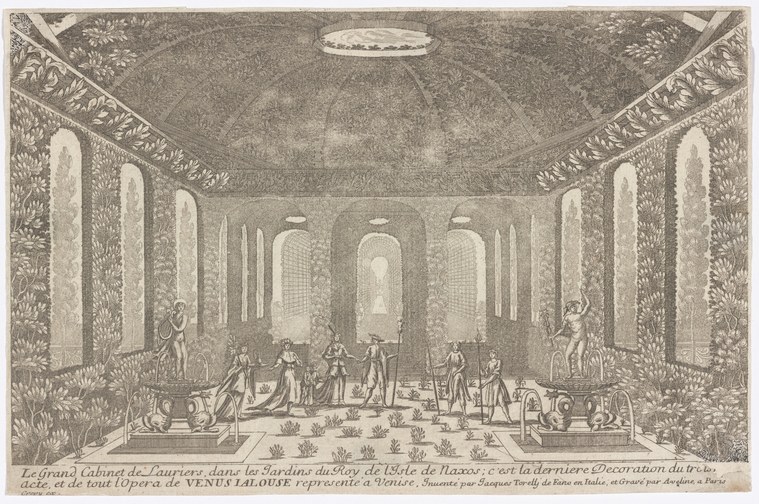
Le Grand Cabinet des Lauriers, dans les Jardins du Roy de l'Isle de Naxos; c'est la derniere Decoration du tro[isième?] acte, et de tout l'Opera de Venus Ialouse representé a Venise
Unknown artist
- Collection:
- Prints depicting dance
- Source:
- New York Public Library
- Rights:
- Public domain — free to use, share and adapt.
- Recorded as:
- Public Domain
This image is one of the few surviving graphic records of an actual theatrical dance spectacle from early 18th-century Venice, documenting not only the architecture and décor but also the formal arrangement of costumed figures within a performance space. For historians of Baroque theatre, opera, and court dance, such designs are primary sources for understanding how dance was integrated into multimedia spectacle, how the dancing body was scaled and positioned within architectural fantasy, and what the visual vocabulary of court ceremony looked like when transferred to the stage.
What you are looking at
This is an engraved design for a grand theatrical garden scene, the final decoration of act three in an opera performed in Venice. The composition depicts an expansive interior garden pavilion with a vaulted ceiling, its architectural vault decorated with dense foliate patterns that create a unified decorative field across the entire upper half of the image. Two rows of tall, fluted columns—at least six on each side—define a processional space down the center, creating powerful linear perspective that draws the eye toward a distant portal or doorway at the back. The columns are rusticated and ornamented, and the walls between them are covered entirely in delicate trellis work or lattice patterns suggesting climbing vines. The pavement is marked with small potted plants or topiaries arranged in rows. A company of elegantly dressed figures—appearing to number around a dozen—is distributed across the floor: some stand in small groups, others appear to be in motion or posed in attitudes suggesting dance. The figures wear what appears to be Baroque or early 18th-century costume, with women in full skirts and men in fitted coats. The scene is rendered entirely in tonal engraving, relying on fine parallel lines and hatching to create depth, shadow, and the illusion of light entering from unseen windows in the vault above.
The dancing
The figures are small relative to the vast architectural setting, emphasizing the grandeur of the space rather than detailed bodily action. Several appear to be in paired or grouped configurations suggesting social interaction or dance engagement, though the scale and technique of the engraving do not permit clear reading of specific holds or steps. A few figures in the foreground and middle distance are oriented toward one another or the center space in postures that suggest courtly movement or processional ordering. The women's full skirts are depicted with attention to how they hang and may move, but feet and lower leg position are largely obscured by drapery. Overall, the composition prioritizes the theatre architecture and decorative spectacle over intimate observation of dancing bodies.
The dance depicted
The title identifies this as a scene from the opera *Venus Jalouse* (Jealous Venus), performed in Venice, specifically the final decoration (scenery) of act three, known as the 'Grand Cabinet of Laurels in the Gardens of the King of the Isle of Naxos.' This appears to be a design for a stage set intended to frame courtly or theatrical dance rather than a record of specific dancers or choreography. The setting and the small, formally arranged figures suggest that this accompanied a court ballet or operatic spectacle typical of early 18th-century Venetian theatre. The precise choreography or dance style cannot be determined from the image; however, the formal court dress, the symmetrical garden setting, and the ceremonial arrangement of figures suggest Baroque court dances of the period—possibly minuet, pavan, or courtly processional forms that would have been the standard vocabulary of such spectacles.
How it was made
This is an engraving, executed in the fine-line Baroque style common to theatrical design prints of the early 18th century. The technique employs parallel hatching and careful tonal gradation to create the illusion of architectural depth, shadow, and the play of light across the vaulted ceiling and through the colonnade. The fineness of the line work and the meticulous attention to ornamental detail suggest this was a finished print intended for publication or distribution—likely an illustration documenting or promoting the theatrical production. The engraving technique allowed for precise reproduction of the architectural fantasy and would have been circulated among the educated public, theatre patrons, and designers interested in contemporary stage spectacle. The relative rarity and specificity of theatrical design engravings from this period and place makes this a valuable document of early 18th-century Venetian opera production.
About this work
This engraved theatre design depicts the final act decoration for a Venetian opera of the early 18th century, showing an idealized Baroque garden pavilion filled with elegantly dressed courtiers. Although the title references a specific performance of *Venus Jalouse*, the work functions as both a stage design document and a work of architectural and decorative fantasy. The image records not a specific choreography but the spectacle and setting within which courtly dance would have taken place—the kind of elaborate, formally composed theatrical environment that framed the dances of the Baroque stage.
How to look at it
Attend first to the architectural composition: the way the colonnade recedes into depth and the vault above unifies the entire space. This framing device is not incidental—it is the stage itself, designed to elevate and formalize any movement or gesture within it. Look then at the distribution of the small figures: notice how they are positioned to respect the symmetry and axes of the architecture, suggesting that their movement and dance would have been equally formal and processional. The engraver's technique—the fine parallel lines creating shadow in the vault, the delicate cross-hatching on the columns—is itself a kind of visual music, an ornamental language that would have been matched by the music and measured movement of the performance.
The artist
The artist is not recorded in the catalogue. However, the style and finish of the engraving, the specificity of the subject matter, and the inscription suggest this was produced by a professional theatrical designer or engraver working in Venice or connected to its theatrical circles in the early 18th century. Such prints were often created by teams—a designer who conceived the stage set and an engraver who translated it to the plate. The work bears the hallmarks of the Italian theatrical design tradition that was reaching its height in this period.
The period
The early 18th century saw the flowering of opera as a multimedia art form across Italy, with Venice as one of the major production centers. The Baroque aesthetic celebrated architectural fantasy, ornamental abundance, and the formal integration of dance into operatic spectacle. Court dances—minuets, pavanes, and courtly processionals—were standard components of opera and ballet productions of this period. The elaborate perspectival settings depicted in stage designs like this one reflected both the mathematical interests of the Baroque period and the desire to create overwhelming sensory and visual spectacle. Engraved theatre designs circulated widely, documenting and promoting these productions and influencing designers across Europe.
Where it lives
The work is held by the New York Public Library as part of its collection of prints depicting dance. It is catalogued by title and subject matter rather than by a known artist signature, and may have been one of a series documenting Venetian theatrical productions of the period.
Dance in this work
Questions about this work
What opera is this from?
The title identifies it as the final scene decoration from *Venus Jalouse* (Jealous Venus), performed in Venice. The setting represents the Grand Cabinet of Laurels in the mythological gardens of the King of the Isle of Naxos. No other details about the specific production—date, composer, or performers—are recorded.
Were people actually dancing in this space?
Almost certainly. This is a stage design, not a record of a completed performance. The engraving documents the architectural and decorative setting in which courtly dances would have been performed during the opera. The small figures arranged in the space suggest the formal, processional dances—minuets, pavanes, and courtly ceremonial movements—that were standard parts of 18th-century opera.
Why is the architecture so elaborate?
Baroque opera and theatre celebrated visual spectacle as integral to the art form. Theatrical designers vied to create fantastical, mathematically sophisticated architectural spaces that would awe audiences and create a suitable stage for mythological or courtly narrative. The elaborate set design was as much a part of the aesthetic experience as the music and dance.
How do we know this is an engraving and not a drawing?
The technique is visible in the parallel hatching lines, the precise tonal gradation, and the crisp, reproducible quality of the line work. These are characteristic of engraving, the most common medium for circulating theatrical designs in print form during this period. The inscription at the bottom is also typical of published prints.
More dance artwork





