49 works in this view — arrow keys or swipe to move between them.
Dance in Art
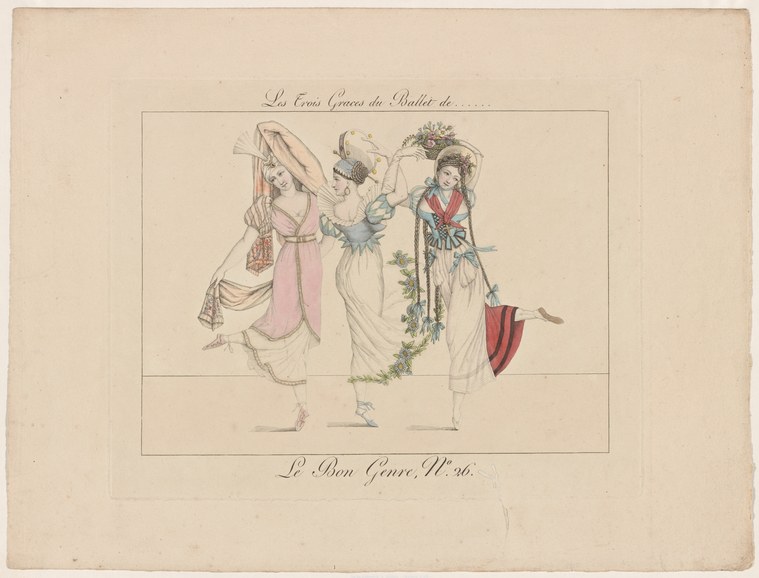
Les Trois Graces du ballet de
Unknown artist
- Collection:
- Prints depicting dance
- Source:
- New York Public Library
- Rights:
- Public domain — free to use, share and adapt.
- Recorded as:
- Public Domain
This image documents the transitional moment between 18th-century court ballet and Romantic ballet, showing the neoclassical aesthetic and technique that dominated Paris in the 1790s–1810s. The numbered series format suggests it was one of many such prints circulated to shape public taste in both dance and fashion. For historians, it offers reliable evidence of how the Three Graces were staged, how female dancers of the period were costumed and posed, and what kind of entertainment dominated the Parisian stage at this specific cultural moment.
What you are looking at
Three female figures in neoclassical dress occupy the composition, arranged in a diagonal line across the shallow picture plane. The leftmost dancer wears pink drapery with elaborate accessories including a parasol or fan held aloft; the central figure is draped in white with a wreath or ornament in her hair; the rightmost wears white with red accents and holds what appears to be a fan or prop. All three stand in balletic poses with raised arms and lifted carriage. The setting is spare—a simple rectangular frame defines the stage, with no scenery or architectural detail. The figures are rendered in delicate line with subtle hand-coloring in pink, white, and red, characteristic of the late 18th-century theatrical print. The title inscribed above reads "Les Trois Graces du ballet de" [The Three Graces of the ballet of...], with the specific ballet name left blank or illegible. Below is inscribed "Le Bon Genre, No. 56."
The dancing
All three dancers are shown in upright, elongated poses with arms raised or extended in balletic positions. Their bodies show the turned-out legs and lifted torsos typical of ballet training of the period. The spacing and positioning suggest they are dancing in relationship to one another rather than in unison; their varied arm positions and slightly different levels create visual rhythm. The weight appears lifted and forward on the balls of the feet, consistent with ballet technique of the late 18th century. None displays the heavy, earthbound quality of pantomime or character dance; the figures are entirely graceful and ethereal.
The dance depicted
This is a theatrical ballet scene, almost certainly from the late 18th-century French stage. The title invokes the classical allegory of the Three Graces (Aglaia, Euphrosyne, Thalia), a motif common in neoclassical ballet and court spectacle. The image depicts the kind of divertissement or entrée that would have concluded a ballet d'action or appeared within a mixed theatrical entertainment. The dancers' poses and dress suggest the Romantic ballet was not yet in full flower—these are elegant, posed figures rather than the dramatically narrative gestures of Romantic ballet, and their skirts remain knee-length rather than the ankle-length tutus that became standard later. The specific ballet is not identified in the visible text, but the style and inscription "Le Bon Genre, No. 56" indicate this was one of a series of fashionable theatrical prints.
How it was made
This is a hand-colored engraving or etching, likely a commercial print from a Parisian publisher. The delicate line work and the way color is applied in discrete areas—pink in the drapery, flesh tones in the faces and limbs, without blending or shadowing—is characteristic of colored theatrical prints of the 1790s–1810s. The technique allowed rapid, economical production for a popular market: the image would have been engraved on a plate, printed in black line, then hand-colored by workshop assistants using stencils or careful brushwork. This suggests a fairly wide circulation among the theatergoing public and the fashion-conscious elite who collected such prints as records of notable performances and as models of elegant dress and behavior.
About this work
This is a scene from a late 18th-century French ballet, specifically depicting the Three Graces in the elegant, formal style of that era. The print is part of a numbered series called "Le Bon Genre," which captured fashionable theatrical moments for a commercial audience. The three dancers are shown in characteristic balletic poses and neoclassical dress, frozen in an instant of graceful, coordinated movement. Such images served multiple purposes: they documented the appearance of celebrated dancers and roles, they advertised performances, and they functioned as fashion prints, showing the elegant dress and deportment an educated person should admire. The work belongs in a dance collection because it records how ballet was actually performed, costumed, and presented to audiences in the pre-Romantic era.
How to look at it
Notice the raised, weightless quality of the figures—how the bodies seem to float above the stage rather than rest upon it. Observe the varied arm positions (one raised overhead, one extended, one lowered) and the slight differences in stance, which create the effect of movement even in this still image. The artist has chosen a moment of poised equilibrium rather than violent action or dramatic narrative; this is the aesthetic of the dance divertissement, where beauty of line and harmony of movement matter more than dramatic force. The hand-coloring distinguishes each dancer's costume and helps the eye read three distinct bodies in shallow space.
The period
This print dates to the period following the French Revolution, when neoclassical aesthetics dominated French art and theater. Ballet at this time was undergoing rapid change: the heavy, ornate costumes and rigid formality of 18th-century court ballet were giving way to lighter dress and greater expressivity, though not yet the narrative intensity and pointe work of Romantic ballet (which began around 1830). The Three Graces was an allegorical subject ideally suited to neoclassical taste—elegant, virtuous, and grounded in classical mythology. The series "Le Bon Genre" (Good Taste) reflected the preoccupations of post-Revolutionary French society with civility, fashion, and polite entertainment. Such prints were mass-produced and affordable, making them a crucial source for understanding how dance and performance were experienced and remembered by ordinary educated people.
Where it lives
This is a hand-colored engraving from a series titled "Le Bon Genre," which numbered at least 56 subjects. It is held by the New York Public Library as part of its collection of prints depicting dance, and reflects the library's role as a repository for theatrical documentation and social history.
Dance in this work
Questions about this work
Who were the Three Graces in ancient mythology?
In classical mythology, the Graces (Greek Charites) were three goddesses embodying beauty, charm, and elegance: Aglaia (radiance), Euphrosyne (joy), and Thalia (bloom). They were frequently depicted in groups, dancing or moving in harmony, making them an ideal subject for neoclassical ballet and visual art of the 18th and 19th centuries.
What is 'Le Bon Genre'?
"Le Bon Genre" was a series of hand-colored satirical and theatrical prints published in France in the early 19th century, typically numbering subjects and capturing fashionable society, current events, and celebrated performances. Each print was meant to be amusing and instructive about proper taste and social behavior.
How does this differ from later Romantic ballet?
This image shows pre-Romantic ballet: the skirts are knee-length (not the ankle-length tutus of Romantic ballet), the poses are formal and symmetrical rather than dramatically narrative, and there is no suggestion of the supernatural or melancholic emotion that would dominate Romantic ballet after 1830. The focus is on elegant line and courtly grace rather than storytelling or pathos.
Was this a real performance?
Very likely. The inscription and series number suggest this was based on an actual ballet or scene performed in Paris, probably between 1790 and 1820. The print was made to commemorate the performance and to sell to people who had seen it or heard about it.
More dance artwork





