49 works in this view — arrow keys or swipe to move between them.
Dance in Art
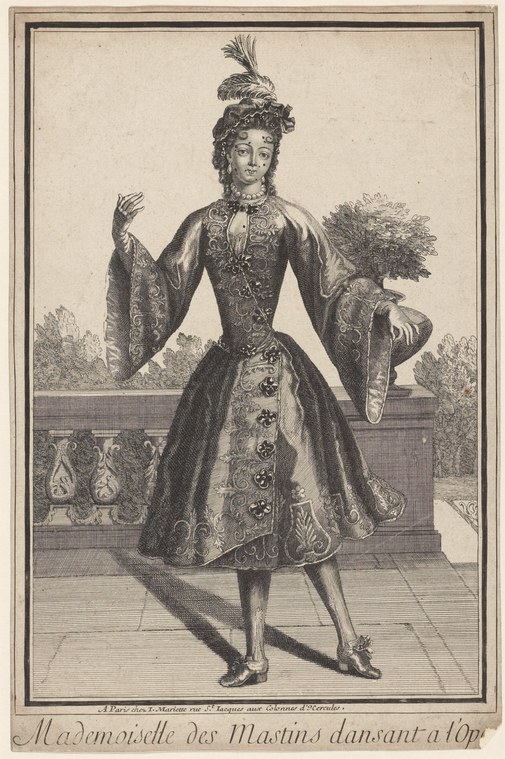
Mademoiselle des Mastins dansant a l'O[péra]
Unknown artist
- Collection:
- Prints depicting dance
- Source:
- New York Public Library
- Rights:
- Public domain — free to use, share and adapt.
- Recorded as:
- Public Domain
This is one of few named records of individual performers from the early modern French operatic stage, and the engraving format means it circulated beyond the theatre itself, reaching a broad collecting public. For historians of dance, costume, and theatre, it is a primary document of how performers were seen, named, and celebrated in this period.
What you are looking at
A young woman stands alone on a paved terrace or stage, posed in an attitude of display rather than active motion. She wears an elaborate late 17th-century court dress: a dark bodice with jeweled ornament, a full skirt with decorative appliqué down the front panel, and long sleeves of sheer fabric pulled back and held at the elbow to expose the forearm. A tall feathered plume rises from her elaborately arranged hair. She gazes toward the viewer with a composed expression. Behind her stands a classical stone balustrade, and the setting suggests an ornamental garden or palace courtyard with trees visible in the distance. The figure is rendered in fine engraved line work with careful cross-hatching for shadow and fabric texture. The composition is frontal and symmetrical, presenting the dancer as an object of visual consumption.
The dancing
The dancer stands in a relaxed contrapposto stance with weight on one leg, the other leg slightly bent. Both arms are raised to roughly shoulder height, one extended outward with the hand open and palm visible, the other bent at the elbow. The posture suggests a moment of presentation or greeting rather than the dynamic extension of theatrical dance. The body is upright but not tensed; the movement is courtly and mannered rather than athletic.
The dance depicted
This appears to be a court dance or theatrical performance piece from the late 17th century, most likely a solo air or character dance performed at the French court or in Paris's operatic venues (indicated by "à l'Opéra" in the title). The pose and dress align with the ornamental court dances of the Baroque period, though the figure is frozen in a moment of courteous presentation rather than mid-movement. The work commemorates a named performer (Mademoiselle des Mastins), suggesting she was a notable dancer of her day. The static, symmetrical pose is typical of how single performers were celebrated in engravings—emphasizing beauty and court manner over the kinetic excitement of the actual dance.
How it was made
This is an engraving, rendered in fine parallel lines and cross-hatching to create volume, shadow, and the luxurious texture of silk and lace. The technique allowed for precise rendering of costume detail and wide circulation as a print; the work was likely sold individually or as part of a series documenting performers and fashions of the Paris opera and court. The line work is controlled and elegant, befitting its purpose as both artwork and document of fashion and celebrity.
About this work
This engraving commemorates a solo dancer, Mademoiselle des Mastins, performing at the Paris Opéra in the late 17th century. It is not primarily a depiction of dance in action, but rather a portrait of a named performer in character dress, frozen in a moment of courtly presentation. Such prints served multiple purposes: they recorded the appearance and name of celebrated dancers, circulated fashionable court costume, and functioned as theatrical memorabilia for collectors. The work is a valuable historical record of who danced, how they dressed, and the visual culture surrounding early modern French dance.
The image sits at the intersection of dance documentation, fashion illustration, and theatrical portraiture. It tells us that even in the late 17th century, individual dancers could achieve sufficient fame to be commemorated in widely circulated engravings, and that the visual record of dance was often composed for the still moment rather than the moving body.
How to look at it
Attend first to the costume: every element—the plume, the jeweled bodice, the sheer sleeves, the decorated skirt front—is rendered with precision and serves to elevate the dancer's body and presence. The pose is deliberately composed and frontal; there is no sense of a moment caught in transition. Notice how the raised arms and open hands create a gesture of display and greeting, and how the balustrade and distant garden behind her frame her as a figure of leisure and refinement. The engraving's fine, regular lines give the entire scene a sense of ordered elegance characteristic of court culture.
The artist
The artist is not recorded in the catalogue. The engraving style and the French caption suggest a French printmaker of the late 17th century, likely working in Paris for the market in theatrical portraits and fashion prints. The hand-signature or monogram—if visible—is too small or unclear to read from the reproduction.
The period
The late 17th century was the period of Louis XIV's court and the establishment of the Académie Royale de Danse (1661), which codified ballet technique and terminology. The Opéra in Paris, founded in 1671, became the primary venue for professional theatrical dancing, and individual dancers began to gain public names and reputations. Costume engravings and theatrical portraits became popular luxury items among the aristocracy and wealthy bourgeoisie, documenting both the dances and the fashions associated with courtly performance.
This period saw the transition from court dance (where nobility danced) to professional theatrical dance, yet professional dancers still inhabited the visual and sartorial world of the court. The elaborate costume in this engraving—with its jewels, feathered plume, and fine lace—reflects the expense and prestige of operatic costume and the dancer's status as a celebrated performer.
Where it lives
This engraving is held in the New York Public Library's collection of prints depicting dance. It is a single-sheet print, likely originally sold individually or as part of a series of theatrical and fashion prints.
Dance in this work
Questions about this work
Who was Mademoiselle des Mastins?
She was a dancer known to have performed at the Paris Opéra in the late 17th century, but little more is recorded. Her name survives primarily through this engraving and other theatrical documents of the period. She was prominent enough to merit a commemorative print, indicating she was a celebrated performer of her day.
Why is she standing still if this is a dance image?
This is a theatrical portrait, not an action scene. The engraver has chosen to show the dancer in a posed, courtly moment—presenting herself to the viewer—rather than in mid-movement. This was the convention for such prints: they emphasize the dancer's appearance, costume, and social presence rather than the physical virtuosity of the dance itself.
What was the Paris Opéra in the late 1600s?
The Académie Royale de Musique (colloquially called the Opéra) was established in 1671 as France's primary venue for theatrical music and dance. It was state-subsidized, operated under royal privilege, and became the training ground and showcase for professional dancers. By the late 17th century, it had a roster of named dancers who were celebrated in the city and memorialized in prints like this one.
How do I know this is an engraving and not a drawing?
The regular parallel lines and precise cross-hatching throughout the image are characteristic of engraving technique, in which lines are cut into a metal plate and then inked and printed. A drawn work would show more variation in line weight and less mechanical regularity. The fine, uniform quality of line visible here is the hallmark of professional printmaking.
More dance artwork





