13 works in this view — arrow keys or swipe to move between them.
Dance in Art
The cotillion dance
Unknown artist
- Medium:
- Lithograph
- Dance:
- Cotillion
- Era:
- Late 1800s (Victorian Ballroom)
- Source:
- New York Public Library
- Rights:
- Public domain — free to use, share and adapt.
- Recorded as:
- public_domain
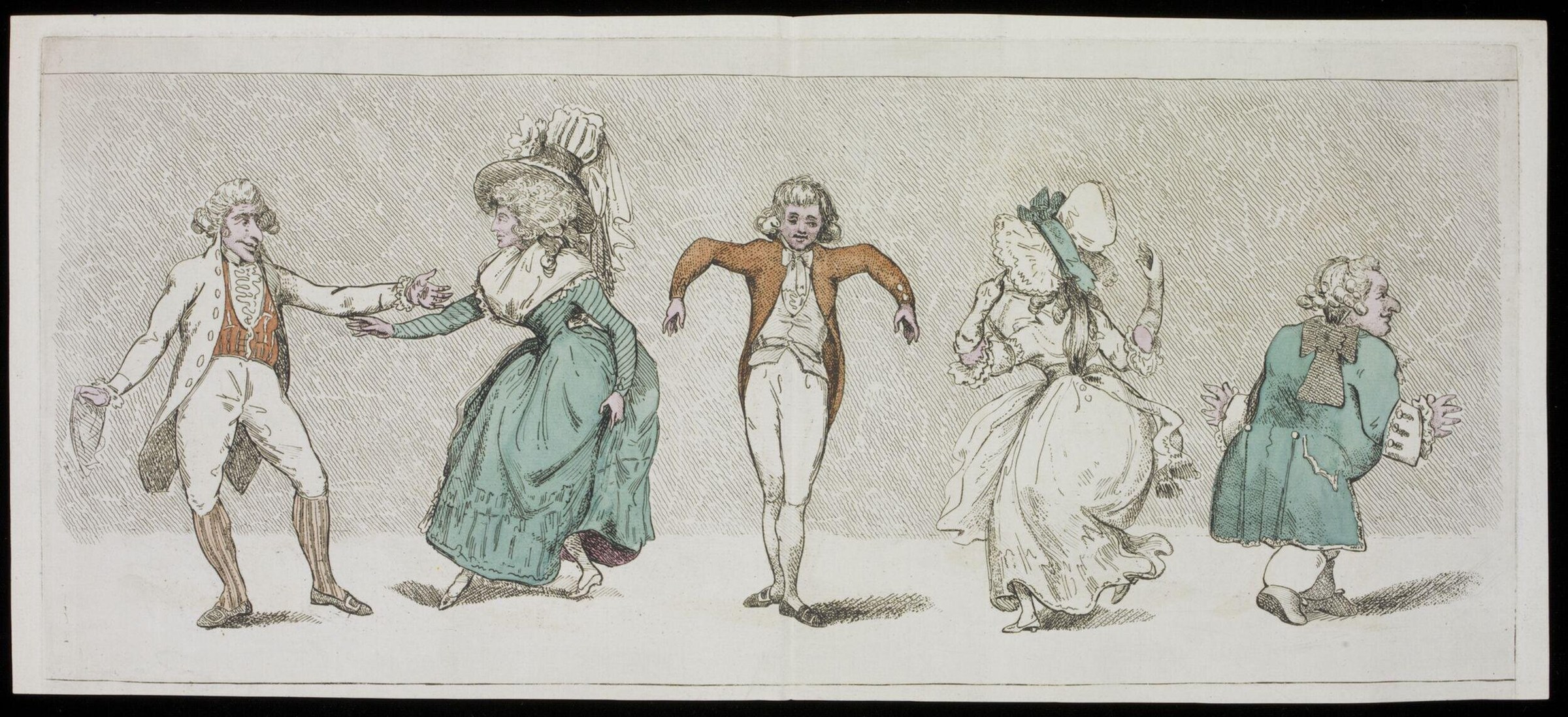
The cotillion was among the most documented of 18th-century dances precisely because it signified status and courtship; this image is one of relatively few visual records that shows the actual physical arrangement, costume conventions, and moment-to-moment figuration of the dance rather than merely naming it. For historians of social dance and gender performance, it offers concrete evidence of how men's authority (the caller's central position and extended gesture) and women's display (the prominent skirts, the passive openness) were choreographed into ballroom etiquette.
What you are looking at
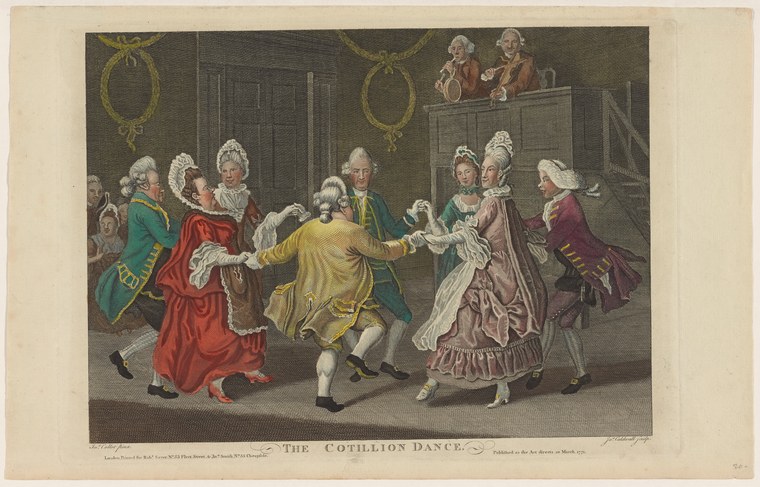
A lively ballroom scene depicts eight or nine figures in 18th-century dress arranged in the formal positions of a cotillion. The setting is an elegant interior with a coffered ceiling and classical architectural details—pilasters and overdoor panels—establishing a Georgian or Louis XVI drawing room. Two spectators occupy a gallery or balcony at upper right, watching the dance below. The dancers wear silks and satins in jewel tones: deep greens, reds, golds, and burgundies, with the men in tailored coats and breeches and the women in full-skirted gowns with elaborate trim and lace fichús. All figures wear white wigs in period style. The composition captures the moment of a figure or transition: one man in yellow-gold (centre) extends his arms to the two women flanking him in an open, courtly gesture, while other couples stand in readiness around the room. The lighting is theatrical—strong shadows define the architecture and create depth—and suggests this is a record of a specific ballroom custom rather than a casual social gathering.
The dancing
The central male figure adopts an open stance with both arms extended sideways at shoulder height, palms facing outward in a welcoming or guiding gesture characteristic of the cotillion's calling and touring figures. The women beside him stand upright in closed posture, their skirts displayed prominently. The surrounding figures hold themselves in formal vertical alignment typical of 18th-century courtly dance; several appear to be in a promenade or processional arrangement. The poses are stiff and decorous rather than dynamic—weight appears centred over the legs rather than transferred through them—which reflects both the restrictive nature of period costume and the measured, processional character of the cotillion itself.
The dance depicted
This is a cotillion, a social ballroom dance of the 18th century that combined elements of the quadrille and the country dance. The cotillion was danced by groups of four to eight couples in a room large enough to permit the elaborate figures described in printed dance manuals of the period. The central figure—typically a gentleman directing or 'calling' the figure—orchestrates the movement of the other dancers through a sequence of predetermined formations: tours, chaînes (chains), promenades, and reversals. This image records the moment of a call or figure introduction, showing the formal dress codes and spatial arrangement that characterised the dance as a display of status, deportment, and courtly accomplishment. The dance was particularly fashionable in European and American ballrooms from roughly 1760 to 1820.
How it was made
This is a hand-coloured lithograph, a technology that allowed relatively inexpensive reproduction of theatrical and social scenes for a broad urban audience. The stone was drawn in crayon and printed in black ink, then hand-tinted with watercolour or gouache—visible in the luminous silks and careful gradation of the background walls. Lithography, developed around 1800, was faster and cheaper than engraving and enabled the circulation of popular prints documenting fashionable amusements, dance types, and costume to thousands of viewers who might never attend such a ballroom themselves. The technique's reliance on crayon line produces the slightly sketchy, animated quality visible in the figures' outlines, suggesting immediacy and observation from life.
About this work
This is a lithographic record of cotillion dancing in the late 18th or early 19th century, capturing both the dance's formal structure and its role as a marker of gentility and refined accomplishment. The work documents the dress, spatial arrangement, and characteristic gestures of a specific ballroom tradition that crossed European and American courts and assembly rooms. The print's existence in the New York Public Library suggests it circulated in America as a record of metropolitan fashion and social dancing—a window onto how this small elite performed their identity through the body and the body's relationship to formal space.
How to look at it
Notice the caller's role: his central position and extended arms do not indicate that he is dancing with the two women beside him, but rather that he is directing or inviting them into the next figure. Observe the vertical, postural quality of the bodies—no one is in a moment of turning, falling, or weight transfer. The artist has chosen the moment of announcement or transition rather than the moment of dynamic motion, which tells us that the cotillion's appeal lay as much in its order, hierarchy, and legibility as in the movement itself. The careful attention to costume—the textures of silk, the placement of lace, the height of the coiffure—signals that this image was made for viewers who cared about ballroom fashion as much as dancing.
The period
The cotillion rose to fashionable prominence in the 1760s as the quadrille's more elaborate cousin, and dominated ballroom dancing across Europe and North America until the waltz's ascendancy around 1815. It represented the apogee of the 18th-century aristocratic or aspirational-bourgeois dance, requiring learned figures, spatial awareness, and the ability to follow a caller's direction—all markers of education and breeding. Lithography, invented in Germany around 1798, had by the 1820s–30s become the dominant medium for popular prints recording current fashion and amusements, making images like this widely available to print collectors and aspiring dancers who could study the dress and deportment without attending an actual ball.
Where it lives
The print is held by the New York Public Library, which acquired it as part of its collections documenting American social and cultural history. Such prints were typically sold singly or in small series to urban audiences, and their presence in American collections reflects the circulation of European ballroom fashions and the aspiration to genteel sociability in late 18th and early 19th-century American cities.
Dance in this work
Questions about this work
What is a cotillion and who danced it?
A cotillion was a formal ballroom dance for groups of couples, most popular from the 1760s through the early 19th century. It was danced by the European and American gentry and upper-middle classes as a display of refinement, courtship, and social rank. Unlike the earlier minuet, which showcased an individual couple's elegance, the cotillion involved multiple couples executing coordinated figures under the direction of a caller or leading gentleman. It required knowledge of the figures (which were published in dance manuals) and the ability to move together as a group.
Why did the artist put two people in a balcony watching?
The spectators in the upper right are likely audience members or chaperones—a common feature of 18th-century ballroom gatherings, where not everyone danced at once, and where the observation of well-dressed dancers was itself a form of entertainment and social participation. Their presence also lends a theatrical character to the scene, suggesting that the dance was as much a spectacle to be watched as a participatory activity.
When was this print made?
The catalogue record does not specify a date beyond 'late 1800s,' which may be an error: the dress, architectural style, and dance itself suggest a date between 1800 and 1830, when the cotillion was still fashionable. The lithographic technique was not widely available before 1800, so the print is almost certainly early 19th century or later. A more precise dating would require examination of the printer's mark or comparison with documented series.
Is this a historical record or a fantasy?
The print appears to be a record made for contemporary or near-contemporary viewers—a documentation of actual ballroom practice rather than an invented scene. The formal composition and attention to costume detail suggest the maker intended to show how the cotillion was actually danced and dressed. However, like all representational prints, it is also a selection and idealisation: the moment chosen, the lighting, and the arrangement of figures all reflect the artist's intention to make the dance legible and fashionable to viewers, not to record it neutrally.
More Cotillion artwork