49 works in this view — arrow keys or swipe to move between them.
Dance in Art · 2019
Harvest dance
Unknown artist
- Medium:
- Source:
- New York Public Library
- Rights:
- Public domain — free to use, share and adapt.
- Recorded as:
- public_domain
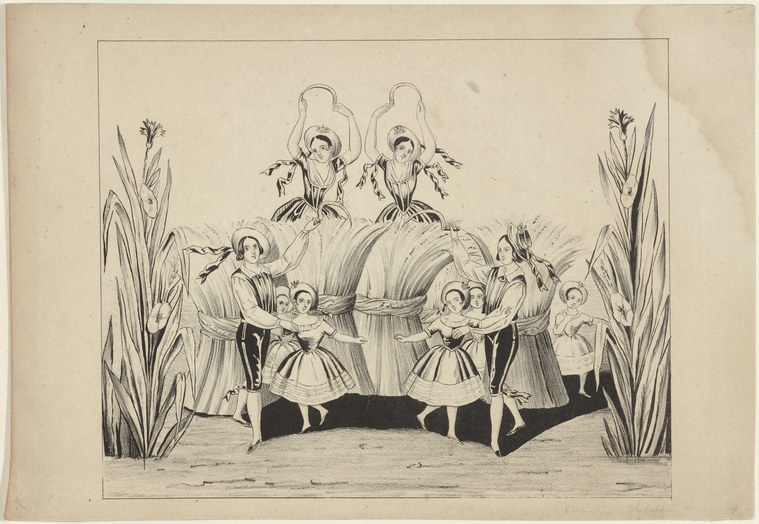
This image captures how early 19th-century artists visualized harvest tradition through the lens of formal dance and aristocratic bodily grace—revealing as much about Romantic-era aesthetics and social fantasy as about actual harvest practice. It demonstrates that printed dance imagery was a significant cultural commodity, distributed to domestic audiences eager to see dance represented with elegance and sentiment.
What you are looking at
Eight figures in flowing Regency-era dress are arranged in a pastoral setting flanked by tall iris plants in bloom. The composition suggests a choreographed ensemble rather than spontaneous movement. Two taller figures occupy the rear center, dressed identically in long gowns with puffed sleeves and headdresses, facing slightly outward. Six smaller figures—likely representing children or young dancers—surround them in a loose formation. All wear high-waisted, ankle-length dresses with short skirts over them, a silhouette consistent with early 19th-century fashion. The figures hold various arm positions: some have arms raised or extended, others rest at the sides. The setting is entirely imaginary, a romantic garden backdrop with no indication of an actual performance space or orchestra. The print's linear style and careful hatching suggest this is an engraving or etching, rendered in black ink on cream paper.
The dancing
The dancers display an upright, formal carriage consistent with early 19th-century ballroom deportment. Arms are positioned with grace and extension—some raised to shoulder height, others curved in classical positions. The two central adult figures appear to anchor the group, while the six smaller figures distribute themselves around them without obvious pair-work or closed holds. Weight appears centered and poised rather than dynamic or weighted into momentum. Footwork is not clearly delineated by the artist, though the long skirts would have obscured most lower-leg detail regardless. The overall frame suggests a procession or formation dance rather than couple-based social dancing.
The dance depicted
This depicts what appears to be an early 19th-century harvest or seasonal celebration dance, most likely a formal country or aristocratic variant of the period. The pastoral setting, the grouping of adults with children, and the formal yet celebratory bearing suggest a ceremonial or theatrical harvest scene rather than working-class harvest festivity. The dress and posture are consistent with Regency-era social dance conventions, though the presence of adults and children together in a single ensemble is unusual for ballroom dance proper. This may represent a theatrical or fanciful interpretation of harvest tradition rather than documentary evidence of actual practice. The exact style—whether a country dance, cotillion, or theatrical tableau—cannot be determined with certainty from the image alone.
How it was made
This is a print, most likely an engraving or etching based on the linear handling, fine parallel hatching, and the way light is modeled through line density rather than wash or color. The technique permits precise delineation of costume detail and delicate rendering of the figures' poses. The even tone and formal composition suggest this was a commercially produced print, probably intended for circulation in illustrated periodicals, gift books, or single-sheet distribution to a educated middle-class or aristocratic audience. The careful attention to costume and the romantic, idealized setting indicate this was meant to appeal to viewers interested in both choreography and sentimental imagery of rural or festive life.
About this work
This engraving or etching presents an imagined harvest dance set in a romantic pastoral garden. Eight figures in Regency-era dress—two adults and six younger dancers—are arranged in a formal, symmetrical composition, their bodies held in the upright, graceful posture of early 19th-century social dance. The work belongs to a tradition of theatrical or idealized dance imagery that circulated in prints during the Romantic period, depicting not actual performance or street festivity but rather a cultivated fantasy of harmonious, classically-posed dancers. It is both a document of how dance was imagined and staged in that era and evidence of the appetite for dance imagery among print-buying audiences of the time.
How to look at it
Attend to the symmetry and formality of the pose: despite the romantic garden setting, these figures are arranged with geometric precision, suggesting this is not a moment of movement captured mid-step but rather a choreographed tableau held for display. Note how the artist has emphasized costume—the high waists, the puffed sleeves, the headdresses—over the actual mechanics of footwork or weight transfer. The iris plants serve a purely ornamental, framing function rather than indicating the real setting of a harvest. The frontality of the figures' gaze and posture suggests this is meant to be viewed as a composed scene, more akin to theatrical set design or a formal group portrait than documentary dance imagery.
The period
The Regency period (roughly 1811–1820 in Britain, though the style persisted longer) saw an explosion of sentimental and picturesque imagery in prints and illustrated books. Harvest scenes, pastoral tableaux, and idealized representations of rural custom were fashionable subjects, often rendered through a lens of nostalgia and refinement. Dance imagery was particularly popular: theatrical performances, ballet, country dances, and fantastical dance scenes circulated widely as single prints and in collections. This work sits at the intersection of three trends: the Romantic appetite for dance representation, the fashion for harvest and seasonal imagery, and the growing market for affordable, mass-produced engravings aimed at domestic display and consumption.
Where it lives
The work is held in the New York Public Library collection. It is catalogued as a print of unknown maker and date, entered into the digital collection with basic descriptive metadata. No edition information, publisher details, or previous provenance have been recorded.
Dance in this work
Questions about this work
Is this a real dance from the Regency era?
Very likely not in any literal sense. This appears to be a sentimental or theatrical artist's vision of a harvest dance, idealized to appeal to early 19th-century taste for picturesque imagery. The combination of adults and children, the impossible floral setting, and the perfect formal symmetry all suggest invention rather than documentary observation. It represents how Romantic-era audiences wished to imagine harvest festivity, not necessarily how it was actually performed.
What kind of print is this—engraving or etching?
The linear technique, fine parallel hatching, and tonal modeling through line density are consistent with engraving or etching. Without examination of the plate itself or watermark analysis, the exact process cannot be determined with certainty from the image alone, but the precision and formal composition suggest a commercial engraving made for distribution.
Why were dance prints so popular in this period?
The early 19th century saw an unprecedented appetite for dance imagery among educated middle-class and aristocratic audiences. Prints offered affordable access to representations of ballet, social dance, and picturesque or theatrical dance scenes. They served both as documentation of fashionable behavior and as objects of sentimental or aesthetic pleasure in the home.
What do the costumes tell us about when this was made?
The high waists, puffed sleeves, and silhouettes are consistent with fashions of the 1810s–1820s. The formal, corseted bearing of even the younger figures reflects Regency standards of deportment. These costume details help date the print to the early 19th century and confirm it was intended for a contemporary, fashionable audience.
More dance artwork