49 works in this view — arrow keys or swipe to move between them.
Dance in Art · 2023
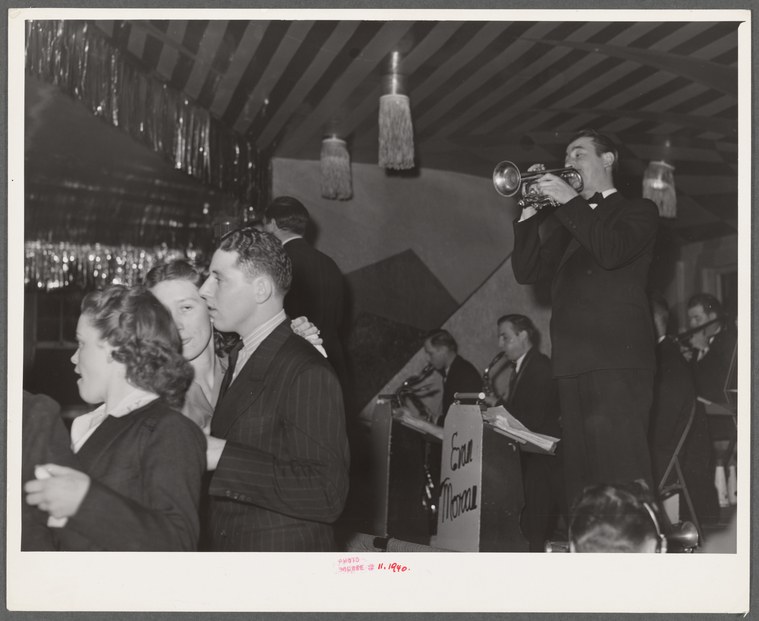
Dance hall, Saturday night. Marshalltown, Iowa
Unknown artist
- Source:
- New York Public Library
- Rights:
- Public domain — free to use, share and adapt.
- Recorded as:
- public_domain
This photograph documents the democratic, participatory dimension of mid-twentieth-century American dance culture, showing how jazz and swing dancing were embedded in the social fabric of small-town Midwestern life rather than confined to urban nightclubs or theatrical venues. For historians of vernacular dance and social history, it provides direct visual evidence of how ordinary Americans danced together and the spaces they inhabited to do so.
What you are looking at
A jazz band performs in a crowded dance hall on a Saturday night in Marshalltown, Iowa. The photograph captures the interior of what appears to be a modest but lively venue with decorative elements: tasseled or fringed fixtures hang from the ceiling, and a stage backdrop is visible behind the musicians. A trumpet player stands elevated, playing with visible energy, while other band members occupy the stage. The dance floor in front is populated with couples and groups dressed in dark suits and dresses typical of the 1940s era. The lighting is dim and atmospheric, casting shadows across the scene. The composition emphasizes the interplay between the performing musicians and the dancing crowd, capturing the participatory nature of this vernacular social dance space.
The dancing
The figures visible on the dance floor are dressed formally in dark suits and dresses, standing closely together in the congested space. While no individual couples are clearly resolved in closed ballroom hold, the proximity and body orientation of the dancers suggest social partnered dancing rather than solo or line forms. The trumpet player dominates the composition through his elevated position and the instrument held high, his body angled toward the audience. The crowd appears to move and sway rather than execute codified steps, consistent with social swing or vernacular jazz dancing of the period.
The dance depicted
This is a social dance scene, most likely swing dancing or the broader category of vernacular jazz-era social dance that flourished in American dance halls during the 1940s. The setting—a local Midwestern venue on Saturday night—confirms this as community social dance rather than theatrical performance. The informal posture and proximity of the dancers, combined with the live jazz band providing music, indicates a participatory social dance context where couples danced in closed or semi-closed positions to hot jazz and swing music. The specific dance style cannot be determined with certainty from the figures alone, but the era, setting, and musical context point toward East Coast Swing, Lindy Hop, or similar swing-era social forms.
How it was made
This is a black-and-white photograph, printed on paper or card stock bearing a stamp from the New York Public Library. The documentary photographic medium preserves a candid moment with the depth and clarity typical of mid-twentieth-century press or archival photography. The grain and tonal range suggest either a gelatin silver print or a photomechanical reproduction. The photographer has captured the scene from within or very close to the crowd, creating an immersive perspective that conveys the density and energy of the space rather than a composed or aestheticized view.
About this work
This is a documentary photograph of a dance hall on a Saturday night in Marshalltown, Iowa, capturing the vernacular social dance culture of the American Midwest during the 1940s era. It documents the lived experience of ordinary Americans engaging in swing-era social dancing—couples dancing informally to live jazz music in a modest public venue. The photograph is significant as a record of how dance functioned in midwestern small-town life: not as theatrical spectacle but as participatory community culture, integral to weekend social life. The image belongs in a gallery of dance in art because it captures a crucial and often under-documented form of dance—the social dancing of working and middle-class Americans in vernacular spaces, preserved through documentary photography.
How to look at it
Look at the density and informality of the crowd—there is no stage separation between dancers and musicians, no formal choreography, and no spectator seating visible. Observe how the couples position themselves close together on a crowded floor, adapting their dancing to the available space. The elevated position of the trumpet player and the casual, energetic posture of the musicians convey the participatory, informal aesthetic of swing-era jazz dance. Notice how the photographer has chosen to situate the viewer within the crowd rather than at a distance, creating the impression of being in the midst of the social action.
The period
The 1940s photograph captures a moment when swing dancing and jazz were at the height of their popularity as social dance forms in America. Swing had emerged in the 1930s and dominated the social dance landscape through the 1940s, becoming a democratic form that crossed class lines and brought live music and dancing to small towns and cities across the country. Dance halls like this one were ubiquitous in American community life, functioning as primary venues for courtship, recreation, and social bonding. The photograph documents a moment before television and changing social patterns would begin to diminish the role of the public dance hall in American life.
Where it lives
This photograph is held by the New York Public Library as part of its collections, suggesting it may have been part of a broader documentary project on American life and culture, or acquired as a historical record. The library stamp visible on the print indicates its institutional provenance and status as an archival photograph.
Dance in this work
Questions about this work
What town is this and when was this taken?
The photograph documents a dance hall scene in Marshalltown, Iowa on a Saturday night. The catalogue record indicates it was acquired or catalogued in 2023, but the original photograph dates to the 1940s based on the clothing styles, photographic technique, and the presence of a live jazz band. Marshalltown was a small industrial city in central Iowa with an active community social life.
What kind of dance is being performed?
The dancers appear to be engaging in swing-era social dancing, likely East Coast Swing, Lindy Hop, or related forms that dominated American social dance in the 1940s. The live jazz band, the informal partnered stance, the crowded dance floor, and the modest venue all confirm this as vernacular social dance rather than theatrical performance or competition dancing.
Why is this photograph important?
It provides direct documentary evidence of how ordinary Americans danced in their communities during the swing era, preserving a record of participatory social dance culture that was often invisible to historical documentation. It shows dance as embedded in everyday community life rather than as spectacle, and captures a specific moment in American social history before the decline of public dance halls.
Who took this photograph?
The photographer is not identified in the available catalogue record. It may have been taken by a staff photographer for a local newspaper, a WPA documentary project, or another institutional source, but attribution cannot be established from the image alone.
More dance artwork