49 works in this view — arrow keys or swipe to move between them.
Dance in Art
Neptune
Unknown artist
- Collection:
- Prints depicting dance
- Source:
- New York Public Library
- Rights:
- Public domain — free to use, share and adapt.
- Recorded as:
- Public Domain
For historians of court ballet and masque, this image documents not just a costume but the visual vocabulary and allegorical systems through which dancers embodied divine and mythological authority in Renaissance and early Baroque performance. The precision of the engraving suggests this was circulated as both artistic record and practical reference, making it evidence of how performance imagery was used and valued within courtly networks.
What you are looking at
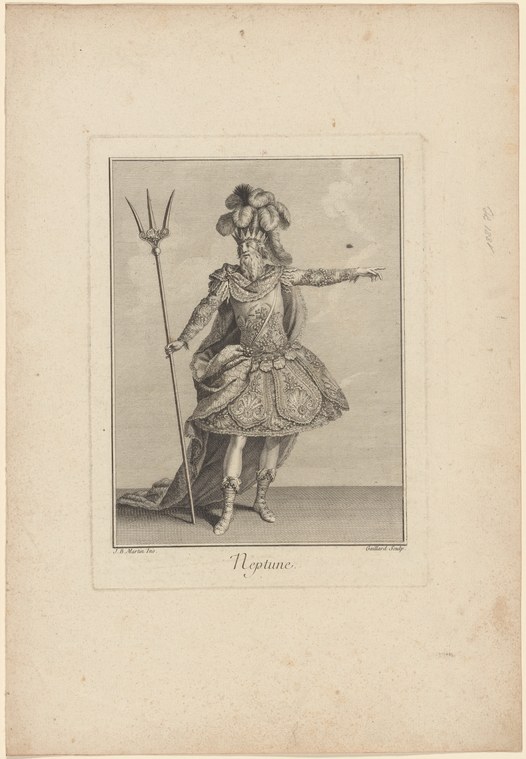
A single figure in elaborate classical costume strikes a commanding pose against a plain background. The dancer wears a decorated cuirass (armored breastplate) over draped fabric, a plumed headdress, and a long train or cloak that pools behind them. The figure's left arm extends outward in a gesture of authority or presentation, while the right arm holds a trident—the weapon and symbol of Neptune, Roman god of the sea. The pose is frontal and statuesque, the weight evenly distributed, the body held with formal dignity. The engraving technique renders every detail of costume and musculature with precise line work, creating a sense of monumental stillness rather than movement.
The dancing
A single figure stands in a relaxed contrapposto pose, weight balanced centrally with no indication of active movement or weight shift. The extended arm gesture is formal and emblematic rather than kinetic—a presentation pose rather than a dance frame. The posture suggests a performer in character, displaying themselves to an audience, rather than executing steps. There is no partnering, no sense of propulsion or momentum, and no visible footwork that might suggest a specific dance technique.
The dance depicted
This is most likely an allegorical or theatrical figure representing Neptune rather than a depiction of an actual dance. The work belongs to the tradition of court ballet and masque costuming from the Renaissance and early Baroque periods, where mythological and divine characters were personified by costumed dancers in courtly entertainments. The elaborate dress, the heraldic pose, and the classical trident identify this as costume design or a portrait of a performer in a mythological role rather than a moment of dancing. The figure displays the character rather than the movement.
How it was made
This is an engraving, identified by the precise linear hatching, fine parallel lines modeling form and shadow, and the clean black line work characteristic of intaglio printmaking. The technique allowed for detailed rendering of costume ornament and architectural elements of dress, and implied circulation as a multiple—copies of this image could be distributed as both artistic record and practical costume reference. The formality and precision suggest this was a document of courtly performance intended for preservation and possibly for pattern-sharing among performers and costume makers.
About this work
This engraving records a costumed character—Neptune in his classical guise—as represented in a court entertainment, most likely a ballet or masque of the Renaissance or early Baroque period. The work belongs to a body of allegorical performance imagery that documented how mythological figures were embodied and displayed in formal courtly contexts. It is a costume study and character portrait rather than a representation of dancing itself, yet it captures the theatrical and visual dimensions of how dance was integrated into courtly spectacle.
How to look at it
Attend to the deliberateness of the pose: this is not a figure caught in motion but one holding a character. The trident, the plumed headdress, and the draped train are all heraldic—they identify Neptune and convey his authority through costume and object rather than through movement. The engraving's precision, with every fold and ornament crisply rendered, transforms costume into a formal portrait, suggesting that the figure's value lay in appearance and symbolic presence as much as in any dance skill.
The artist
The artist is not recorded. The style and technique are consistent with 16th or 17th-century European engraving practice, and the work may derive from a more famous source or be part of a larger series of allegorical figures. Without signature or inscription visible in the image, attribution cannot be established.
The period
Court ballet emerged as a major art form in Renaissance Italy and France, reaching its height in the 16th and 17th centuries as a vehicle for dynastic display and allegory. Performers, often nobles, were costumed as classical and mythological figures and arranged in geometric formations that combined music, verse, and spectacle. The printing and circulation of costume designs and performance records in engraved form was a central means by which these ephemeral courtly events were documented and their imagery disseminated. This image reflects the formal aesthetics and mythological content of that tradition.
Where it lives
The work is held in the New York Public Library's Prints collection, catalogued as part of their holdings of dance-related prints. It is an example of early modern performance documentation, likely created as both an artistic record and a practical reference for costume and character in courtly entertainments.
Dance in this work
Questions about this work
Is this actually a dancer dancing?
No—this is a costumed performer holding a character pose rather than executing steps. The formal, frontal stance and the emblematic use of the trident indicate that the figure is displaying the mythological character of Neptune, not dancing. This is a costume study or character portrait, a record of how the god was visually represented in court performance.
What kind of entertainment would this figure appear in?
Most likely a court ballet or masque, courtly entertainments combining music, verse, spectacle, and dance that were common in Renaissance and early Baroque Europe. Nobles and professional performers were costumed as classical and mythological figures and arranged in formal patterns. Neptune would typically have appeared in such entertainments as a symbolic figure of authority and power, aligned with the patron or the celebration.
Why is this image useful for dance history?
It documents the visual and material culture of early court dance—the costumes, the allegorical systems, and the formal aesthetics that dancers inhabited. It is evidence of how performance was represented and circulated through print, and of the formal, dignified bearing expected of courtly performers playing divine roles.
More dance artwork





