49 works in this view — arrow keys or swipe to move between them.
Dance in Art
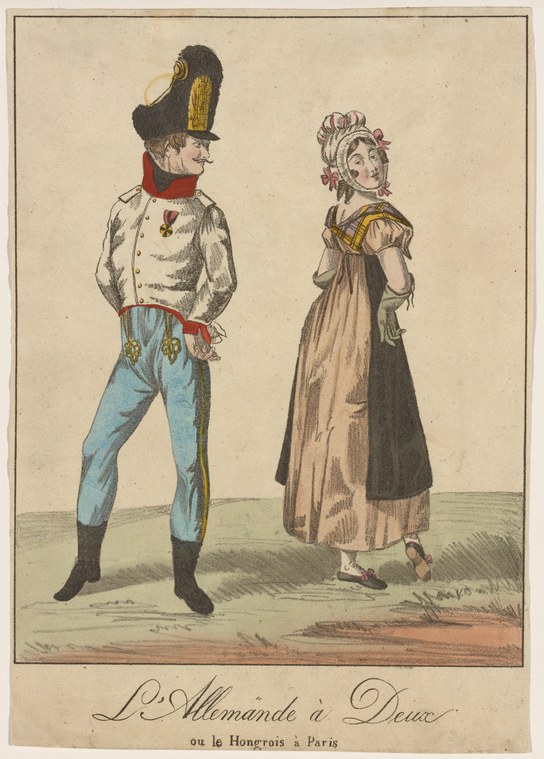
L'Allemande à deux, ou le Hongrois à Paris
Unknown artist
- Collection:
- Prints depicting dance
- Source:
- New York Public Library
- Rights:
- Public domain — free to use, share and adapt.
- Recorded as:
- Public Domain
The image preserves a visual vocabulary of Allemande posture and costume at a moment when the dance was transitioning from Baroque ceremonial form to Regency social practice. For historians, it documents the persistence of this couple-dance tradition and the way military dress codes shaped male dance posture in the early 19th century. The engraving's wit—capturing a moment of formal stiffness rather than graceful motion—reminds us that dance images are often as much about satire, fashion, and social hierarchy as they are about movement itself.
What you are looking at
A colored engraving showing two figures in an interior or neutral setting against a pale background. On the left stands a military officer in a white coat with blue trousers, wearing a tall plumed hat and a red collar or neck decoration; his posture is upright and somewhat stiff, weight on one leg. Facing him on the right is a woman in a high-waisted Empire dress of tan and dark fabrics, her hair dressed in ringlets with a decorative headdress. She stands in profile or three-quarter view, her body angled toward the officer. The composition suggests a formal encounter or dance position rather than mid-movement. The print is hand-colored in the style of early-19th-century popular engravings, with careful attention to costume detail and a flat, staged quality typical of dance instruction or fashion documentation of the period.
The dancing
The officer's posture is nearly rigid, his frame closed and vertical, suggesting the formal military bearing of the period rather than fluid dance movement. The woman's body is more relaxed, inclined slightly toward her partner, her arms positioned at her sides or loosely in front of her. There is no closed hold or dance frame visible; the two figures are separated by a small distance, oriented toward each other. The positioning suggests the opening or closing moment of a social dance rather than its kinetic center.
The dance depicted
The title *L'Allemande à deux, ou le Hongrois à Paris* identifies this as depicting the Allemande, a couple's dance from the Renaissance and Baroque eras that persisted as a social form into the early 19th century. The Allemande was typically performed in a closed or semi-closed position with turning movements, but the image here shows the dancers in a static, posed moment rather than in action. The subtitle "or the Hungarian in Paris" suggests either a variant or a satirical commentary on the dance in a French social context. The stiffness of the male figure—exaggerated by his military uniform—may be intentional, even comic, implying cultural or class contrast between the officer and his partner.
How it was made
This is a hand-colored engraving or possibly a colored woodcut, characteristic of early-19th-century popular and instructional prints. The technique allows for sharp linear definition of costume details and posture, making it suitable for both dance instruction and social satire. The hand-coloring in gouache or watercolor was applied after printing, and its uneven coverage (note the pale wash background and the precise work on fabrics) is typical of mass-produced popular prints of the Napoleonic and Restoration periods. Such prints were inexpensive and circulated widely among the middle classes, often serving as both fashion plates and social commentary.
About this work
This is a documentary print of an early-19th-century couple dance, the Allemande, frozen in a formal pose that emphasizes costume and social presentation over kinetic content. The work belongs to a tradition of dance instruction and social criticism through the medium of popular engraving. The military officer and his fashionable female partner are positioned to suggest the encounter and negotiation implicit in social dance of the period—a moment of courtship, status display, or cultural exchange conducted through posture and dress. The title's reference to a "Hungarian in Paris" indicates that the print may also be satirizing exoticism or foreign fashion in French salons, making it both a historical record of dance practice and a social document.
How to look at it
Notice the deliberate stiffness of the officer's posture: his vertical alignment, the formal angle of his shoulders, the way his legs are planted rather than flexed. Contrast this with the woman's more graceful inclination and the softness of her silhouette. The artist has chosen not a moment of turning or traveling, but a moment of presentation—the beginning or end of a figure, or a pause between movements. This is typical of dance instruction prints of the period, which taught through static postures rather than sequential movement. The exaggeration of the officer's military bearing suggests that the print is partly satirical, poking fun at the tensions between military masculinity and the fluid grace expected of social dancers.
The period
The Allemande, originating in the Renaissance and reaching its height in the Baroque court, remained a fixture of European social dancing well into the 19th century, though its form evolved significantly. By the Napoleonic era, when this print was likely made, the Allemande coexisted with newer dances like the quadrille and cotillion in French ballrooms. The engraving's emphasis on costume—the officer's military uniform, the woman's Empire waist and neoclassical styling—places it firmly in the Regency period (c. 1810–1820). The subtitle's playful reference to "the Hungarian in Paris" reflects the period's fascination with exotic and regional dance variants, a feature of early-19th-century ballroom fashion that also drew on Spanish, Polish, and Scottish forms.
Where it lives
The work is held in the New York Public Library's collection of prints depicting dance. It is an example of the mass-produced popular engravings that circulated in Paris and other European cities in the early 19th century, likely sold individually or in series to collectors, dance instructors, and the fashionable public.
Dance in this work
Questions about this work
What is the Allemande?
The Allemande is a couple's dance that originated in the Renaissance and remained popular through the 18th and early 19th centuries. It is typically performed in a closed or semi-closed frame with turning and sliding movements. The name derives from "German," though the dance's origins are complex and debated. By the Napoleonic era, it had become a fixture of formal ball dancing, coexisting with newer forms like the quadrille.
What does the title mean?
"L'Allemande à deux" means "the Allemande for two [dancers]." The subtitle "ou le Hongrois à Paris" ("or the Hungarian in Paris") may indicate either a regional variant of the Allemande or a satirical comment on foreign fashions in French salons. The Hungarian Hussar style was fashionable in Napoleonic-era Paris, and the military officer's uniform may be a deliberate reference to this trend.
Why is the officer so stiff?
The stiffness is almost certainly intentional. Military uniform conventions required a rigid posture, and the contrast between the officer's formal bearing and the expected fluidity of social dance may have been the point of the print—either as instruction (showing how even a stiff partner must dance) or as satire. Early-19th-century popular prints often mixed instruction with social commentary.
How was this print made and colored?
This appears to be a hand-colored engraving or possibly a colored woodcut, typical of affordable popular prints made for middle-class audiences in the early 19th century. The image was first printed in black ink, then colored by hand with watercolor or gouache. Such prints were mass-produced and sold individually, making them accessible teaching aids and fashion documentation.
More dance artwork





