29 works in this view — arrow keys or swipe to move between them.
Dance in Art
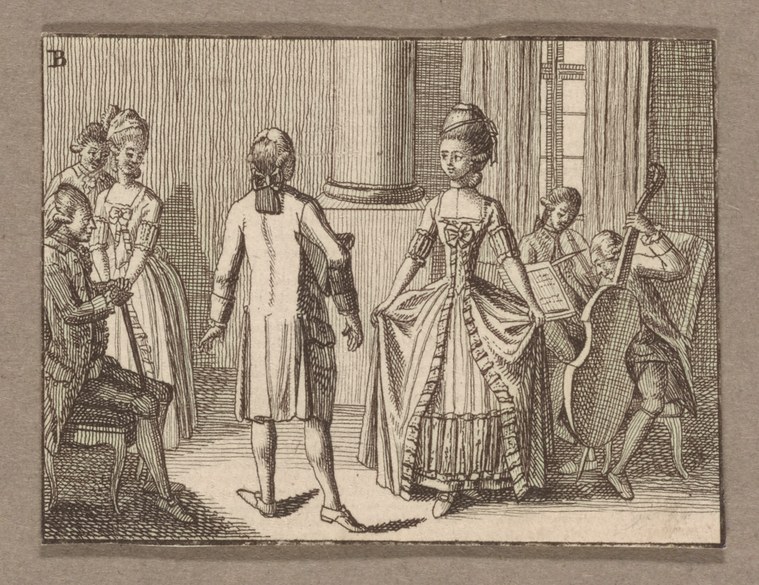
Dancers bowing before the minuet?
Unknown artist
- Medium:
- Engraving
- Dance:
- Minuet
- Era:
- 1700s (Enlightenment/Minuet Era)
- Source:
- New York Public Library
- Rights:
- Public domain — free to use, share and adapt.
- Recorded as:
- public_domain
Court dance historians need to understand that the minuet was not simply about footwork and arm patterns, but about an entire choreography of approach, greeting, and acknowledgment. This engraving shows that the dance began before music played and steps were taken. For historians of manners and visual culture, the work documents how the 18th century imagined and represented courtly interaction, with every gesture and posture invested with social meaning.
What you are looking at
An engraved interior scene of a formal court gathering. A woman in an elaborate gown with a long trained skirt stands at center, her body turned in three-quarter view. She wears a fitted bodice with decorative trim and her hair is styled high in the fashion of the mid-18th century. To her left stands a man in a simple white or cream-colored coat, viewed from behind, his posture upright and formal. Behind them a second woman adjusts or attends to the first woman's train. On the right side of the composition, a young boy or youth holds sheet music or a document, and an adult (possibly a musician or attendant) stands nearby. The setting is defined by vertical paneling in the background suggesting an interior wall or architectural frame. The lighting is created entirely through cross-hatching and line work typical of engraving, with deeper shadows along the drapery and architectural elements. The scene captures a moment of formal presentation or greeting between figures in courtly dress, with an air of ceremony and restraint.
The dancing
The primary female figure stands with weight evenly distributed, her body held upright in the formal posture required of court dress. Her arms fall naturally at her sides, one hand visible. The male figure facing away from us displays the straight spine and stillness of ceremonial standing rather than active dancing. His arms are at rest. The second attendant woman bends slightly forward in a posture of service or adjustment rather than dance. The boy holds papers passively. No figures are in a dancing hold or frame; all postures are those of standing, waiting, or attending rather than the physical commitment of active movement.
The dance depicted
The title suggests this depicts a bow or formal greeting before a minuet, and the image supports that reading. The minuet was the pre-eminent court dance of the 18th century, and such formal presentations were indeed preceded by deep courtly bows. However, no active dancing is shown here—the figures are stationary and formal. What we see is the ceremonial moment before the dance begins: the acknowledgment and positioning of partners in the strict etiquette of court performance. The minuet itself demanded upright carriage, small steps, and formal geometry, all of which this engraving's composition suggests through its emphasis on vertical alignment and careful spatial arrangement rather than through visible motion.
How it was made
This is an engraving, a relief printing technique created by incising lines into a metal plate (likely copper). The artist used fine parallel lines (hatching) and cross-hatching to model form, depth, and shadow. The technique allowed for precise delineation of costume detail—the pleating and trim of the woman's gown, the buttons and seams of the man's coat—and for the creation of an interior architectural setting with receding perspective. Engravings of this type were produced in multiple impressions from a single plate, making them relatively affordable and widely distributed compared to paintings. This work was likely part of a series documenting court manners, dance instruction, or contemporary fashion, circulating among an educated audience interested in courtly behavior and decorum.
About this work
This engraving documents the formal preliminaries of 18th-century court dance, specifically the moment of greeting and bow that preceded the minuet. The image is valuable not as a depiction of dancing itself, but as evidence of the courtly ritual and etiquette surrounding dance performance. The careful attention to dress, posture, and spatial arrangement reflects the highly codified nature of court life in the Enlightenment period, when even the approach to a dance partner was governed by strict rules of deportment. The work belongs in a dance archive because it shows us what preceded and framed the dances themselves—the social and physical protocols that made the minuet not merely a series of steps, but a complete theatrical and social act.
How to look at it
Attend to the absolute verticality and stillness of the figures—note how the engraver has made no attempt to suggest movement, weight shift, or spatial depth in the bodies themselves. The drama of the image lies instead in the careful arrangement of figures in space and the precise rendering of textiles and costume. Notice how the woman's train is a major formal element, attended to by another figure, suggesting that even the fabric was part of the ceremonial moment. Look at the architectural framing—the verticals of the paneling echo the verticality of the human figures, creating a sense of order and formality that was central to minuet aesthetics. The presence of the musician or music-holder on the right indicates that what we are witnessing is framed by music and controlled by it, even before the visible dance has begun.
The period
The minuet dominated European court culture from roughly the 1650s through the late 18th century. By the mid-1700s, when this print was likely made, minuet instruction was a standard part of aristocratic education, and numerous printed manuals with illustrations and notated choreographies existed for both women and men. Engravings of dance scenes, deportment, and courtly behavior were popular in the market for prints documenting contemporary fashion and etiquette. The emphasis on formal posture, correct dress, and regulated movement reflected Enlightenment values of order, reason, and proper social hierarchy. At the same time, the minuet was beginning to be perceived as old-fashioned by younger generations drawn to the faster, more playful contredanses and country dances that would dominate the later 18th century.
Where it lives
The work is held in the New York Public Library collection. It is catalogued as an engraving of unknown artist and undocumented date, though stylistic features suggest the mid-18th century. The catalogue record offers minimal information, indicating this is one of many similar prints in institutional collections documenting court life and dance practice.
Dance in this work
Questions about this work
Why is no one dancing if this is supposed to be a minuet scene?
The title suggests this depicts the moment *before* the minuet begins—the formal greeting and bow that was part of minuet protocol. In 18th-century court dance, approaching a partner, greeting them, and taking position were ritualized and governed by rules of etiquette. The actual steps and movement would have followed this ceremonial moment. The engraver has chosen to document the preparation rather than the dance itself.
How do we know this is about the minuet and not another 18th-century dance?
The title in the catalogue record identifies it as depicting a bow before the minuet. The formal, upright postures and the emphasis on ceremonial greeting are consistent with minuet protocol. However, the image alone does not distinguish between minuet and other court dances of the era, as all required similar formal deportment and greeting rituals. The title is our primary evidence.
What does the costume tell us?
The woman wears a fashionable court gown of the mid-18th century with a fitted bodice, decorative trim, and a trained skirt—impractical for vigorous movement but essential for court ceremony and display. The man's simple white coat and formal stance show his role as a partner rather than a servant or musician. Both figures are dressed for formal performance in front of an audience, not for private recreation.
Is this a real scene or a stylized representation of minuet etiquette?
It is almost certainly a stylized representation created for instructional or documentary purposes, not a record of an actual event. Engravings like this were often part of dance manuals or prints on manners that taught proper deportment. The formal, almost frozen quality of the poses suggests they are meant to show correct positioning rather than to capture a spontaneous moment.
More Minuet artwork