49 works in this view — arrow keys or swipe to move between them.
Dance in Art
La sultane
Unknown artist
- Collection:
- Prints depicting dance
- Source:
- New York Public Library
- Rights:
- Public domain — free to use, share and adapt.
- Recorded as:
- Public Domain
For historians of theatrical dance and costume, this engraving is primary documentation of how exotic character roles were embodied, costumed, and posed in court ballet—a genre that shaped all later theatrical dance forms. For dancers and choreographers, it reveals the gestural vocabulary and physical bearing expected of court dancers, and the constraint and spectacle of the elaborate costumes they performed in.
What you are looking at
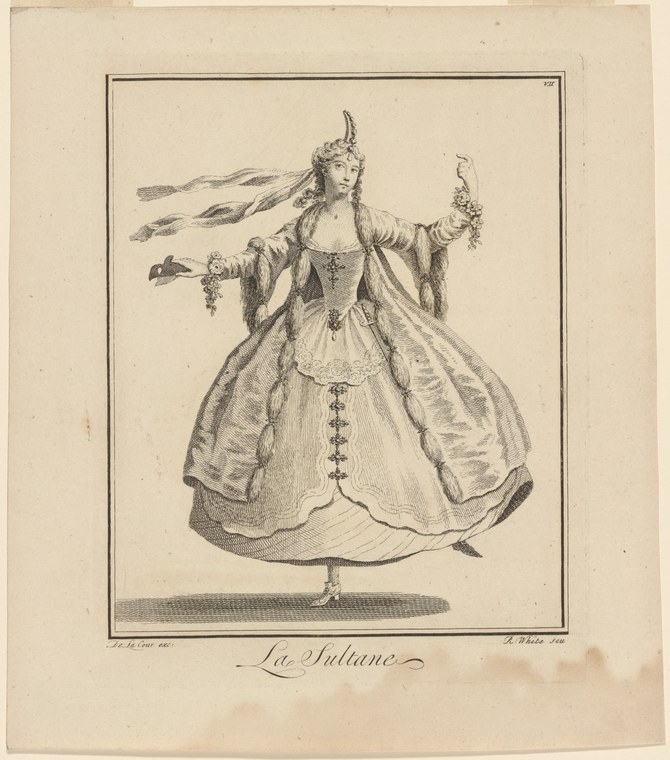
A single female figure is centered in this engraving, posed in an exuberant, dynamic stance against a plain background. She wears an elaborate costume consisting of a fitted bodice with decorative elements, a voluminous skirt with deep pleats or godets that flare dramatically from the waist, and a long, flowing outer coat or robe with ornate trim and swirling fabric that extends behind and around her. Her costume is completed by a tall, crescent-shaped headdress adorned with what appears to be horns or feathers. Both her arms are raised and extended outward in an open, theatrical gesture; her left arm holds an ornamental object (possibly a fan or small prop), while her right arm curves upward. Her body leans slightly forward in a spirited, animated posture, with one leg appearing to support her weight while the other suggests movement or extension. The engraving style suggests this is a documentation of theatrical costume and movement from the 17th or early 18th century.
The dancing
The dancer occupies an asymmetrical stance with weight shifted to one leg while the other appears to extend or lift slightly, suggesting arrested movement rather than stable repose. Her arms frame her upper body in an expansive, open position characteristic of courtly or theatrical display—neither arm is in contact with a partner, and the raised positions suggest celebratory or gestural movement rather than structural partnering. The body angles slightly forward from a proud, lifted spine. The exaggerated proportions of the costume—particularly the enormous skirt—would have severely constrained actual movement, meaning this figure depicts a moment of pause or declaration rather than rapid footwork.
The dance depicted
This engraving appears to document a character from court ballet or the comédies-ballets of the 17th century. The title 'La Sultane' (The Sultana) and the exotic costume suggest a non-European, aristocratic female character—likely from a ballet entry or intermède featuring an Ottoman or Turkish-inspired figure. The pose and costume align with the theatrical dance vocabulary of the Louis XIV court, where such character roles were performed by professional dancers and courtiers. The absence of male partner, the theatrical prop, the heraldic headdress, and the emphasis on the costume itself suggest this depicts a solo or leading female character's moment of display rather than participatory social dance.
How it was made
This is an engraving, identifiable by the fine parallel lines (hatching and cross-hatching) used to create tone and shadow, the crisp line definition, and the characteristic uniform, high-contrast black-and-white appearance. The technique of engraving allowed precise documentation of costume detail—every pleat, button, and trim is rendered with clarity—and enabled the image to be reproduced in multiple impressions, making it suitable for circulation as prints to record theatrical or court performances. The dating and artist attribution are unknown, but the style and technique suggest production in the 17th or early 18th century, a period when engravings of court dancers and theatrical figures were produced in series.
About this work
This engraving documents a character type and costume from court ballet of the 17th-18th century, specifically a solo female figure identified as 'La Sultane'—likely a character role from a ballet entry, intermède, or comedia-ballet. The image serves as both costume record and movement documentation, capturing the theatrical pose and ornate dress of a professional court dancer or trained courtier. The print circulated as documentation of elaborate courtly spectacle, a genre that was central to the cultural life of the French and European aristocracy during this period. The work belongs to the visual archive of historic theatrical dance, revealing what theatrical female virtuosity looked like when it was primarily documented through engraving rather than written description.
How to look at it
Observe the stillness of this pose: despite the theatrical exuberance of the gesture and the swirling costume, the body appears momentarily arrested, frozen at a point of display rather than in the middle of traveled movement. The artist has chosen a moment of presentation—a held attitude or striking tableau—rather than a step in progress. Note how the enormous skirt dominates the composition; such garments were central to the spectacle of court dance and would have determined what movements were physically possible. The open, symmetrical arm position and the frontal orientation of the body suggest this is a solo moment of individual display, a character's moment of entrance or declaration.
The period
Court ballet emerged in Renaissance Italy and developed into a major form of aristocratic entertainment and political spectacle in 17th-century France under Louis XIV. Comédies-ballets, developed by Molière and Jean-Baptiste Lully, blended comedy, music, and dance, often featuring exotic or allegorical characters. Female dancers and dancing courtiers performed increasingly prominent roles in these spectacles. Engravings of dancers, costumes, and choreographic figures were produced and circulated as documentation and promotion of these entertainments, and served as records for courtiers who might recreate or reference them. The late 17th and early 18th centuries saw a growing systematization of dance technique and vocabulary, reflected in early dance notation systems like Feuillet notation. Exotic character types—Turks, Africans, Asians—appeared frequently as entertainment and were costumed with theatrical fantasy rather than ethnographic accuracy.
Where it lives
The print is held in the New York Public Library as part of a collection titled 'Prints depicting dance.' It is an example of the surviving documentary engravings that record theatrical dance practice and costume from the court ballet era.
Dance in this work
Questions about this work
Was this a real dance that people performed, or just a theatrical costume?
It was almost certainly both. The pose documents an actual moment in a performed choreography—the theatrical character 'La Sultane' danced in a ballet or comedia-ballet. However, the extreme costume, with its enormous skirt and ornate headdress, would have prevented the kind of footwork we associate with ballet today. The movement was likely relatively contained, emphasizing gestural arms, carriage, and traveling steps rather than speed or elevation.
Who danced this role?
The engraving does not identify the dancer. In the court ballet and comedia-ballet tradition of 17th-century France, such character roles were performed by professional dancers, trained courtiers, or members of the royal family. The complexity of the costume and the prominence of the pose suggest this was a significant character role, but the original performer's identity is lost.
Why is she dressed as a Sultana?
Exotic characters from the Ottoman Empire, Asia, and Africa were popular in 17th and 18th-century court entertainment. They were used to convey luxury, foreignness, and novelty—not ethnographic accuracy. The 'Sultana' costume showcased fine fabrics, rich decoration, and fantastical design, serving the courtly function of displaying wealth and sophistication rather than documenting actual Ottoman dress.
How do we know this is from the court ballet tradition and not something else?
The costume, the engraving technique, the pose, and the titling all align with documented practices of court ballet and comedia-ballet documentation from the 17th-18th centuries. The theatrical headdress, the ornate salon costume, the solo presentation, and the celebratory pose are characteristic of character entries in these genres. The engraving medium was the standard way of circulating images of court dancers during this period.
More dance artwork





