49 works in this view — arrow keys or swipe to move between them.
Dance in Art
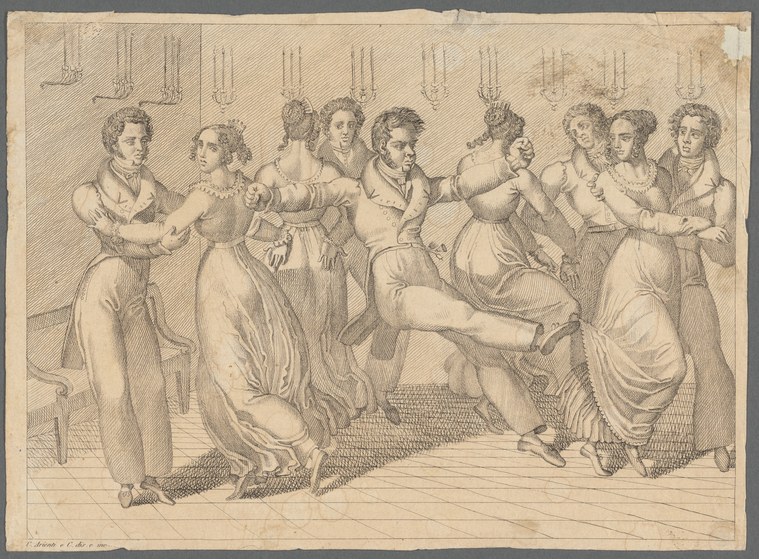
Couples dancing in an interior; at center, a man with clenched fists, who appears to be falling
Unknown artist
- Collection:
- Prints depicting dance
- Source:
- New York Public Library
- Rights:
- Public domain — free to use, share and adapt.
- Recorded as:
- Public Domain
This work documents the vocabulary of theatrical distress and collapse that was essential to neoclassical and romantic ballet. Rather than celebrating technical virtuosity, it captures the moment when the dancer's body becomes a vehicle for emotional and social rupture—a key mode of meaning-making in the period's dance theater. The surrounding figures' reactions tell us as much about how the period understood dance as a form of social and emotional communication as the fallen figure's arch does.
What you are looking at
Ten figures in classical dress occupy an interior space with a coffered or paneled ceiling. They are arranged in a loose circle or clustered group around a central moment of drama: a man in the middle has fallen or is falling backward, his body inverted at an acute angle, arms raised with fists clenched. The surrounding figures—both male and female—are turned toward him in attitudes of attention or alarm. The women wear high-waisted, draped gowns of classical cut; the men wear short tunics or chitons. The floor is indicated by parallel lines suggesting perspective. The figures are rendered in pen and ink with cross-hatching for shadow, the line confident and fluid, suggesting this is a preliminary study or finished print.
The dancing
The composition centers on the fallen man's extreme backward arch: his spine is curved, his legs extended, his arms raised with tension in the clenched fists. His weight appears to be supported at the lower back or hips. The surrounding figures maintain upright postures, their bodies angled inward, their heads turned to watch. Several have hands raised toward their faces or chests in gestures of concern or surprise. The spacing and arrangement suggest this is a moment of social rupture—a violation of decorum—rather than a coordinated ensemble pattern.
The dance depicted
This appears to depict a moment from classical or neoclassical theatrical dance, most likely a scene of collapse, fainting, or dramatic distress within a ballroom or court interior. The classical dress, the formal gathering, and the central figure's backward arch recall the conventions of romantic or neoclassical ballet and pantomime, where exaggerated physical distress was a key mode of dramatic expression. However, the artist captures not the execution of a step but a moment of narrative crisis—the instant of loss of control. This is dance as drama, not dance as technique, and the emphasis falls on the shock registered in the surrounding figures' responses.
How it was made
This is an engraving or etching in pen and ink, likely a study or finished print. The hatching technique, the precision of the line work, and the absence of color are consistent with 18th or early 19th-century reproductive printmaking. The medium allowed for wide circulation of theatrical scenes and was commonly used for dance documentation and publicity in this period. The fluidity and confidence of the line suggests this is either a finished work or a preparatory study by an artist of considerable skill.
About this work
This is a print documenting a moment of theatrical crisis within a neoclassical dance or pantomime scene. Ten classically dressed figures witness the collapse of a central male dancer—his body inverted, his fists clenched, his control lost. The artist captures not the beauty of coordinated movement but the rupture of social order and the visceral response of onlookers to bodily distress. The work sits within a tradition of theatrical documentation and narrative pantomime that was central to late 18th and early 19th-century dance practice. The scene has the character of a rehearsal or a study for a larger theatrical work, rendered with the precision and clarity of a formal print.
How to look at it
Look first at the inverted arch of the central figure—the extreme backward bend places his body outside the normal range of social posture and signals distress or loss of consciousness. Then trace the response of each surrounding figure: some turn their heads, some raise their hands, one places a hand to the face in shock. The artist has frozen the moment not of the fall itself but of its aftermath, when the social world registers the crisis. The classical dress and formal interior anchor this in a specific theatrical and social world, but the emotional register is intimate and immediate.
The period
This work dates to the late 18th or early 19th century, a period when theatrical dance was expanding its vocabulary beyond courtly formality toward narrative and emotional expression. Neoclassical aesthetics encouraged the use of the body as a vehicle for dramatic storytelling, and the language of pantomime—exaggerated gesture, collapse, swoon—became central to ballet. Printmaking was the primary medium for disseminating images of dancers and theatrical scenes to a wide public. The precision and classicism of the engraving style suggests this work circulated within educated circles interested in the arts.
Where it lives
This print is part of the New York Public Library's collection of prints depicting dance. The sparse catalogue record reflects the print's status as a document of a theatrical scene rather than a work attributed to a named artist or a specific known production.
Dance in this work
Questions about this work
Is this a real dance move?
Not a technical step, but the backward arch and collapse were part of the vocabulary of neoclassical pantomime—the language dancers used to communicate distress, fainting, or emotional rupture. The printed record shows that such moments were carefully choreographed and rehearsed as part of theatrical narrative.
What are the other figures doing?
They are reacting—watching, turning toward the fallen figure, raising their hands in surprise or concern. In the context of neoclassical theater, the watching figures are part of the choreography: they show the audience how to interpret what they are seeing.
Could this be from a specific ballet?
Without a date or artist attribution, it is difficult to identify a specific production. The style is consistent with neoclassical ballet of the 1780s–1820s, when such moments of theatrical collapse were common in narrative ballets.
More dance artwork





