49 works in this view — arrow keys or swipe to move between them.
Dance in Art · 2023
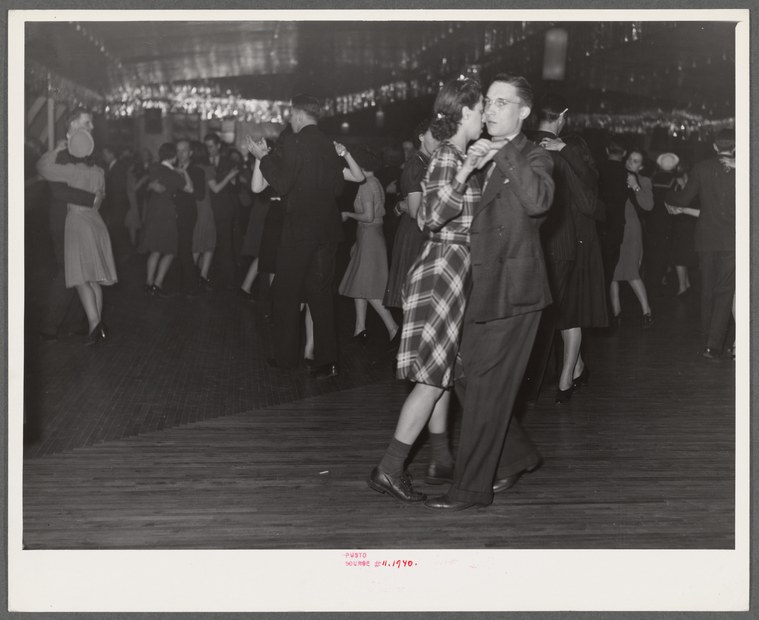
Dance hall, Saturday night. Marshalltown, Iowa
Unknown artist
- Source:
- New York Public Library
- Rights:
- Public domain — free to use, share and adapt.
- Recorded as:
- public_domain
This photograph is rare evidence of how American social ballroom dance was actually practiced in public venues at ground level, away from performance contexts and competition frameworks. It documents the gender relations, the physical density, and the formality maintained within crowded social conditions—information that is difficult to recover from other sources. For dance historians and practitioners studying the ballroom tradition in its social context (as opposed to its competition or theatrical versions), this image is a direct primary document.
What you are looking at
A crowded dance hall in full swing, captured in black and white photography. The space is large and open, filled with couples dancing across a wooden floor under bright overhead lighting that casts sharp shadows. In the foreground, a couple dances in a close embrace—the woman wears a patterned plaid or checked dress, the man a dark suit and glasses. Behind them, dozens of other dancers fill the hall in pairs, their bodies slightly blurred by motion or distance. The ceiling is high and industrial, visible in the background along with what appear to be spectators or musicians elevated above the dance floor. The photograph conveys the energy and density of a popular social dance venue on a Saturday night, with the kind of casual intimacy and crowding characteristic of mid-twentieth-century American dance halls.
The dancing
Couples dance in closed position throughout the hall—the standard ballroom embrace with frame intact and bodies in direct contact. The foreground couple shows clear weight transfer in motion; the woman's torso and the man's frame suggest they are mid-stride in a smooth, gliding step. Arms are bent and held close to the body, elbows soft. The dancers around them maintain similar formal frame despite the crowding, indicating trained or conventionalized technique rather than free movement. The density of couples means most are seen at medium distance or smaller, but all appear to be moving as partners in synchronized pairs.
The dance depicted
This is a social ballroom dance, almost certainly American smooth or swing-era social dancing. The closed position, the gliding locomotion visible in the foreground couple, and the formality of frame suggest Foxtrot or Waltz—the standard couple dances of American public dance halls in the 1930s–1950s. The setting and the attire (men in suits and dress shoes, women in dresses and heels) confirm this is a formal social context, not jitterbug or swing dancing. Marshalltown, Iowa, would have had such halls as standard community entertainment venues. The photograph documents how these dances were actually danced in public—in crowded conditions, with real bodies, without performance exaggeration.
How it was made
This is a black and white photograph, likely taken with available artificial light (visible overhead fixtures). The photographic medium captures the scene as documentary evidence rather than idealized representation. The sharpness of the foreground couple against the softer focus of dancers behind suggests the photographer had a specific focal plane, focusing on the main couple while keeping the crowd context visible. The lighting is industrial and institutional—typical of 1930s–1940s public halls with electric fixtures. The grain and tonal range suggest either professional studio photography or high-quality press photography of the period. Photography's indexical quality—its direct capture of light from the scene—makes this a primary historical document of how ballroom dancing was actually practiced in a specific place and time.
About this work
This is a documentary photograph of a Saturday night dance at a public ballroom in Marshalltown, Iowa, showing the social ballroom dancing that was standard American entertainment in the mid-twentieth century. The image records not a performance or a posed studio scene, but the actual practice of couple dancing in a crowded public venue—the density, the intimacy, the formality maintained in close quarters, and the gender dynamics of heterosexual couple dance. It belongs in a dance archive as evidence of how ballroom social dancing functioned as lived social practice, not as spectacle.
The photograph's interest lies precisely in its ordinariness. This was not a famous dance hall, a competition, or a theatrical event. It is the weekly routine of ordinary people in a small Midwestern town. That ordinariness, captured with clarity and detail, makes it historically valuable: it shows what ballroom dancing looked like when it was a normal social activity rather than a competitive or theatrical form.
How to look at it
Attend to the moment of locomotion frozen in the foreground couple: the woman's weight appears to be transferring, her frame held steady within the man's embrace. Notice how the maintained frame persists even in a crowded space—the dancers do not relax or break position despite the density around them. Look at the pattern of motion throughout the hall: all couples are moving in the same direction, following the line of dance (counterclockwise), a convention that allowed multiple couples to share a small floor. The overhead lighting and the wooden floor are institutional markers of the public dance hall as a commercial space, not a private or elite setting.
The period
In the 1930s–1950s, public dance halls were standard American entertainment venues in towns of all sizes, from major cities to small Midwestern communities like Marshalltown. The ballroom dances—Foxtrot, Waltz, and swing variations—were democratized social practices, not elite activities. Live bands or recorded music provided accompaniment, and Saturday nights were customary occasions for young and middle-aged adults to gather for couple dancing. This was the era before rock and roll transformed youth culture and before televised competition programs (like later ballroom competitions) professionalized and spectacularized the dances. The photograph sits at the end of an era in which ballroom dancing was a routine social activity.
Where it lives
The photograph is held in the New York Public Library collection and is attributed to the Library's archival holdings. It is catalogued as documentation of a specific place and date (Marshalltown, Iowa, undated but likely 1930s–1940s based on clothing and photographic style). The exact date and photographer remain unrecorded in the available metadata.
Dance in this work
Questions about this work
What dance is this?
The closed position, frame, and gliding locomotion visible in the foreground couple indicate American smooth ballroom dancing, most likely Foxtrot or Waltz. These were the standard couple dances in public ballrooms in this era and region. The photograph does not show swing or jitterbug, which would have looser frame and more vigorous movement.
When was this taken?
The catalogue record does not provide an exact date. The photograph's style, the clothing (men's suits and women's dresses of the 1930s–1940s cut), and the ballroom's infrastructure suggest it was taken sometime between the 1930s and 1950s, likely in the 1940s.
How many people are dancing?
The foreground shows one couple clearly; the background shows dozens of other dancers, but the exact number is difficult to determine due to crowding and focus. The image conveys the density of a typical busy Saturday night at a public hall.
Who took this photograph?
The photographer is not recorded in the available metadata. The image is part of the New York Public Library's archival holdings, which suggests it may have been taken by a staff photographer or acquired from a press archive, but attribution cannot be confirmed.
More dance artwork