49 works in this view — arrow keys or swipe to move between them.
Dance in Art
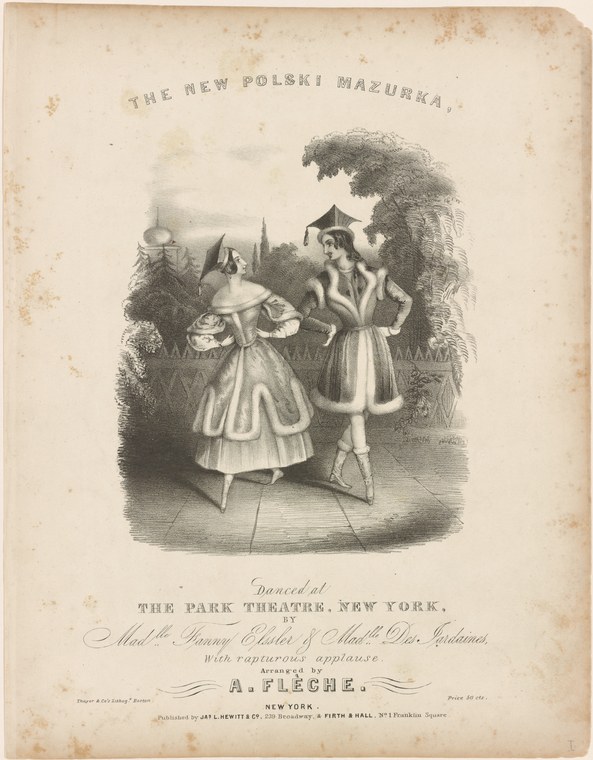
The new Polski mazurka, danced at the Park Theatre, New York, by Madlle. Fanny Elssler & Madlle Des Jardaines, with rapturous applause
Unknown artist
- Collection:
- Prints depicting dance
- Source:
- New York Public Library
- Rights:
- Public domain — free to use, share and adapt.
- Recorded as:
- Public Domain
Fanny Elssler was one of the most celebrated ballet dancers of the 19th century, and her performances in America in the 1840s were major cultural events. This print documents a specific moment in the dissemination of Romantic ballet to the United States and preserves visual evidence of how national character dances—in this case, the Polish mazurka—were choreographed, costumed, and presented to Western theatrical audiences. For scholars of dance history, Elssler's career and the circulation of her image through prints like this one reveal how professional ballet performance, celebrity, and popular culture were intertwined.
What you are looking at
This is a lithographed sheet-music cover or theatrical print from the mid-19th century. Two dancers in classical ballet dress occupy the center of the composition against a softly rendered backdrop suggesting an outdoor or garden setting. The figure on the left wears a short tutu with a fitted bodice and a distinctive tall headdress or crown; the figure on the right is in a similar classical ballet costume. Both are positioned in profile or three-quarter view, with the dancer on the right appearing to extend her leg in a développé or similar movement, while the dancer on the left turns toward her companion. The setting behind them includes trees or foliage rendered in soft stippled tones, and the overall atmosphere is one of theatrical romance. The print's title, credits, and publication information appear in elegant typography above and below the central image, situating this as a commercial theatrical souvenir or music publication.
The dancing
Both dancers are en pointe or rising on their toes, with arms raised and extended in a graceful port de bras typical of Romantic ballet. The dancer on the right lifts her working leg high and extended, suggesting a développé à la seconde or attitude position. Their bodies are long and linear, with the characteristic upward lift and turnout of classical ballet training. The spatial relationship between the two figures suggests a moment of encounter or duet, with both engaged in refined, elevated movement. The musculature visible in the engraving suggests trained classical dancers rather than character performers.
The dance depicted
This depicts the 'Polski Mazurka' as danced by Fanny Elssler and another dancer (des Jardaines or similar) at the Park Theatre in New York. The title identifies it as a mazurka—a character dance with Polish national associations that became a staple of Romantic ballet repertoire in the 1830s–1840s. Mazurkas in this period were often featured as divertissements within larger ballets and were executed by principal dancers in elaborate costume. The classical ballet technique visible here shows how European theatrical dance of this era absorbed and stylized folk material from Eastern Europe. The engraving preserves both the specific historical performance and the Romantic aesthetic that framed such national character dances for Western audiences.
How it was made
This is a steel engraving or lithograph, likely from the 1840s, produced for commercial distribution as sheet music or theatrical ephemera. The technique allows for fine linear detail, particularly in the dancers' anatomy and costume, while softer tonal effects in the background are achieved through stippling and subtle shading. The image was printed in black ink on tinted or cream paper. Such prints were mass-produced and affordable, making them important documents of touring performances and star dancers; they functioned as promotional material and souvenirs sold to theatregoers. The quality of execution and the prominent credits suggest this was a professional production by an established publisher, with some care taken to capture the dancers' likenesses and performance moment.
About this work
This is a mid-19th-century theatrical engraving documenting a performance of the 'Polski Mazurka' by the celebrated ballerina Fanny Elssler at the Park Theatre in New York. It is a primary source for understanding how Romantic ballet integrated national character dances and how touring European dancers shaped American theatrical culture in the 1840s. The image combines documentary function—it records a specific performance and its stars—with aesthetic intention, presenting the mazurka as an elegant, refined theatrical spectacle rather than a folk form.
The work belongs to a large body of Romantic-era dance ephemera that preserves both the look of specific historical performances and the values of the period: the elevation and technical precision of classical ballet technique, the exoticism and prestige of European material performed by touring stars, and the commercial infrastructure of theatrical culture (sheet-music covers, lithographed souvenirs, newspaper engravings). For dance historians, it provides evidence of performance practice, costume, and choreographic tradition; for art historians, it illustrates the circulation of theatrical imagery and the role of printmaking in celebrity culture.
How to look at it
Notice the moment chosen: both dancers are suspended in movement, neither at rest nor at the climax of an action, but in an elegant intermediate position that allows the viewer to appreciate their technique and line. The engraver has paid particular attention to the dancers' legs and feet, the extension and turnout that signify trained classical ballet technique, and to the delicate taper of the ankles and calf—elements that would have been admired and discussed by contemporaries. The two-figure composition, with one dancer turning toward the other, suggests intimacy or narrative interaction; look at how the spatial relationship between them and the asymmetry of their poses create a sense of movement and exchange rather than static display. The soft, hazy background keeps the focus on the dancers' bodies and costumes, a convention of Romantic aesthetics that emphasizes the ethereal and otherworldly quality of ballet.
The artist
The print credits are partially visible but do not clearly identify the original artist or the engraver. The publication line indicates it was issued in New York by Jay & Hines (or similar), a commercial music and theatrical print publisher. Such theatrical prints were often based on stage or portrait photography or sketches made at or near the actual performance, or they were idealized compositions created in consultation with the dancers or their managers to capture the essence of a celebrated performance. Attribution to a specific artist would require further research in theatrical archives and publishing records of the period.
The period
This print dates to the 1840s, the height of the Romantic ballet era in Europe and the peak of Fanny Elssler's international fame. Elssler was touring the United States from 1840 to 1842, a hugely successful venture that helped establish ballet as a prestigious theatrical form in America. During this period, Romantic ballet was incorporating character dances from across Europe—Spanish, Italian, Polish—as colorful divertissements within narrative ballets or as standalone showcases for star dancers' technical and dramatic abilities. The mazurka was one of the most popular of these national numbers. Simultaneously, lithography and steel engraving were at their peak as technologies for mass-producing theatrical imagery; prints of celebrated dancers were sold in theaters and print shops, functioning as both souvenirs and advertisements. This print sits at the intersection of theatrical performance, celebrity culture, national identity, and printmaking technology.
Where it lives
The print is held by the New York Public Library, part of its collection of theatrical ephemera and dance-related prints. Such prints were produced for commercial distribution—sold to theater patrons, collected in bound volumes, and preserved in personal collections and institutional archives. The NYPL's holdings of 19th-century American theatrical prints provide important documentation of touring performances, visiting stars, and the development of theatrical culture in the United States.
Dance in this work
Questions about this work
Who was Fanny Elssler?
Fanny Elssler (1810–1884) was an Austrian ballet dancer and one of the greatest stars of the Romantic era. She was known for her technical prowess, her vivid characterizations, and her performances of character dances from across Europe. Her 1840–1842 tour of the United States was a legendary success, helping to establish ballet as a major theatrical form in America and making her one of the first European artists to achieve celebrity status in the young republic. She was also celebrated for her passionate temperament and her rivalry with other great ballerinas of the period.
What is a mazurka in ballet?
The mazurka is a Polish folk dance in triple meter with characteristic rhythmic accents and a turning, stamping quality. In Romantic ballet, it became a popular character dance—a colorful, national-themed divertissement performed by principal dancers in elaborate costume. Ballet mazurkas typically showcased a dancer's technical ability and dramatic flair while incorporating stylized versions of folk movement vocabulary. They were often included as 'variations' in longer ballets or performed as standalone features, serving both aesthetic and commercial purposes.
Why was this printed and sold?
Theatrical prints like this were mass-produced for multiple audiences: as souvenirs for theater patrons, as promotional material for the theater and the dancers, as illustrations in newspapers and journals, and as collectible images in an era fascinated by theater and celebrity. Prints of star dancers were particularly popular and profitable, as they functioned simultaneously as art objects, advertisements, and mementos of a performance experience. They also helped circulate images of celebrated dancers across the country, extending their fame beyond the cities where they actually performed.
What does the costume tell us?
Both dancers wear short romantic-era ballet tutus—made of multiple layers of lightweight fabric—fitted bodices, and pointe shoes. The dancer on the left wears a distinctive tall headdress or crown, likely part of the character costume designed to evoke Polish or Eastern European identity. The attention to costume detail in the engraving—the texture of the tutu, the fit of the bodice, the decoration of the headdress—indicates that visual spectacle and sumptuous costume were central to the appeal of Romantic ballet, especially in character dance numbers designed to showcase a star dancer.
More dance artwork





