49 works in this view — arrow keys or swipe to move between them.
Dance in Art
Balet du Prince de Salerne, exécuté à Fontainebleau en novembre 1746
Unknown artist
- Collection:
- Prints depicting dance
- Source:
- New York Public Library
- Rights:
- Public domain — free to use, share and adapt.
- Recorded as:
- Public Domain
This is a dated documentation of a specific historical performance, rare for the period. It preserves the visual record of how court nobles danced and watched dance together in 1746, including the costume, body position, and spatial arrangement that made the event meaningful. For historians of eighteenth-century social dance and performance, it is evidence of the choreographic and theatrical standards that shaped European aristocratic culture.
What you are looking at
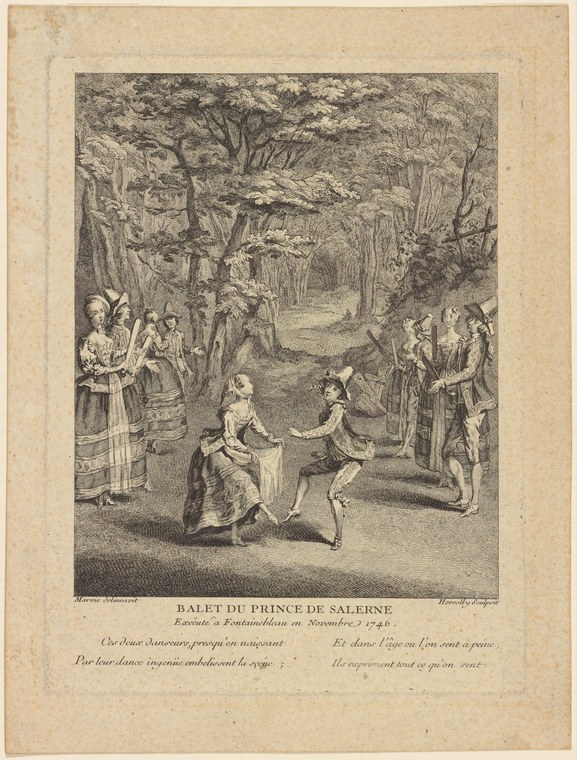
This engraving depicts a formal court dance performance set in a wooded landscape, executed in the refined style of eighteenth-century Rococo illustration. The scene is dominated by a dense canopy of tall trees creating a theatrical backdrop, with a clearing in the center where dancers perform. On the left, a group of courtiers in elaborate dress watches from beneath the trees; on the right, additional spectators gather. The dancers occupy the central space: two principal female figures in the foreground wear full-skirted court dresses with decorative trim, their bodies bent in the courtly postures of the minuet or similar formal dance. At least two male figures are visible, one kneeling or bending low before a standing woman in an attitude of courtship or deference. The lighting is rendered through fine parallel hatching, creating depth and atmosphere, with the forest canopy casting shadow across the scene while the dancers remain luminous in the clearing. The composition is framed by an ornamental border typical of dance prints of the period.
The dancing
The principal dancers adopt the formal, upright carriage of eighteenth-century court dance. The women stand with turned-out legs and elongated frames in full court dress; one female figure appears to be turning or processing, her skirts splayed to show the voluminous fabric characteristic of the period. The male figures bow or kneel in the attitude of courtship, their upper bodies sharply bent at the waist while their legs remain straight and turned out. The spacing between dancers is deliberate and hierarchical, reflecting the geometric precision of baroque and rococo courtly movement. At least six figures participate actively in the choreography, with additional spectators forming an observing frame around the action.
The dance depicted
The engraving documents 'Balet du Prince de Salerne,' a court ballet performed at Fontainebleau in November 1746. This was a theatrical entertainment embedded in aristocratic life, combining elements of theater, music, and social spectacle. The visible gesture—particularly the kneeling male figures and the formal carriage of the women—suggests the language of the minuet or a similar measure danced at court. The composition, with its clear separation of active dancers from observing courtiers, reflects the social structure of French court performance, where nobility danced primarily for each other. The wooded setting with theatrical cleared space suggests this may have been a garden or courtyard performance rather than an indoor theater, though the formal dress and careful choreography indicate a planned spectacle rather than spontaneous social dancing.
How it was made
This is an engraving, executed in the refined line-work characteristic of mid-eighteenth-century French illustration. The technique employs fine parallel lines (hatching) to create tonal gradation and depth, particularly visible in the rendering of the forest canopy and the volume of the dancers' costumes. Engraving allowed for wide circulation of court spectacles to a literate audience who had not witnessed the performance in person, making it a key tool for documenting and disseminating court culture. The ornamented border and the printed text beneath the image indicate this was issued as a print in a series or publication, likely for courtiers or cultural enthusiasts across France and Europe. The medium's precision and legibility made it ideal for recording both the visual splendor and the precise choreographic positions that defined fashionable dance.
About this work
This engraving records a specific court ballet performed for Prince of Salerno at the royal château of Fontainebleau in 1746, during the reign of Louis XV. It documents the visual language and social framework of French aristocratic dance at the height of the Rococo period. The work belongs in a dance history collection as evidence of how eighteenth-century court society represented itself through formal movement and theatrical spectacle, and as a rare visual record of a historical performance event.
The image captures the conventions by which court ballet was understood and displayed: the formality of body position, the hierarchical arrangement of active dancers and observers, the integration of movement into landscape, and the elaborate costuming that both enabled and defined the dance. For a historian or dancer interested in the eighteenth century, this engraving is a primary document showing not just what was danced but how it was presented and valued.
How to look at it
Observe the posture of the principal dancers in the foreground: the upright carriage, the turned-out legs, and the controlled arm positions that define the aesthetic of eighteenth-century court dance. Notice the deliberate spacing between figures and the clear geometric relationship between the dancers—this reflects the choreographic precision expected of nobles. The composition uses the forest canopy to frame the action and direct the eye to the dancers' bodies; the clearing is a theatrical space within a naturalistic landscape. The presence of spectators on both sides is not incidental but integral to the meaning: court dance was always witnessed, always a display of status and accomplishment. The kneeling postures suggest a narrative moment—courtship, homage, or deference—that gives the abstract choreography a social meaning.
The artist
The engraver is not recorded in the catalogue, but the style and subject matter indicate a professional artist working within the French court print tradition of the 1740s. The quality of line and the familiarity with court dress suggest someone with direct access to court circles or detailed visual documentation of the event. The signed cartouche in the lower right of the engraved area may carry an artist name, but it is not legible in the available image.
The period
In 1746, court ballet in France was in transition. The formal danced spectacles of Louis XIV's reign had given way to more integrated, socially interactive forms of dance, though formal court dances like the minuet remained the foundation of aristocratic accomplishment. Fontainebleau, where this ballet was performed, was one of the principal royal residences and a site for elaborate courtly entertainments. The year 1746 falls within the War of the Austrian Succession, yet court culture continued to function as a arena for aristocratic display. The engraved documentation of court performances was standard practice; such prints circulated among the nobility and the educated public, reinforcing the visibility and prestige of court spectacle. The Rococo style visible in the composition—the ornamental border, the theatrical woodland setting, the emphasis on graceful curving lines and aristocratic leisure—was at its height in French visual culture.
Where it lives
This engraving is held in the Prints collection of the New York Public Library, acquired as part of a broader collection of dance and theatrical prints documenting European performance from the seventeenth through nineteenth centuries. It is catalogued as evidence of a specific historical event and represents the documentary and promotional function of engraved prints in court culture.
Dance in this work
Questions about this work
Was this a real performance?
Yes. The title and date indicate this engraving documents a ballet performed for the Prince of Salerno at the royal château of Fontainebleau in November 1746. Engraved prints were commissioned to record and publicize such court spectacles, and this image served as a visual record for those who attended and as promotional documentation for the French court's cultural achievements.
What dance is being performed?
The formal postures, turned-out legs, and upright carriage suggest the minuet or a similar formal court measure, possibly combined with theatrical elements specific to this ballet. The title 'Balet du Prince' indicates it was a choreographed spectacle rather than a social dance, blending narrative or allegorical content with formal movement vocabulary.
Who are these people?
The dancers were members of the French nobility or their trained attendants; court ballet was performed by and for the aristocracy. The composition distinguishes between the active dancers in the clearing and the observing courtiers arranged around them, reflecting the hierarchical nature of court performance.
Why is it set in a forest?
The wooded landscape reflects both Rococo aesthetic taste for pastoral and romantic imagery and the reality of court entertainments, which frequently took place in gardens and outdoor spaces at Fontainebleau. The forest canopy creates a theatrical framing device that isolates and elevates the dancers' bodies against a naturalistic backdrop.
More dance artwork





