49 works in this view — arrow keys or swipe to move between them.
Dance in Art
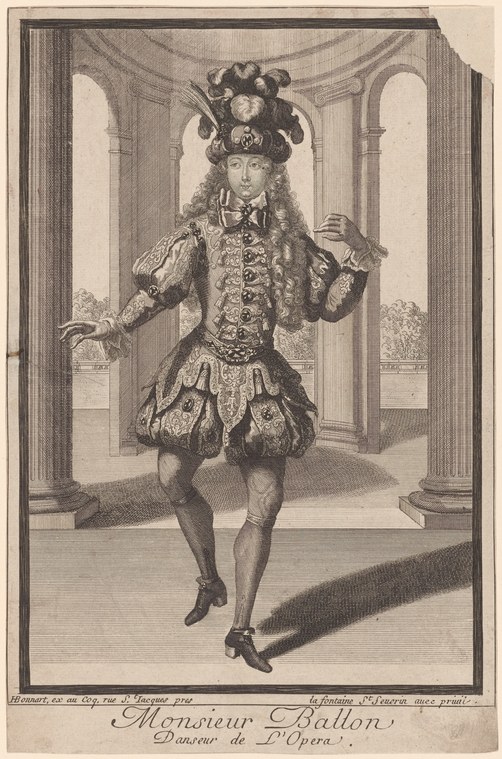
Monsieur Ballon: Danseur de l'opera
Unknown artist
- Collection:
- Prints depicting dance
- Source:
- New York Public Library
- Rights:
- Public domain — free to use, share and adapt.
- Recorded as:
- Public Domain
Male ballet and theatrical dance in the Baroque era is poorly documented in images, making contemporary portraits of named professional dancers exceptionally valuable. This engraving preserves the appearance of costume, headdress, footwear, and bodily carriage of a celebrated performer whose own writings or performances are otherwise lost, offering a rare visual index to the physicality and presentation of Baroque professional dance at the highest level.
What you are looking at
A male dancer stands in contrapposto within a classical columned interior, posed as if mid-performance. He wears an ornate Baroque costume: a heavily embroidered coat with long skirts reaching mid-thigh, puffed sleeves, stockings, heeled shoes, and an elaborate feathered headdress. His weight rests on one leg while the other is extended, arms held in an open, expansive frame. The setting is austere—Corinthian columns and arches frame the figure against a neutral ground. The engraving is rendered in fine parallel lines and cross-hatching that creates subtle modulation of light across the fabric and flesh. A cartouche at the bottom bears the dancer's name and title in French script.
The dancing
The dancer's pose exemplifies the turned-out, lifted carriage of formal Baroque dance: knees appear straight and slightly hyperextended, heels prominent, the body organized around vertical alignment. One leg appears to be in a devant or tendu position while he supports his weight, the torso upright and the chest open. Both arms are held away from the body at approximately shoulder height, palms open and gestures rounded—characteristic of the épaulement and arm port of the period. The overall effect is one of nobility and controlled ease rather than vigorous movement.
The dance depicted
This is a portrait of a professional opera dancer, likely from the Paris Opera in the late 17th or early 18th century, depicted in the formal theatrical idiom of Baroque court dance and its professional stage variant. The pose and costume suggest someone trained in the five positions and the turned-out aesthetic that defined European court dancing of the era. Ballon (or Balon) was a celebrated male dancer of this period, and the inscription identifies him as a dancer of the opera. His pose—restrained, centered, with no suggestion of jumping despite the name's association with elevation—presents him as a master of technique and decorum rather than acrobatic virtuosity. This is a demonstration of the épaulement and arm work that distinguished the accomplished dancer.
How it was made
This is an engraving, identifiable by the fine hatching lines and the formal composition suited to reproductive printmaking. The artist has rendered the costume and architectural setting with considerable linear precision, using parallel and cross-hatched lines to suggest volume, shadow, and texture—the technique typical of 17th–18th-century French reproductive engraving. The print format indicates this was produced for circulation among the educated public and within theatrical circles, likely as a record of a celebrated performer or as a model for other artists. The cost and technical skill required to produce such a work suggests it had value beyond ephemeral documentation.
About this work
This is a formal engraved portrait of Monsieur Ballon, a celebrated dancer of the Paris Opera, posed in the restrained, turned-out stance of Baroque theatrical dance. The artist has captured him in costume and idealized studio light, frozen in a moment of display rather than action—the convention of professional dance portraiture in the period. The work belongs to a small but significant category of 17th–18th-century prints documenting the appearance, dress, and carriage of celebrated male dancers, serving both as record and advertisement of their status and skill.
How to look at it
Notice the deliberate artificiality of the pose: Ballon is not caught mid-jump or in the midst of any vigorous step, but rather posed as if for a portrait, displaying the carriage and arm work that training produced. The headdress, feathered and elaborate, is part of theatrical costume rather than street dress, situating this in the world of professional spectacle. The columned interior is a studio or stage convention rather than a naturalistic setting, elevating the figure and signaling his professional status. Attend to the feet and legs—the turned-out position and the straightness of the leg are the visible signature of the training and discipline he embodied.
The period
This work dates to the era of Louis XIV's reign or shortly after, when the Paris Opera was the dominant institution of French theatrical dance and the five positions and turned-out aesthetic were becoming systematized into formal technique. Male dancers in this period were often noble or aspirant to noble status, and their dress and presentation reflected courtly values even in theatrical contexts. The formal, restrained pose reflects the ideal of controlled nobility that governed both court dance and its professional theatrical variant. Engravings of celebrated dancers served as analogues to engravings of celebrated actors, documenting stars of the stage for a literate public.
Where it lives
This engraving is held in the New York Public Library's collection of prints depicting dance, a curatorial category that recognizes the historical importance of visual documentation of performance. It functions as both artwork and historical document—a record of an individual performer preserved through the reproductive medium of engraving.
Dance in this work
Questions about this work
Who was Monsieur Ballon?
Ballon was a celebrated male dancer at the Paris Opera in the late 17th or early 18th century, known for his skill and grace. He is recorded in the history of Baroque dance, and this engraving preserves a formal portrait of him in costume. Little else is widely documented about his career, making images like this invaluable to understanding the appearance and status of celebrated performers of his era.
What does the pose tell us about Baroque dance?
The turned-out legs, lifted carriage, open arm positions, and vertical alignment are the hallmarks of Baroque theatrical dance technique. Ballon is posed to display these qualities—not in action, but in the formal posture that demonstrated a dancer's training and nobility. This portrait-like presentation was conventional for engravings of celebrated dancers.
Why is he wearing such elaborate costume in this portrait?
This is his stage costume, the dress he wore in theatrical performances at the Paris Opera. The feathered headdress, embroidered coat, and fine stockings and heeled shoes were part of the visual spectacle of Baroque theater, and this engraving documents both his skill and the luxury of his professional presentation.
Why was this engraved and printed?
Professional engravings of celebrated dancers served as records of stars of the stage for literate urban audiences, much as engraved portraits of celebrated actors did. This print would have circulated among people interested in theater, dance, and the cultural life of Paris, making Ballon's fame visible and durable.
More dance artwork





