49 works in this view — arrow keys or swipe to move between them.
Dance in Art
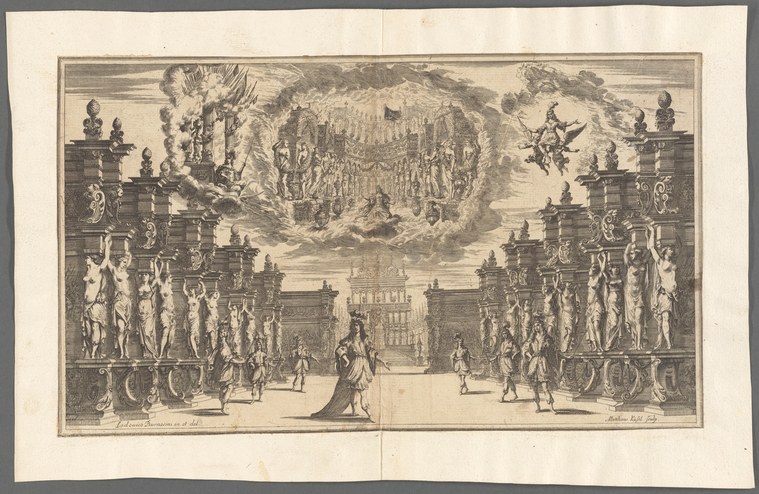
Il pomo d'oro: [Act I, scene xi]
Unknown artist
- Collection:
- Prints depicting dance
- Source:
- New York Public Library
- Rights:
- Public domain — free to use, share and adapt.
- Recorded as:
- Public Domain
This engraving preserves a record of the visual and theatrical world in which seventeenth-century court dance was performed, showing the architectural and scenic framework within which dancers moved. For scholars of baroque spectacle and intermezzi, it is direct evidence of how these vast collaborative works combined design, machinery, and human figures to create unified theatrical experiences. The print circulation of such images shaped how contemporaries outside Venice understood and valued court dance.
What you are looking at
This is a theatrical stage scene engraved in the seventeenth-century Italian style, depicting an elaborate court spectacle or intermezzi. A grand architectural proscenium frames the stage: twin colonnaded porticoes flank the edges, their pedestals topped with sculptural figures in classical poses—some standing, some in dynamic attitudes. The center stage opens onto a deep scene with mountains, castles, and clouds rendered in atmospheric perspective. In the foreground, elegantly dressed courtiers and nobility occupy the stage floor in small groups. The figures wear period costume of the 1650s–70s era: men in doublets and breeches, women in full-skirted gowns with draped sleeves. The lighting is even and clarifying, a product of the print technique, which renders all detail with equal emphasis. The composition creates a theatrical "gallery" effect: the spectator views performers and architecture simultaneously, invited to admire the machinery, statuary, and human figures as a unified work of art.
The dancing
The human figures on stage are small and distributed across the foreground in loose, conversational groupings rather than tightly partnered pairs. Their poses suggest walking, pausing, and social interaction rather than synchronized movement. A few figures appear to be engaged in gesture or pantomime, arms raised or extended in expressive attitudes. The posture throughout is upright and formal, consistent with court deportment of the period. No figure is depicted in dynamic aerial movement or turn; the bodies are stable and grounded, oriented toward social encounter and spectacle-viewing.
The dance depicted
This appears to be a scene from an intermezzi or court spectacle—possibly the famous *Il pomo d'oro* (The Golden Apple), a Venetian opera-ballet mounted in 1666. These multimedia entertainments combined dance, music, elaborate machinery, and scenery. The scene does not depict virtuosic social dancing but rather the formal procession and scenic tableau that frame musical numbers and dramatic moments. The human figures function as courtly actors within a larger architectural and decorative spectacle, consistent with the intermezzi convention of treating the stage as a unified work of art rather than a dance floor.
How it was made
This is an engraving, evidently a plate illustrating a theatrical design or commemorative record of a spectacle. The technique allows for fine linear detail in the architecture, sculpture, and distant landscape, and creates even tone suitable for print circulation. Engravings of this kind—recording elaborate court spectacles—were published to distribute images of the performance far beyond Venice, serving as documents of princely magnificence and theatrical invention. The print medium indicates a work intended for educated courtly audiences across Italian cities and beyond.
About this work
This is a theatrical engraving recording a scene from an elaborate seventeenth-century court spectacle, likely *Il pomo d'oro*, an intermezzi that combined music, dance, and architectural scenery. The image captures the formal interplay of human figures, sculptural ornament, and illusionistic architecture that defined the aesthetic of court entertainment in Venice and northern Italy during the 1660s. It is neither a dance manual nor a representation of virtuosic dancing, but rather a record of the theatrical and social contexts in which courtly dancing was performed—the grand settings, ceremonial groupings, and mingling of human and sculptural figures that surrounded musical performance and courtly interaction.
For historians of dance, this image illuminates the world of intermezzi and court spectacle in which baroque dance was embedded. The engraving shows the machinery, setting, and formal arrangements that shaped how dance was experienced in elite circles. It is also evidence of how theatrical spectacle was documented, circulated, and remembered—through prints that emphasized architectural grandeur and courtly decorum.
How to look at it
Attend first to the architecture and sculptural ornament: this is a theatrical *set*, not a ballroom, and the engraving invites you to admire the engineering and artistry of the design as much as the human figures. Notice how small the courtiers are within this vast classical frame—they are actors within a architectural spectacle rather than the focus of attention. The poses and groupings are formal and processional rather than dynamic; this captures a moment of social encounter or ceremonial pause rather than the execution of a dance step. The print technique's even lighting and fine detail allow you to read both the distant scene (mountains, buildings) and the foreground figures simultaneously—a compositional strategy that emphasizes the unity of the theatrical work.
The period
This image belongs to the world of seventeenth-century Italian court spectacle, particularly the Venetian intermezzi tradition. The 1660s saw the height of elaborate court entertainments combining music, dance, scenic design, and technical machinery. *Il pomo d'oro*, commissioned to celebrate a royal wedding, was one of the most famous examples—a multi-act spectacle with multiple intermezzi, each with its own set and cast. The engraving style and the classical architectural language reflect the influence of Roman and Florentine court spectacle on Venice, and the prints documenting these events circulated widely among European nobility, advertising the power and taste of their patrons. Baroque court dance was always embedded within these larger multimedia contexts; dancing was one element among music, machinery, scenery, and courtly ceremony.
Where it lives
The work is catalogued as a print depicting dance, held in the NYPL Prints collection. It is identified as Act I, scene xi of *Il pomo d'oro*, a commemorative engraving of the 1666 Venetian spectacle. Such prints were created as records and advertisements of the production, circulated among patrons and courtly audiences across Italy.
Dance in this work
Questions about this work
What is Il pomo d'oro and why does it matter for dance history?
*Il pomo d'oro* (1666) was one of the most elaborate court spectacles ever mounted, a Venetian production combining music, dance, machinery, and scenery across multiple acts and intermezzi. It is significant because it represents the apotheosis of seventeenth-century court entertainment, in which dance was integrated into a total theatrical work. The spectacle was documented through engravings like this one, which circulated far beyond Venice and shaped how European courts understood and valued integrated spectacle.
Are there actual dancers performing here?
The small figures in the foreground are courtly actors and musicians within a vast theatrical set, not necessarily professional dancers. In intermezzi, dance was performed, but this particular scene emphasizes spectacle and machinery—the architecture, sculpture, and illusionistic scenery—rather than a moment of virtuosic dancing. The human figures are distributed in social groupings, suggesting conversation and courtly ceremony rather than synchronized dance movement.
What does the engraving technique tell us about this work?
Engravings were the print medium of choice for circulating images of court spectacle, allowing fine detail and reproducibility. This print was almost certainly published to distribute the fame of the production beyond Venice—to show patrons, courts, and artists elsewhere what Venetian magnificence looked like. It is evidence not just of the spectacle itself but of how early modern courts used prints to advertise power and taste.
More dance artwork





