49 works in this view — arrow keys or swipe to move between them.
Dance in Art
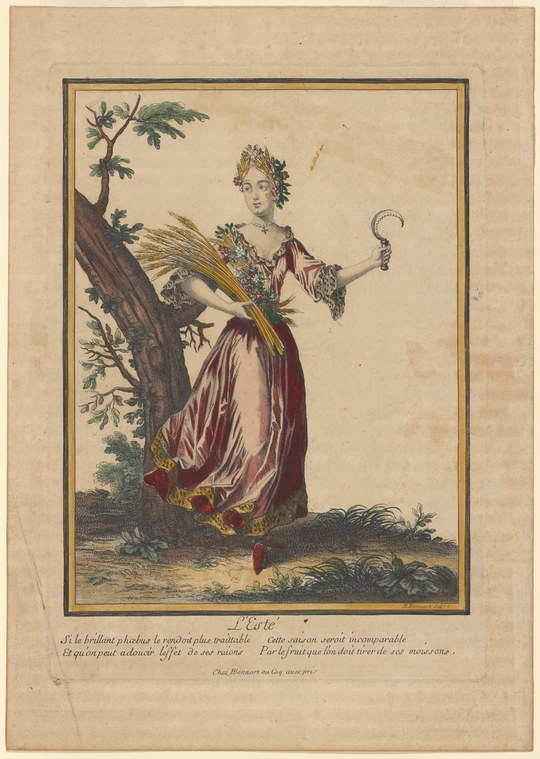
L'Esté
Unknown artist
- Collection:
- Prints depicting dance
- Source:
- New York Public Library
- Rights:
- Public domain — free to use, share and adapt.
- Recorded as:
- Public Domain
This print reveals the intimate connection between 18th-century dance ideals and visual representation: the body itself, trained in courtly dance, had become the primary medium through which artistic and allegorical concepts were expressed. For dance historians, the image is evidence of how the values of grace and refinement cultivated in the ballroom became universalized as markers of culture, beauty, and civilization.
What you are looking at
A young woman stands alone in a bucolic landscape, posed in an attitude of classical grace. She wears a flowing mauve or rose-colored silk gown with a low, draped neckline and high waistline characteristic of late 18th-century dress; the skirt falls in soft folds to her feet, and a gauzy overlay or shawl is caught up and extends behind her like a theatrical prop or dance accessory. A wreath or garland adorns her hair, and she holds a curved crook or shepherd's staff in her right hand—a pastoral attribute. At her feet lies a cornucopia overflowing with flowers and fruits. To her left stands an ancient gnarled tree, its trunk and twisted branches rendered in warm brown tones, rooted in rocky ground. The background is spare and luminous, a soft cream or pale buff, allowing the figure to dominate the composition. The entire scene is framed by a double-line border in the manner of an engraving or colored print.
The dancing
The woman's weight rests on her left leg in a gentle contrapposto; her right leg is softly extended. Her left arm hangs naturally while her right arm is raised to hold the crook, creating an open, expansive silhouette. Her torso is turned slightly, her gaze directed outward toward the viewer with a composed, idealized expression. The pose is one of graceful stillness rather than active motion—the body elongated and refined in the manner of academic figure drawing, with no tension or strain visible.
The dance depicted
This is an allegorical representation of summer (L'Esté in French) rather than a depiction of an actual social or theatrical dance. The figure embodies the season through costume, attribute, and setting in the tradition of classical and Renaissance personification. However, the woman's pose—with its elegant contrapposto, lifted carriage, and balletic coordination of limbs—reflects the conventions of courtly dance and refined bodily comportment that were inseparable from artistic representation of the period. The flowing silk and the pastoral setting suggest an association with the pastoral dances and court ballets popular in 18th-century aristocratic entertainment, though no specific dance steps or partner interaction is shown.
How it was made
This is a hand-colored engraving or etching, characteristic of 18th-century luxury print production. The fine line work of the tree, rocks, and drapery, combined with the evidence of selective hand-coloring in watercolor or gouache (visible in the mauve dress, green foliage, and flesh tones), indicates a print made for a cultivated audience—likely part of a larger allegorical series on the seasons, elements, or virtues. The technique allowed wide circulation of refined classical imagery to collectors and the educated classes, and the hand-coloring elevated it to the status of a precious cabinet object.
About this work
This engraving represents Summer as a graceful female allegorical figure in late 18th-century dress, posed in a manner that reflects the refined bodily ideals of courtly dance and aristocratic comportment. The work belongs to a long tradition of seasonal and allegorical personification in European art, wherein abstract concepts are given form through the body of a beautiful, idealized woman. Although not a record of actual dance practice, the image demonstrates how deeply the language of the dance—elegance, grace, balanced weight, and controlled extension—had become embedded in the visual language of refined femininity and artistic virtue during the period.
How to look at it
Attend to the woman's posture and the positioning of her limbs: her weight-bearing and the gentle S-curve of her spine follow balletic principles of balance and elegance. Note how the artist has chosen a moment of poised stillness—not mid-step or in active motion, but rather in the state of dignified repose that demonstrated good breeding and training. The pastoral attribute (crook), the wreath, and the cornucopia work together to signal 'summer' through symbol rather than narrative action; the beauty of the figure herself is the primary message.
The period
The late 18th century saw a flourishing of allegorical prints depicting personifications of the seasons, virtues, and elements, responding to Enlightenment taste for classical learning and visual wit. Court dance—particularly minuet, contredanse, and pastoral-themed spectacles—was at its height as a marker of aristocratic identity and education. The fashion visible here, with its high waistline and neoclassical silhouette, dates to roughly the 1770s–1790s, a period when dance costume and daily dress were increasingly influenced by classical ideals. Engraving and hand-coloring allowed such allegorical imagery to circulate widely among the wealthy and educated.
Where it lives
The New York Public Library holds this work as part of its Prints depicting dance collection, indicating its recognition as relevant to dance history despite being primarily allegorical in subject.
Dance in this work
Questions about this work
Is this actually a dance scene?
Not in the sense of showing active dancing or partner interaction. It is an allegorical personification of Summer in the tradition of Renaissance and Baroque emblem books and classical art theory. However, the figure's pose and comportment embody the refined bodily ideals cultivated by courtly dance training, and the work belongs to the visual culture of 18th-century aristocratic dance society.
What does the crook and cornucopia mean?
These are classical attributes identifying the figure as Summer personified. The shepherd's crook references pastoral convention and the care of flocks during warm months; the cornucopia (horn of plenty) overflowing with flowers and fruit symbolizes the season's abundance and fertility.
When was this made?
The catalogue record does not provide a date. However, the style of dress, the neoclassical aesthetic, the technique of hand-colored engraving, and the manner of depicting the figure all suggest the late 18th century, likely 1770s–1790s. The work appears to be part of a series on the seasons or similar allegorical subjects.
More dance artwork





