49 works in this view — arrow keys or swipe to move between them.
Dance in Art
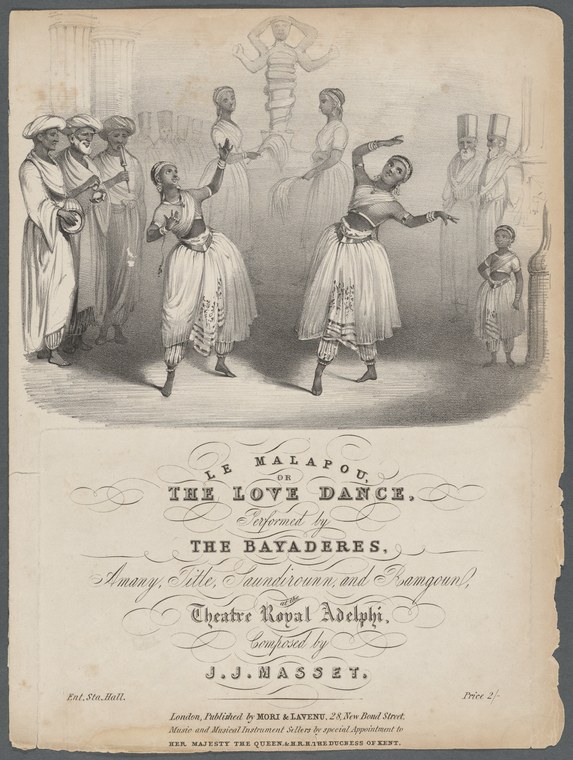
Le malapou, or the love dance, performed by the Bayaderes, Amany, Title [sic], Saundirounn, and Ramgoun, at the Theatre Royal Adelphi, composed by J.J. Masset
Unknown artist
- Collection:
- Prints depicting dance
- Source:
- New York Public Library
- Rights:
- Public domain — free to use, share and adapt.
- Recorded as:
- Public Domain
This work directly documents the early commercialization and Romanticization of South Asian dance on the European stage, a process that shaped Western perceptions of Indian dance for generations while often effacing the classical traditions behind them. For dancers and historians, it is a primary source for understanding how Romantic-era theatrical vocabulary—extended lines, lifted ports de bras, solo virtuosity—was applied to exoticized colonial subjects, and how performance became a vehicle for Orientalist fantasy.
What you are looking at
A theatrical scene staged at the Theatre Royal Adelphi, London, depicting four dancers identified as the Bayaderes (Amany, Title, Saundirounn, and Ramgoun) performing the Love Dance, or *Malapou*. The composition is shallow and intimate, staged against draped backdrops that suggest an interior or temple space. Two dancers occupy the foreground: one in the centre-left, arms raised overhead with palms together or parted, and another centre-right in a lunging pose with one arm extended. Two additional figures are visible in the background, one of whom appears to be holding or manipulating a large sculptural object overhead—possibly a prop or architectural element. All dancers wear light, flowing white garments consistent with early-19th-century theatrical interpretations of South Asian dress, with draped skirts and fitted bodices. The engraving captures a moment of dynamic, upright movement: the bodies are extended, the poses open and expressive rather than formally closed.
The dancing
Four female dancers occupy the stage, arranged in depth. The two foreground dancers are in sharply contrasting poses: one stands nearly upright with arms lifted overhead, the other lunges forward with trailing arm gestures suggestive of continued motion. Both figures display an open carriage with elongated, extended lines through the torso and limbs. The background figures appear smaller and less defined, maintaining the spatial recession. The costumes—high-waisted skirts with decorative borders, fitted sleeves or bare arms, and flowing drapery—are consistent throughout and suggest a unified ensemble. The overall impression is one of individual, virtuosic poses rather than synchronized group work or formal coupling.
The dance depicted
The *Malapou* (also *Malapop*) was a fashionable theatrical representation of Indian dance, created for the London stage in the early 19th century and performed by the Bayaderes—a designation then applied to professional female dancers from South India, though the theatrical version was typically a stylized, Romantic-era interpretation rather than authentic classical practice. J. J. Massey composed the piece; the title character list suggests these four were celebrated performers of the type. The depicted movements—raised arms, extended lines, lunging contrapposto—align with Romantic-era theatrical convention rather than any documented South Asian technique. This is a London drawing-room fantasy of exoticism, not documentation of *bharatanatyam* or any classical Indian dance.
How it was made
This is a lithographic or engraved print, as indicated by the fine linear hatching, the delicate grey washes defining form and shadow, and the printed credit line and publication information at the base. The print shows the characteristics of early-19th-century theatrical publicity engraving: fine detail in costume and setting, theatrical framing and composition, and professional reproduction for circulation to London audiences. The technique allowed for wide distribution of images of celebrated performers and new theatrical productions, functioning as both advertisement and souvenir. The work was published by Mori & Laveuu of New Broad Street, London.
About this work
This is a lithographic or engraved print documenting a performance of the *Malapou*, a fashionable Romantic-era theatrical dance piece staged at the Theatre Royal Adelphi in London. Composed by J. J. Massey and performed by the celebrated Bayaderes (Amany, Title, Saundirounn, and Ramgoun), the work represents the early-19th-century fascination with "Indian" or "Oriental" dance as an exotic theatrical spectacle. The print freezes a moment of fluid, expressive movement—one dancer with arms overhead, another lunging forward—rendered in the open, extended lines characteristic of Romantic ballet vocabulary of the period. As a piece of theatrical publicity and documentation, the print offers evidence of both the choreography (poses, costuming, number of performers) and the cultural fantasy that shaped how London audiences understood dance from colonized territories.
How to look at it
Look first at the two foreground dancers and how the engraver has frozen different moments of the same choreography: one with arms elevated and body extended upward, the other lunging forward with a trailing gesture. These poses reveal what the choreographer valued—the display of the dancer's body in extended, open lines and in rapid transitions between high and low, upright and inclined positions. The costume is equally important: note the flowing skirts, the fitted bodice, the bare or lightly sleeved arms, all designed to show the movement of limbs and torso. The composition—shallow stage depth, theatrical backdrop, careful spacing—tells you this was a starring role for celebrated performers, not background or corps work.
The artist
The engraver or lithographer is not recorded. J. J. Massey is credited as the composer of the dance piece; he was active in London theatrical circles in the early 19th century. The Bayaderes themselves—Amany, Title, Saundirounn, and Ramgoun—were professional performers whose names appear in playbills and prints but for whom biographical detail is sparse. The print was published by Mori & Laveuu of New Broad Street, London, a firm active in theatrical ephemera.
The period
The early 19th century saw an explosion of Orientalist spectacle on the London stage, driven by imperial expansion, colonial trade, and a Romantic appetite for the exotic, sensual, and foreign. Bayadere dances, often called the "dance of the temple maidens," became a fashionable entertainment in London playhouses, performed by European actresses in simplified, Romanticized costumes and poses. The *Malapou* sits squarely within this tradition: it took a South Asian dance form, stripped it of its original context and technique, grafted Romantic ballet vocabulary onto it, and packaged it as erotic spectacle for English audiences. The theatrical ballet vocabulary of the period—sustained poses, lifted carriage, open ports de bras—is visible throughout.
Where it lives
This print is held in the New York Public Library's collection of prints depicting dance. It is a published theatrical print, likely a commercial release produced for sale to audiences and collectors in London and distributed beyond.
Dance in this work
Questions about this work
What is a Bayadere?
In colonial-era English theatrical parlance, a Bayadere was a professional female dancer, supposedly from India. The term conflated South Indian temple dancers (*devadasis*) with professional courtesans and entertainers. On the European stage, the Bayadere became a stock exotic character, costumed in lightweight drapery and pointe shoes, performing narrative dances in theatrical settings. The term is now recognized as problematic, as it both exoticized and erased the actual classical training and artistic traditions of South Asian dance.
Is this based on a real Indian dance?
The *Malapou* appears to be an original theatrical creation by J. J. Massey, not a direct transcription of any South Asian dance tradition. While the title and framing suggest an Indian origin, the movement vocabulary—lifted arms, extended lines, contrapposto lunges—is entirely consistent with Romantic-era ballet. This is a London composition inspired by a fantasy of India, not a documentation of Indian classical dance.
Who were these four dancers?
Amany, Title (or "Tillee"), Saundirounn, and Ramgoun are named in the print as the performers of this piece at the Adelphi. They are recorded in playbills and prints as celebrated performers of the Bayadere repertory in London, but detailed biographical information about them is scarce. They appear to have been professional theatrical dancers—whether English actresses trained in this specialty or performers of South Asian origin is not clear from available sources.
What was the Theatre Royal Adelphi?
The Theatre Royal Adelphi, located in London's Strand, was a major playhouse and venue for musical theatre and melodrama in the 19th century. It was known for spectacular productions and for hosting fashionable entertainment. The staging of exotic dance spectacles like the *Malapou* was consistent with the house's programming.
More dance artwork





