49 works in this view — arrow keys or swipe to move between them.
Dance in Art
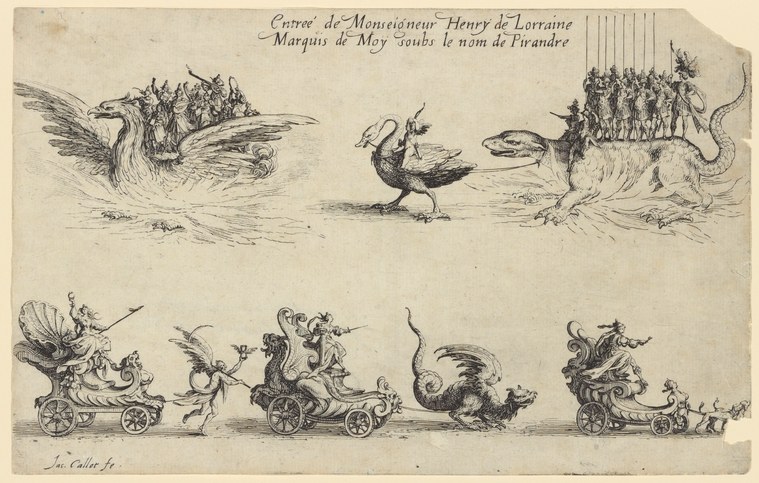
Entrée de Monseigneur Henry de Lorraine, Marquis de Moy soubs le nom de Pirandre.
Unknown artist
- Collection:
- Prints depicting dance
- Source:
- New York Public Library
- Rights:
- Public domain — free to use, share and adapt.
- Recorded as:
- Public Domain
This work documents a crucial but often overlooked form of movement spectacle in Renaissance and Baroque court culture: the choreography of human bodies not in social dance or ballet, but in ceremonial procession and allegorical theatre. It reveals how 'dance' in the broadest sense—patterned, rhythmic, performative movement—encompassed vehicular spectacle, costume display, and the orchestrated assembly of courtiers in mythological guise, not merely footwork on a ballroom floor.
What you are looking at
A satirical engraving depicting an elaborate processional entry, likely from a court masque or theatrical spectacle. The composition is divided into two registers: the upper shows three fantastical creatures—a winged dragon or griffin bearing a crowd of tiny figures on its back, a bird-legged creature in the center, and a serpent or dragon-tailed beast on the right, also laden with figures. The lower register displays five wheeled vehicles or floats, each drawn by or carrying hybrid creatures and clusters of human figures in period dress. The entire scene is rendered in fine etching or engraving technique with detailed cross-hatching. The title inscription indicates this depicts the entry of Henry of Lorraine, Marquis de Moy, under the assumed name Pirandre—suggesting a courtly disguise or theatrical alias typical of Renaissance entertainment spectacles.
The dancing
The human figures throughout are rendered in miniature scale relative to the creatures they ride or accompany. They are clustered in groups on the creatures' backs and in the wheeled vehicles, suggesting the choreographed assembly of a court procession. The figures appear in formal period dress; some gesture outward or assume postures of display. The creatures themselves are animated, with exaggerated poses suggesting movement and spectacle rather than naturalism. No evidence of partnered dance holds or formal ballroom frames; instead, the composition emphasizes ceremonial positioning and the dramatic bearing of elaborately costumed participants.
The dance depicted
This is not a depiction of social or theatrical dance in the conventional sense, but rather a record of a court masque entry or ballet-like spectacle where the 'dancing' is vehicular and processional rather than footwork-based. The entry genre was central to Renaissance and early Baroque court entertainment, particularly in France and at the court of Lorraine. Such entries combined music, allegorical staging, elaborate costumes, and choreographed movement into a unified performance. The creatures and floats served as mobile stages from which courtiers displayed themselves in costume, enacting fantastical or mythological roles. The rhythm and order of the procession constituted the kinetic structure of the entertainment.
How it was made
This is an engraving, executed in fine lines with careful cross-hatching to create tonal variation and depth. The technique suggests a printed work of circulation—likely a broadsheet or plate produced for distribution at court or to document the spectacle for a wider audience. Engravings of this type served an important function in court culture: they made the ephemeral spectacle of a single performance permanent and reproducible, allowing the event to be disseminated, described, and remembered through its visual record. The delicate detail and compositional complexity indicate skilled craftsmanship.
About this work
This engraving documents a court masque entry from the Renaissance or early Baroque period, depicting Henry of Lorraine's ceremonial entrance under the name Pirandre. Rather than depicting social or theatrical dance with conventional footwork, it records a form of courtly spectacle in which elaborately costumed figures, mounted on fantastical creatures and wheeled vehicles, constituted the 'performance' through their processional movement and display. The work belongs to a tradition of court entertainment design and documentation common in French and Lorraine aristocratic circles, where such entries served as occasions for political pageantry, allegorical instruction, and the exhibition of courtly taste and imagination. The engraving itself is an artifact of the culture it depicts—a means of preserving and circulating the memory of an ephemeral event.
How to look at it
Attend to the hierarchical composition: the creatures dominate by scale, yet serve primarily as platforms for human display. Notice the careful ordering of the wheeled vehicles in the lower register—they represent a processional sequence, and the arrangement embodies the choreographic principle of the entry spectacle: the gradual revelation and succession of elaborately costumed performers. The fantastical nature of the creatures—impossible hybrids of animal and vehicle—underscores that this is theatrical artifice, not documentary naturalism. The dense clustering of small human figures invites the eye to trace patterns and hierarchies within the procession, reading the spectacle as an ordered, composed movement through space rather than as individual dancers.
The artist
The artist is not recorded in the catalogue, but the style and execution are consistent with Lorraine court printmaking of the 16th or early 17th century. The inscription and subject matter suggest the work was produced either at or by commission from the court of Lorraine, a major center of Renaissance artistic patronage and theatrical innovation. Lorraine was particularly known for its elaborate court spectacles, masques, and ballet entries, and for the production of high-quality engravings documenting these events.
The period
This engraving dates to an era—likely the late 16th or early 17th century—when court masques and ballet entries were at the height of their development in France and Lorraine. These spectacles were the primary theatrical medium of the aristocracy before the rise of professional theatre. They combined elaborate costumes, scenic design, music, and choreographed movement into unified productions that could last hours and involve dozens of performers. The form allowed courtiers to enact allegorical and mythological roles, embedding political messages and flattery in fantastical entertainment. Engravings like this served both as souvenirs of specific events and as models for future productions, circulating designs, ideas, and innovations across court networks.
Where it lives
The work is held in the NYPL's collection of prints depicting dance. It is catalogued with minimal identifying information beyond the inscription on the plate itself, which provides the only clear attribution of subject matter. The object is a single engraved print, likely part of a series or a standalone broadsheet produced to document or commemorate a specific court event.
Dance in this work
Questions about this work
Is this really a dance?
Yes, in the Renaissance and Baroque sense of the word. The spectacle combines choreographed movement, music, and the carefully ordered processional display of costumed performers—all elements central to court entertainment. The 'dance' here is not footwork-based social or theatrical dance, but rather the kinetic and spatial orchestration of an elaborate ceremonial procession.
Why are the figures so small and the creatures so large?
Scale serves a compositional and allegorical function. The creatures are fantastical vehicles or platforms that embody the mythological or allegorical themes of the spectacle. The courtiers mounted on them are displayed as actors within an invented world, not as primary subjects. This scaling emphasizes the theatrical fiction over individual performers.
Who was Henry of Lorraine, Marquis de Moy?
The catalogue identifies him as performing under the assumed name Pirandre, suggesting this entry was part of a disguise spectacle or themed entertainment. Without additional documentation, the specific historical event cannot be pinpointed, but the Lorraine court was renowned for such elaborate ceremonial performances throughout the Renaissance and early Baroque periods.
How do we know this was a real event?
The engraving itself is the primary evidence. Court spectacles of this kind were documented in prints precisely to prove they happened, to circulate their designs, and to preserve their memory. The detailed, professional execution suggests this was a commissioned work produced for a court audience—testimony to the significance of the event it records.
More dance artwork





