49 works in this view — arrow keys or swipe to move between them.
Dance in Art
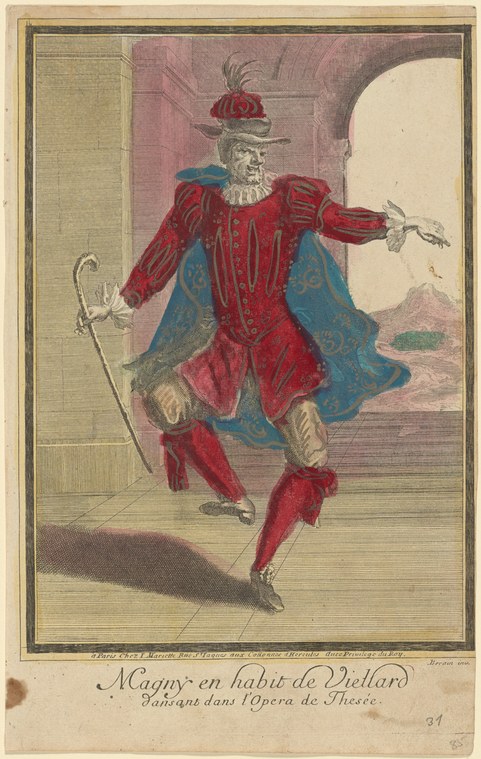
Magny en habit de viellard dansant dans l'opéra de Thésée: Berain inv.
Unknown artist
- Collection:
- Prints depicting dance
- Source:
- New York Public Library
- Rights:
- Public domain — free to use, share and adapt.
- Recorded as:
- Public Domain
This print names a specific performer in a specific role and preserves the physical vocabulary of baroque theatrical dance at a moment when dance was being professionalized and systematized. The high leg lift and turned-out positions show that the technique we associate with ballet was already developing within character and comic forms, not only in the formal courtly dances. For historians of theater and dance, this is direct evidence of how French baroque opera used the body to convey character type.
What you are looking at
A single male dancer dominates the composition, positioned in dynamic motion across a shallow stage. He wears an elaborate red doublet with puffed sleeves and ornate gold embroidery, paired with a striking teal-blue cloak that swings behind him, red hose, and a feathered hat. His left leg extends in a high, controlled lift while his right supports his weight, his torso twisted in an elegant contrapposto. His right arm gestures expressively outward with fingers splayed, while his left hand grips a walking staff or cane. The setting is a classical interior with pale columns at left and a vast arched opening revealing a distant landscape at right, rendered in muted greens and browns. The floor is a receding checkerboard pattern that anchors the figure's movement in space. The figure's expression is animated, suggesting comic or character pantomime.
The dancing
The dancer stands on his right leg in a weight-bearing position while the left leg lifts high in front of his body—a movement that combines ballet's controlled line with the exaggerated physicality of commedia dell'arte. His torso is arched backward slightly, creating an open, expansive frame. The extended right arm with spread fingers reads as emphatic gesture rather than balletic port de bras, while the cane in his left hand serves both as a prop and a balance point. His weight is clearly distributed to enable the high leg lift, suggesting trained control; the lifted leg is turned out and held at approximately hip or chest height.
The dance depicted
This depicts Magny, an old man character (vieillard) performing in Lully's opera *Thésée* (1675). The image captures a character dance or pantomime moment rather than social or formal ballet. The costume—especially the exaggerated feathered hat and the walking cane—signals the stock old-man type of French baroque opera, where character dances provided comic relief. The high leg lift contradicts the 'old man' persona and suggests the physical virtuosity of the dancer, a common feature of baroque spectacle where even character roles displayed technical skill. The walking staff becomes an extension of the body in the dance, used for balance and expression.
How it was made
This is a hand-colored engraving, as indicated by the fine parallel hatching visible in the background architecture and the precise line work defining the figure. The technique allowed for multiple impressions to be colored by hand, making it affordable to circulate among opera-goers and collectors. The inscription at the bottom, identifying the role and opera, suggests this was a commercial print sold as a souvenir or document of a notable performance or performer. The coloring is applied with restraint—bright reds and blues dominate while backgrounds remain pale—a practice that made hand-coloring economically feasible while keeping focal attention on the costumed figure.
About this work
This is a late seventeenth-century souvenir print of a character dancer in French baroque opera, specifically the role of Magny (an old man) from Lully's *Thésée*. The engraving captures a moment of virtuosic pantomime and character dancing in the elaborate courtly spectacle of Louis XIV's opera system. It documents both the costume and the physical vocabulary of baroque theater dance, showing how character roles combined comic exaggeration with trained bodily control. The print's circulation as an affordable hand-colored engraving tells us that named performers and specific roles attracted enough popular interest to be documented and distributed—evidence of how opera dancers were beginning to achieve celebrity status in the seventeenth century.
How to look at it
Observe the moment the artist chose to freeze: not a stable pose but an active phrase, with the lifted leg at its highest extension. This captures the explosive virtuosity of the character dancer rather than a quiet, posed moment. Notice how the cane, costume, and feathered hat all contribute to the 'old man' type, yet the body is clearly capable of technical accomplishment—this double register (comic character + physical skill) was essential to baroque theater. The open setting and receding checkerboard floor suggest the scale and formality of the opera house stage, a space of courtly spectacle rather than popular entertainment.
The artist
The print is attributed to Jean Berain (inv., 'invented'), the most famous designer of French baroque opera and ballet spectacle. Berain (1638–1711) served as designer for the Académie Royale de Musique under Louis XIV and designed costumes, machines, and sets for nearly all major productions of the period. He was renowned for his ability to render elaborate costume in precise, legible form. If Berain designed the costume shown here, the engraving documents his work; however, the catalogue record does not confirm the engraver's identity.
The period
Jean-Baptiste Lully's *Thésée* (1675) premiered during the height of the French baroque opera tradition, when Louis XIV's court was the center of European dance innovation. Character dances and comic interludes were essential to the five-act *tragédie en musique* structure, providing contrast to the formal nobility of the main action. Dancers were increasingly professional, trained in the codified technique being systematized by Pierre Beauchamp and documented in Raoul Feuillet's *Chorégraphie* (1700). The engraving dates to this period of professionalization and suggests that opera dancers—even those in comic or character roles—were becoming celebrities whose performances merited commercial documentation.
Where it lives
The print is housed in the New York Public Library's collection of prints depicting dance. Its inscription identifies it as documenting a role in a specific opera, suggesting it circulated as a commercial souvenir or art print in the decades following the opera's premiere.
Dance in this work
Questions about this work
Who was Magny?
Magny was a character role (an old man, or vieillard) in Lully's opera *Thésée*. We do not know the name of the specific dancer depicted here, only that he danced this role. In baroque opera, character roles provided comic and dramatic relief; dancers in these roles were skilled professionals despite—or because of—the exaggerated physicality required.
What does the cane mean?
The cane serves both as a costume property (marking the old-man type) and as a functional balance point for the dancer's body, especially during the high leg lift. In baroque theater, props became extensions of the dance vocabulary rather than purely narrative objects.
Is this ballet?
Not in the later sense of the term. It is theatrical dance within French baroque opera, specifically a character dance or pantomime scene. The technique visible in the turned-out legs and high lift shows that the physical principles we associate with ballet were developing within opera spectacle, but 'ballet' as a distinct art form did not yet exist.
Why hand-color an engraving?
Hand coloring made engravings affordable to produce in quantity while adding visual appeal and information—the bright red and blue costumes tell us more about the spectacle than line work alone could. It also allowed prints to be customized or corrected by hand, making them more valuable to collectors and opera enthusiasts.
More dance artwork





