49 works in this view — arrow keys or swipe to move between them.
Dance in Art
Transformation polka from The black crook
Unknown artist
- Collection:
- Prints depicting dance
- Source:
- New York Public Library
- Rights:
- Public domain — free to use, share and adapt.
- Recorded as:
- Public Domain
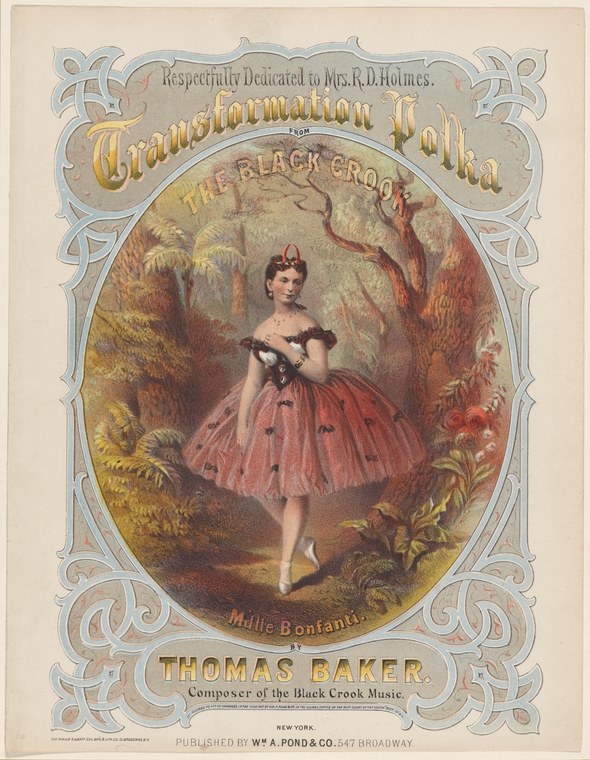
The image is evidence of the integration of professional ballet into American commercial theatre and of the celebrity status enjoyed by European-trained ballerinas like Bontanti in the 1860s. It shows how the vocabulary of Romantic ballet was adapted and marketed to the American public through popular theatrical spectacle. The lithograph format testifies to the role of the music-publishing industry in promoting theatrical entertainment and documenting its stars.
What you are looking at
This is the cover of a theatrical score for *The Black Crook*, showing a young female dancer posed in an ornamental interior landscape. She wears a pale pink or salmon tutu—short, voluminous, and gathered at the waist—with a dark corseted bodice and off-shoulder neckline, her blonde hair topped with a small crown or tiara. Her pose is classical and upright, with one arm raised and the other positioned at her side or holding the skirt; her weight appears to rest on one leg in a pose suggesting preparedness to move. The setting is a romantic woodland or garden, rendered in warm earth tones and muted golds, with ferns and hanging willow branches framing the figure. The whole scene is enclosed in an ornate rococo border of pale blue and silver, with elaborate scrollwork at the corners. At the base, a cartouche names the dancer as "Millie Bontanti" and credits Thomas Baker as composer. The publishing information—"W.A. Pond & Co., 547 Broadway"—places this in New York.
The dancing
A single dancer, viewed from the front in a three-quarter stance. Her posture is upright and formal, with the carriage expected of a trained classical dancer. The raised arm and composed placement of the body suggest a moment of presentation rather than vigorous movement—a pose for the lithographic plate as much as for the stage. The tutu is short and full, characteristic of the mid-to-late 19th century; the pale tone and the body's alignment suggest facility with the vocabulary of ballet.
The dance depicted
*The Black Crook*, which premiered at Niblo's Garden in New York in 1866, was a spectacular musical-theatrical production that mixed melodrama, pantomime, ballet, and acrobatics. This cover depicts one of its transformation scenes—moments of magical staging where scenery and costume changed to create supernatural or fantastical effects. Millie Bontanti was an Italian ballet dancer prominent in the American theatre of the 1860s; she is recorded in the cast of *The Black Crook*. The term "transformation polka" suggests a piece of stage music accompanying a rapid change or revelation, framed within the polka rhythm that was fashionable in theatre orchestration of the period. The image does not depict a specific polka step; rather, it shows the dancer in repose, presenting herself as the visual object of the transformation scene.
How it was made
This is a color lithograph, as evidenced by the soft gradations of tone, the flat colour fields, and the decorative rococo border rendered in delicate blues and silvers against the cream stock. The technique allowed for relatively inexpensive mass production and wide circulation of theatrical publicity and scores. The image was likely drawn on stone and printed with hand-tinted colour passes; the quality of detail and finish suggests an accomplished lithographic workshop, such as those that flourished in New York in the 1860s. Such scores were sold to the theatregoing public and to amateur musicians; the cover image served both as advertisement and as a souvenir of a celebrated performance.
About this work
This is a lithographed cover to a piece of stage music from *The Black Crook*, the sensational 1866 American musical spectacular that introduced large-scale ballet and scenic transformation to Broadway audiences. It shows Millie Bontanti, an Italian dancer, posed in classical ballet costume within a romantic woodland set. The image is both a portrait of a celebrated performer and a document of American theatrical practice: the tutu, the pose, and the title all testify to the growing prominence of ballet (and of ballet dancers) in commercial musical theatre. The work sits at the intersection of fine printmaking, theatrical marketing, and the new mass entertainment of the American stage in the post-Civil War era.
How to look at it
Observe the precision of the classical pose: the upright carriage, the placement of the arms, the apparent readiness of the dancer's body. This is not a moment of vigorous action but of presentation and repose—the dancer as object of display. The romantic landscape and soft lighting serve to elevate the figure and to align her with the taste for Romantic imagery in mid-19th-century theatrical design. The tutu is the visual marker of ballet; note its shortness and fullness, characteristic of the period. The decorative border frames the figure as a jewel or a cherished image, appropriate to a theatrical souvenir intended for a broad audience.
The artist
The artist is not recorded, but the lithograph was published by W. A. Pond & Co., a major New York music publisher of the mid-19th century. Pond & Co. issued theatrical scores, popular songs, and instrumental music, often with elaborate and hand-colored covers featuring actors and dancers. The visual quality and decorative sophistication suggest a house lithographer or an established workshop collaborating with the publisher.
The period
*The Black Crook* (1866) was a watershed moment in American entertainment history. It combined the spectacle and technical resources of the theatre with European ballet training and technique, brought to the American stage by dancers like Bontanti and others. The 1860s saw the rise of theatrical "leg shows" and extravagant musical productions that used dance and scenic transformation as primary attractions. Ballet, previously the province of opera houses and elite venues, became accessible to popular theatre audiences. The polka, prominent in both ballroom and theatrical contexts of the 1850s–1870s, was a musical idiom suited to rapid, lively action and scenic surprise.
Where it lives
This lithographed score cover is held by the New York Public Library as part of its collection of prints depicting dance. It represents the genre of theatrical music publication, where visual publicity and musicological content were unified in a single object for sale to both theatregoers and amateur musicians.
Dance in this work
Questions about this work
What was *The Black Crook*?
*The Black Crook* was a spectacular musical melodrama that premiered at Niblo's Garden, New York, in 1866. It mixed spoken drama, pantomime, acrobatics, and large-scale ballet sequences with elaborate scenic effects. It ran for over a year and was widely imitated, establishing the formula for the American musical spectacular.
Who was Millie Bontanti?
Millie Bontanti was an Italian-trained classical dancer who performed in the original production of *The Black Crook* and was celebrated as one of the first European ballet stars to gain wide fame in American commercial theatre. She was among the dancers who brought Romantic and classical ballet technique to American popular audiences.
What is a 'transformation' scene?
A transformation scene is a moment in theatrical spectacle where the stage setting, lighting, or costume of a character changes rapidly and magically before the audience, often through elaborate machinery and scenic design. In *The Black Crook*, these scenes were occasions for ballet and dance.
How were theatrical scores sold and used?
Theatrical scores were published and sold as sheet music for piano, allowing amateur musicians and theatregoers to recreate and enjoy music from successful productions at home. The illustrated covers, like this one, served as advertisement for the theatre, souvenir of attendance, and visual appeal to potential buyers.
More dance artwork





