30 works in this view — arrow keys or swipe to move between them.
Dance in Art
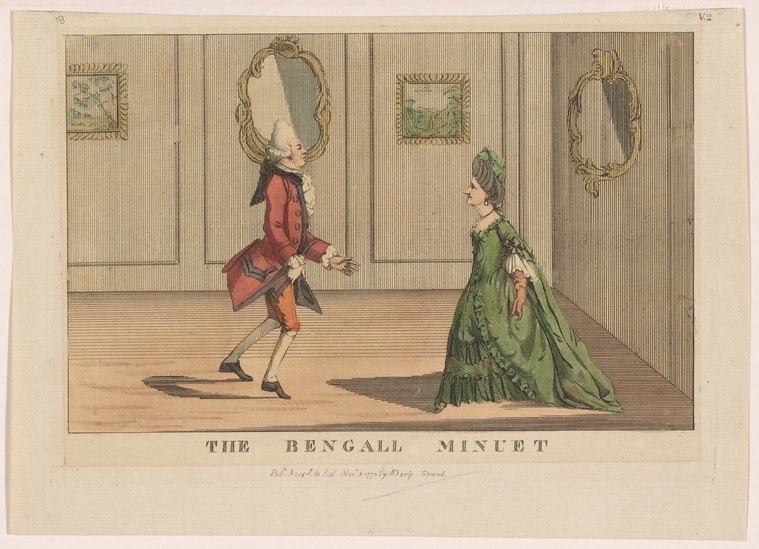
The Bengall minuet
Unknown artist
- Medium:
- Engraving
- Dance:
- Minuet
- Era:
- 1700s (Enlightenment/Minuet Era)
- Source:
- New York Public Library
- Rights:
- Public domain — free to use, share and adapt.
- Recorded as:
- public_domain
This image documents not minuet form itself but the 18th-century discourse around it: the anxiety about correct style, the anxiety about foreign and exotic influence, and the role of satire in dance criticism. For historians of social dance and performance, it is evidence that even the most prestigious courtly forms were contested, parodied, and subject to competing claims about authenticity and propriety.
What you are looking at
A man and woman stand in an elegant interior space with pale walls, vertical paneling, and three framed oval mirrors or artworks hung symmetrically. The man, dressed in a scarlet coat with dark breeches and white stockings, leans forward in an exaggerated pose with one leg extended behind him and arms gesturing expressively. The woman, wearing a green gown with a long train and an ornate headdress, sits or kneels on the floor in a composed, graceful posture, observing the man's display. The floor is rendered in warm tan, and the vertical striations of the paneling create a sense of refined domestic space. The composition captures a moment of courtly interaction—possibly a dance demonstration, flirtation, or instruction—frozen in a single frame.
The dancing
The man's posture is extravagant and off-balance, with his torso pitched forward, legs in a wide lunge, and arms splayed in animated gesture—a silhouette suggesting vigorous movement or theatrical exaggeration rather than the controlled frame of a formal dance. The woman's posture is upright, knees bent, weight stable, her gaze directed toward the man. Their spatial relationship suggests performance and observation rather than partnership: he is the actor, she the audience. The contrast between his dynamic instability and her stillness is central to the image.
The dance depicted
The title names this 'The Bengall minuet,' but the image presents a paradox. The minuet of the 1700s was a stately, processional dance of controlled courtly elegance, danced by couples in closed or formal holds. Here, the man's exaggerated lunge and unbalanced posture contradict everything minuet convention required. This may be satire, caricature, or a representation of a 'new' or eccentric performance style marketed as exotic or foreign ("Bengall" suggests an imagined reference to Bengal or colonial India). The woman's composed stillness suggests she represents proper courtly restraint in contrast to the man's ridiculous affectation.
How it was made
This is a hand-colored engraving, a print medium that allowed multiple copies to circulate widely in the 18th century. The fine parallel lines (hatching) visible in the walls and shadows, the crisp black outlines defining form, and the restrained color palette of reds, greens, and pale flesh tones are characteristic of period engraving technique. The precision of the line work and architectural detail suggests this was a polished, publishable print intended for an educated audience—not a sketch or private work.
About this work
This engraving offers a visual joke about dance fashion and courtly propriety in the 1700s. Whether sincerely titled or ironically so, it presents the minuet—the century's most prestigious social dance—in a state of comic collapse. The man's exaggerated, uncontrolled posture and the woman's unmoved observation suggest the image functions as satire: perhaps mocking the affectation of 'exotic' dance styles, or the pretension of poor dancers claiming mastery of the minuet. The print circulated in an era when minuet instruction was ubiquitous and minuet form was subject to constant innovation and debate. What reads as farce now may have been topical commentary on specific fashions or personalities of the 1700s.
How to look at it
Attend to the man's center of gravity and the stability of his stance. A trained minuet dancer would immediately recognize this as wrong: the minuet required vertical alignment, controlled turnout, and gliding rather than lunging steps. The artist has frozen him mid-gesture, or caught him in an unstable moment—whether intentionally clownish or genuinely incompetent is left to the viewer to interpret. The woman's composed, almost dismissive posture sharpens the satire: she is not impressed, and she is not dancing with him. Note also the refinement of the setting and dress—this is not a mockery of poor people, but of pretension within elite circles.
The period
The minuet dominated European court and social dance from the 17th through the 18th century, reaching peak prestige and codification by the 1700s. It was the foundation of all ballroom instruction, slow and processional, performed by couples in elaborate dress in formal settings. Yet by the 18th century, it was also the subject of intense critical debate: Enlightenment writers, dance masters, and satirists disputed questions of tempo, technique, regional variation, and the creep of new styles into the form. Colonial contact and the cultural fantasy of the 'exotic East' fed European appetite for novel movement vocabularies and the naming of dances as 'foreign'—whether authentically so or not. Satire directed at dance was common in prints, serving as social commentary on courtly excess and the pretense of refinement.
Where it lives
The work is held in the New York Public Library collection. The record provides no artist attribution, date beyond the broad '1700s' era label, or other provenance information. It is catalogued as an engraving, consistent with the visual evidence of hand-coloring over engraved line work.
Dance in this work
Questions about this work
Is this really a minuet?
The title claims it is, but the visual evidence suggests satire or critique. The man's exaggerated, unstable posture violates every principle of minuet form—which required controlled, vertical movement. The woman's unmoved observation reinforces the idea that his dancing is absurd or improper. The title may be sincere (documenting an eccentric style), ironic (mocking the pretension of calling bad dancing a minuet), or topical (referring to a specific person or fad now lost to history).
What does 'Bengall' mean?
The spelling and the reference remain unclear. 'Bengall' does not correspond to any standard minuet variant in the historical record. It may be a fantasy reference to colonial India or the East Indies, part of 18th-century Europe's appetite for 'exotic' dances and styles. It could also be the name of a specific performer or impresario, or a joke in the original audience's language.
Why was the minuet satirized?
By the 1700s, the minuet was the most prestigious ballroom dance but also the most contested. Dance masters debated its 'correct' form, tempo, and proper execution. Enlightenment satirists used dance to comment on courtly excess, affectation, and the pretense of refinement. A print mocking a ridiculous minuet could critique a particular fashionable style, a celebrity dancer, or the general human tendency to mistake gesture for grace.
More Minuet artwork