49 works in this view — arrow keys or swipe to move between them.
Dance in Art
Les heures de la nuit
Unknown artist
- Collection:
- Prints depicting dance
- Source:
- New York Public Library
- Rights:
- Public domain — free to use, share and adapt.
- Recorded as:
- Public Domain
The print records a specific mode of representing the body in motion or dramatic presentation that was integral to Renaissance court culture: the allegorical figure posed for maximum visual and symbolic effect. For dance historians, it shows how the language of gesture, costume, and bodily presentation was used to communicate abstract meaning in an era when theatrical spectacle and dance were closely intertwined. The technical precision of the engraving also demonstrates how prints were used to disseminate and preserve records of ephemeral court spectacles.
What you are looking at
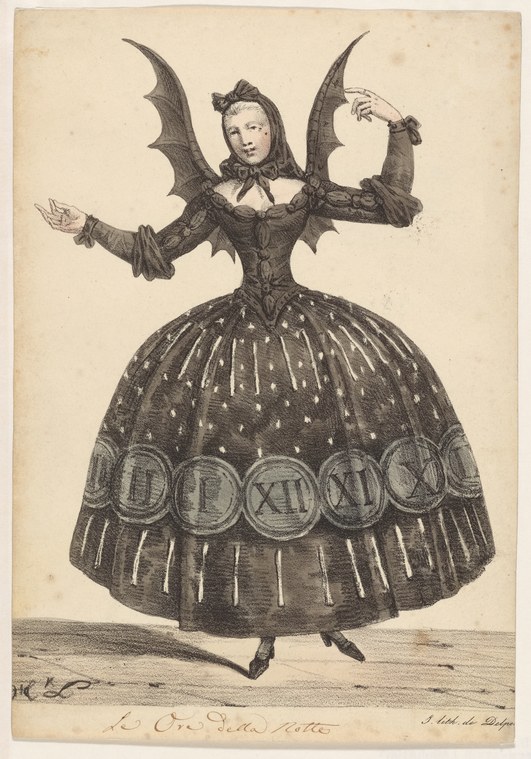
A single female figure dominates the composition, dressed in an elaborate dark costume with a full skirt decorated with radiating linear patterns and dotted embellishment. The skirt is gathered at the waist with a broad decorative band inscribed with Roman numerals (XII, XI, X, IX, VIII, VII, VI, V, IV, III, II, I) arranged in a circle—the hours of the night. The figure has a pale human face with a neutral expression, framed by an ornate bonnet or headdress with a bow at the chin. Most strikingly, she has two large bat wings extending from her shoulders, rendered with anatomically detailed membranes and articulated fingers. Her arms are raised and extended outward in a dramatic gesture, the left hand open and expressive, the right hand holding what appears to be a small object (possibly a star or jewel). She stands barefoot on a bare ground line against an unmarked background. The overall effect is theatrical and allegorical—a personification of Night rendered as a hybrid creature between woman and nocturnal bat-creature.
The dancing
The figure stands in an upright, frontal pose with weight evenly distributed. Both arms are raised to approximately shoulder height or slightly higher, extended outward in an expansive gesture that emphasizes breadth and drama. The torso is held upright, the head slightly tilted upward, creating a sense of weightlessness or apotheosis. The stance suggests neither a balletic fifth position nor any recognisable ballroom frame, but rather a theatrical or allegorical presentation pose—the body arranged for visual impact and symbolic legibility rather than technical dance vocabulary.
The dance depicted
This is not a depiction of social or theatrical dance but an allegorical figure—a personification of Night in the form of a supernatural or mythological creature. The raised arms and frontal presentation recall the gesture language of late Renaissance and early modern court spectacle and pageantry, where allegorical figures were presented in tableau vivant or processional form. The bat wings, the clock-face skirt, and the nocturnal associations suggest this may relate to nocturnal court entertainments, masquerades, or allegorical ballet-like spectacles popular in Renaissance and early modern European courts. The inscription 'Les heures de la nuit' confirms the allegorical intent: the hours of night are literally inscribed on the costume.
How it was made
This is an engraving or etching on paper, recognisable from the fine parallel line work (hatching) used to build tone and shadow, the sharp black lines defining form, and the pale ground typical of intaglio printmaking. The technique allows for precise linear detail—visible in the articulation of the bat wings and the careful rendering of the costume's geometric patterning. This was a reproductive and distributable medium, suggesting the image was intended for a relatively wide audience: such prints circulated among courtiers, artists, and patrons as record, instruction, or entertainment. The style and technique are consistent with 16th or early 17th-century practice.
About this work
This is an engraved or etched print depicting an allegorical female figure personifying Night, identified by the inscription 'Les heures de la nuit' (The Hours of the Night) and by the cosmic attributes adorning her costume: bat wings, a skirt inscribed with the numerals of a 12-hour clock face, and a raised, expansive pose. The work belongs to the tradition of Renaissance and early modern allegorical spectacle—court entertainments in which personified abstractions and mythological figures were presented in elaborate costume as pageant, masque, or tableau vivant. The figure's pose, costume, and symbolic language reflect the language of court dance and theatrical presentation rather than social or recreational dance, but her theatrical presentation and the performance context of court spectacle place her within the visual culture of dance and movement in the Renaissance court. The work documents how abstract concepts and nocturnal themes were given physical form and costume for courtly audiences.
How to look at it
Observe the geometric precision and symbolic density of the costume: every element—the bat wings, the numerals, the radiating skirt panels, the pale face—is arranged to communicate the figure's identity as an embodiment of Night and time. Note the gesture: the raised, extended arms and the lifted gaze create a sense of theatrical presentation rather than dance movement. The figure is arranged for legibility and symbolic impact, not for motion. This is the aesthetic of court spectacle, where the body is a vehicle for elaborate signification rather than virtuosity or athletic display.
The artist
The artist is not recorded in the catalogue. The style, technique, and costume detail are consistent with 16th or early 17th-century Northern European or Italian printmaking, when allegorical engravings and etchings were a major vehicle for the dissemination of court spectacle and emblematic imagery. The precision of line and the sophisticated rendering of complex costume suggest a trained and accomplished engraver, likely working within or for a court circle.
The period
In the 16th and 17th centuries, the Renaissance and early modern courts of Europe hosted elaborate spectacles—masques, ballets, pageants, and court dances—in which allegorical and mythological figures played central roles. These entertainments combined music, dance, costume, and scenic display to create elaborate allegorical narratives. Engravings and etchings were crucial tools for recording, circulating, and preserving these ephemeral events. Night, as a personification, was a stock figure in Renaissance allegory and astronomy; nocturnal themes and nocturnal creatures (bats, owls, stars) were favourite motifs in masque and spectacle. The clock-face motif suggests Renaissance fascination with mechanical time and cosmological order, which were frequently encoded in court spectacle through costume and scenic display.
Where it lives
The work is held in the New York Public Library's collection of prints depicting dance. It is catalogued under the era label 'unknown' and dance style label 'dance,' indicating institutional uncertainty about its precise dating and context. Such prints were typically collected and preserved by institutions because of their documentation of court spectacle and theatrical costume.
Dance in this work
Questions about this work
Is this a dance?
Not in the modern sense. This is an allegorical figure posed for theatrical presentation, likely from a Renaissance or early modern court spectacle or masque. The raised arms and frontal stance reflect the gesture language of court entertainments rather than the specific steps or holds of a social or ballroom dance. However, court spectacle in this period was an integrated art form combining dance, music, and dramatic presentation, so the figure would have been embodied and moved by a performer as part of a larger entertainment.
Who is depicted here?
The figure is a personification of Night, identified by the inscription 'Les heures de la nuit' (The Hours of the Night). The bat wings, the clock-face skirt inscribed with the numerals I–XII, and the pale, otherworldly appearance all signify Night as a supernatural or mythological being. In Renaissance allegory and court spectacle, abstract concepts and celestial bodies were frequently embodied as costumed figures.
What is the purpose of the numerals on the skirt?
The numerals I through XII arranged in a circle form a clock face, literally inscribing the hours of the night onto the figure's body. This reflects the Renaissance fascination with mechanical time and cosmological order, and demonstrates how allegorical costume was designed to communicate meaning visually and conceptually. The wearer would have been understood as a living embodiment of temporal measurement.
Where would this figure have appeared?
Most likely in a Renaissance or early modern court spectacle, masque, or ceremonial pageant. Such entertainments were performed for aristocratic audiences and combined music, dance, elaborate costume, and scenic display. The figure would have been danced or presented by a trained performer—often a professional dancer or court musician—as part of a larger narrative or allegorical scheme.
More dance artwork





