49 works in this view — arrow keys or swipe to move between them.
Dance in Art
Le carnaval du Parnasse
Unknown artist
- Collection:
- Prints depicting dance
- Source:
- New York Public Library
- Rights:
- Public domain — free to use, share and adapt.
- Recorded as:
- Public Domain
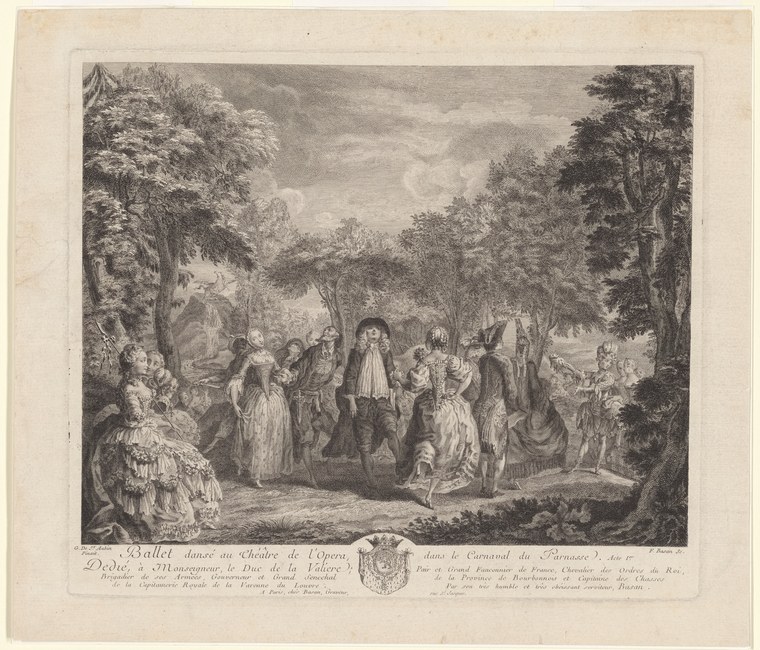
This engraving provides rare visual evidence of how 18th-century court ballet looked, how dancers held themselves, and how the aristocracy experienced dance as both intimate social practice and formal spectacle. The work also documents the role of printmaking in making ephemeral performance events—which were seen by only a handful of courtiers—into images that could circulate and be remembered.
What you are looking at
A grand outdoor fête in a wooded setting, with tall trees framing a clearing where a large assembly of elegantly dressed figures gathers. The composition centers on a group of dancers and musicians arranged in the middle distance, with spectators distributed throughout the scene. The figures wear the formal dress of the 18th century: the men in coats and breeches, the women in full-skirted gowns with fitted bodies. A musician plays a stringed instrument at the left; at the center, several couples appear to be dancing or preparing to dance. The lighting is diffuse and atmospheric, suggesting either morning or late afternoon, with clouds breaking through the canopy above. The engraver has used fine cross-hatching to suggest depth and shadow, creating a sense of movement and animation across the entire gathering. The title inscription at the base indicates this depicts a ballet performed at a theater during a carnival, though the setting shown is an outdoor pastoral idyll rather than a stage.
The dancing
The dancers occupy an open stance typical of 18th-century courtly dance, with upright posture and extended limbs. Several couples appear to be in or moving toward a closed hold, though the engraving's scale and detail make precise footwork difficult to read. The figures are arranged in loose groups rather than strict geometric lines, suggesting a social gathering rather than a formal procession. Spectators—both seated and standing—frame the dancers, indicating an audience watching a performance or entertainment.
The dance depicted
This appears to depict a ballet or theatrical dance suite performed as part of a carnival or festive celebration, likely from the mid-to-late 18th century. The outdoor pastoral setting and the mingling of dancers with spectators suggest a court ballet or ballet d'action presented as entertainment at a princely gathering. The formal dress, the presence of musicians, and the orderly arrangement of the assembly indicate court dance of the baroque or early rococo period. The inscription's reference to both theater ('Théâtre de l'Opéra') and carnival suggests this may represent a specific historical performance, though the engraving presents an idealized, theatrical vision of the event rather than a documentary record.
How it was made
This is an engraving, likely made in the 18th century, as evidenced by the fine line work, systematic cross-hatching for tone, and the copperplate technique. The coat of arms and formal inscription at the base indicate this was a commissioned work, probably intended for a patron of rank. The engraving's technical sophistication—the handling of perspective, the subtle gradations of light, and the intricate detailing of costume—suggests a skilled practitioner working for a wealthy or institutional patron. Such engravings were the primary means of circulating images of court spectacles and theatrical performances before the advent of lithography.
About this work
This engraving records or commemorates a ballet performance held during a carnival at the Opéra in Paris, presented as an outdoor pastoral fantasy rather than a stage scene. It is both a document of 18th-century court dance and a work of imaginative composition, translating a theatrical event into an idealized landscape. The work belongs in a dance collection as evidence of how dance was understood, performed, and circulated among the aristocratic and courtly classes in the ancien régime. It shows the conventions of court ballet at a moment when the form was becoming more theatricalized and when printmaking was the primary means of making dance visible to those who had not witnessed it.
How to look at it
Attend to the poses and spacing of the central figures: notice how the dancers maintain an open, upright carriage even in movement, and how the composition balances the dancers themselves with the watching crowd around them. The engraver has frozen the moment of performance but left enough animation in the arrangement and gesture to suggest ongoing action. Compare the formality of dress and posture to the relative informality of the outdoor setting—this contradiction is deliberate and reveals how court dance functioned as a civilizing display of grace and order imposed on nature.
The period
In the mid-to-late 18th century, court ballet was undergoing significant change. The rigid geometric dances of the baroque were giving way to more naturalistic and expressive movement influenced by the emerging ideology of sensibility and the rococo aesthetic. Ballet was becoming increasingly theatrical, moving toward the narrative spectacles of the 19th century. At the same time, carnival celebrations remained central to aristocratic entertainment, particularly in France and Italy. Engravings such as this one served to disseminate images of these spectacles beyond the court, allowing them to circulate in prints and illustrated books that documented the manners and pleasures of the nobility.
Where it lives
This engraving is held in the New York Public Library's collection of prints depicting dance. It is part of the library's visual documentation of dance history and is catalogued as part of their broader holdings of 18th-century European prints.
Dance in this work
Questions about this work
What is a ballet carnival?
A ballet carnival was an elaborate entertainment combining music, dance, and spectacle, performed during carnival season (typically January–February) at European courts. These events were often allegorical or mythological in theme and functioned as demonstrations of courtly refinement and aristocratic power. Participants were typically nobles or professional dancers employed by the court, and the events could last several hours.
How do I know this is an engraving and not a painting or drawing?
The fine parallel lines and cross-hatching used to create tone and shadow are characteristic of copper-plate engraving. The precise, linear technique and the even distribution of light across the composition are consistent with intaglio printmaking rather than painting or drawing. The inscription and coat of arms, typical of formal printed documents, also indicate this is a print.
What can we learn about 18th-century dance from this image?
The engraving shows that dancers maintained an upright, dignified posture with extended limbs, and that dance was performed in relatively open formations rather than tight geometric patterns. The prominence of spectators indicates that dance was as much about being seen as about the movement itself. The formal dress and the pastoral setting reveal the cultural fantasy at work: the aristocracy wished to see itself as refined, natural, and graceful even as it maintained strict codes of behavior and dress.
More dance artwork





