31 works in this view — arrow keys or swipe to move between them.
Dance in Art
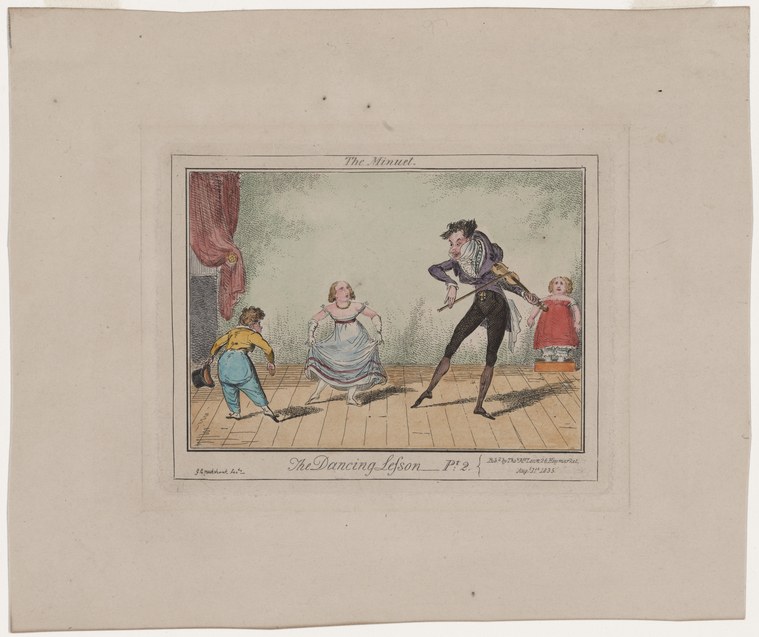
The dancing lesson, pt. 2, the minuet
Unknown artist
- Medium:
- Engraving
- Dance:
- Minuet
- Era:
- 1700s (Enlightenment/Minuet Era)
- Source:
- New York Public Library
- Rights:
- Public domain — free to use, share and adapt.
- Recorded as:
- public_domain
This is evidence of how dance was actually learned and taught in the period when the minuet was at its cultural apex. It shows the direct transmission of technique through the master's gesture and the pupils' mimicry, capturing a pedagogical moment that shaped the bodies of Europe's ruling classes. For a historian or dancer, it is a rare depiction of the infrastructure of dance training rather than its social or theatrical display.
What you are looking at
An engraved domestic scene depicting a dance lesson in progress within an elegantly appointed interior. A dancing master in dark coat and breeches demonstrates the minuet to three pupils: a small boy in yellow breeches on the left, a young woman in pale grey dress in the center, and a child in red on the right. A red damask curtain hangs at the upper left, framing an open wooden floor. The master holds a stick or baton, gesturing with one arm extended while the other grips his coat, adopting the refined posture the minuet demanded. His weight appears poised and controlled. The pupils' bodies are upright and attentive, their arms held at an educated distance from their bodies in the formal carriage of courtly dance. The fine parallel lines of the floorboards converge toward a back wall, establishing spatial depth and the formality of the setting.
The dancing
Four figures occupy the floor, arranged in a shallow diagonal line. The dancing master stands at right-center, his body turned three-quarter to the viewer with one arm extended in instructional gesture, the other held at his side with visible flourish—characteristic of the minuet's dignified arm work. His pupils stand with upright spines and arms held slightly forward of their bodies, feet positioned in the turned-out stance associated with French courtly training. Their gazes follow or anticipate the master's movements. The smallest child and the young woman maintain the careful, minimal arm movement the minuet required.
The dance depicted
This is unambiguously the minuet, one of the defining social and theatrical dances of the eighteenth century. The inscription 'The Dancing Lesson, pt. 2, the minuet' confirms it, as does every visual marker: the formal interior, the master-and-pupil arrangement typical of aristocratic dance instruction, the turned-out carriage, the refined restraint of the gesture. The image documents not performance but pedagogy—the minuet taught as a system of refined movement that shaped noble bearing. By the 1700s the minuet was the centerpiece of dance education for anyone of rank, and this scene shows exactly how it was transmitted: through individual or small-group correction by a professional maître de danse.
How it was made
Hand-colored engraving with fine parallel line-work defining form, shadow, and spatial recession. The technique allowed precise anatomical detail and reproducible imagery, making it ideal for circulation as instructional or documentary material. The careful cross-hatching and tonal control suggest a professional shop production. Color—the yellow and red of the children's dress, the grey-blue of the woman's gown, the red damask—was applied by hand after printing, a labor-intensive process that indicates this was a higher-value document, likely part of a bound instructional series or luxury periodical. The inscription and caption placement suggest publication in the 1700s.
About this work
This engraving documents the pedagogy of the minuet, the dance that defined courtly sociability and aristocratic education in eighteenth-century Europe. It shows a dancing master correcting three young pupils in an interior suited to their rank, each body positioned in the precise upright carriage and turned-out leg that the dance required. The image is part of a larger instructional or satirical series (indicated by the inscription 'pt. 2'), suggesting it circulated among an educated public interested in both dance and social behavior. It is not a performance scene but a lesson—the minuet not as spectacle but as habitus, a system of movement that made a body legible as refined.
How to look at it
Attend to the master's teaching gesture: his arm extended, his body in three-quarter position, his posture itself a demonstration. Notice how the pupils mirror not his movement but his bearing—their spines straight, their arms held at a distance, their gaze on him or on their own feet. The engraver has captured the moment of instruction rather than execution, freezing the dance at the point where learning happens. The background recession and the careful staging suggest this is not a snapshot but a constructed composition meant to show, to teach, to convey the decorum of the minuet across print.
The artist
Unknown. The work's style and technique suggest a mid-to-late eighteenth-century European engraving shop, likely producing instructional or satirical materials for a print-buying public. The careful hand-coloring and formal composition indicate competent professional work, not amateur satire. The series format ('pt. 2') suggests a sustained commercial project.
The period
The minuet reached its peak social significance in the early-to-mid eighteenth century, particularly in French and English aristocratic circles. It was simultaneously a social dance, a theatrical form, and a system of physical education that inculcated correct posture and deportment. By the 1700s, formal dance instruction was standard for anyone of rank, and the dancing master was a professional figure of significance. This engraving belongs to a body of eighteenth-century material—treatises, instruction books, satirical prints—documenting the minuet's role in shaping elite bodies and behavior. The instructional format reflects Enlightenment interest in codifying and transmitting refined behavior.
Where it lives
The work is held in the New York Public Library collection. It is a hand-colored engraving from the eighteenth century, part of a series on dance instruction or social behavior (indicated by the 'pt. 2' designation). The catalogue record does not specify the artist, date, or original publication context, but the technical and stylistic evidence suggests professional European production, likely mid-to-late 1700s.
Dance in this work
Questions about this work
How do we know this is the minuet?
The inscription on the print reads 'The Dancing Lesson, pt. 2, the minuet.' Every visual element confirms it: the formal interior, the master-and-pupil arrangement, the turned-out carriage of the dancers' bodies, the refined restraint of all gesture, and the straight-backed posture that the minuet's technique demanded. The dancing master's instructional stance—with extended arm and controlled bearing—is exactly the position from which a minuet would be taught.
Was the minuet danced socially or only in performance?
Both. In the eighteenth century, the minuet was the essential social dance of aristocratic society—performed at court, at balls, and in the home—and it was also danced on stage as part of theatrical productions. This image shows domestic instruction, the training that enabled both contexts. The minuet was not primarily a performance spectacle; it was a marker of social status and refined bearing, and it required formal instruction to learn.
What is the dancing master's stick for?
The stick or baton served multiple purposes: it allowed the master to point out errors, to keep time, and to indicate the path or pattern of the dance on the floor. In formal French instruction, it was a tool of pedagogy and authority, part of the master's professional apparatus.
Was this image meant to teach or to satirize?
The formal, careful execution and the professional quality suggest this is instructional or documentary rather than satirical. However, by the late eighteenth century, the minuet was also becoming a subject of gentle satire as social tastes changed. Without more context on the series it belonged to, the primary function is most likely instructional—showing correct posture and the proper arrangement of a lesson—though satirical intention cannot be ruled out.
More Minuet artwork