49 works in this view — arrow keys or swipe to move between them.
Dance in Art
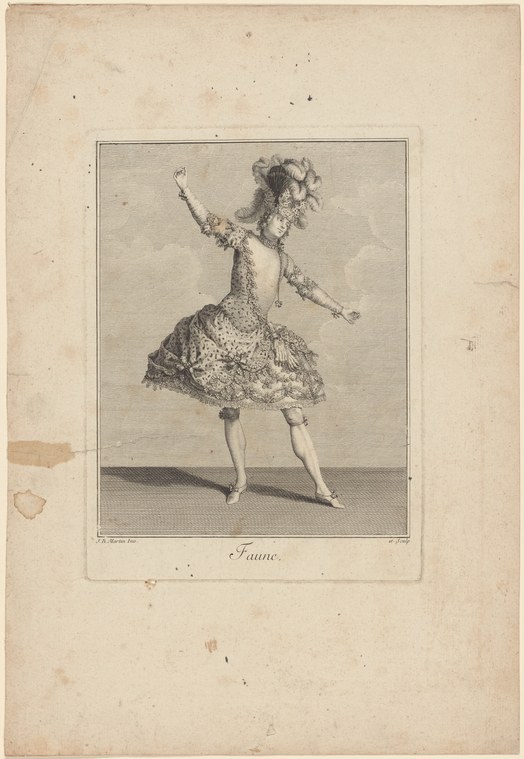
Faune
Unknown artist
- Collection:
- Prints depicting dance
- Source:
- New York Public Library
- Rights:
- Public domain — free to use, share and adapt.
- Recorded as:
- Public Domain
This print preserves the visual record of how a mythological character was embodied and performed in 18th-century theater at a moment when dance was becoming an increasingly refined and codified art form distinct from pantomime or social dancing. The image shows us exactly where the dancer's body was placed and how her limbs were arranged—the kind of concrete evidence historians need to reconstruct the physical vocabulary of the period.
What you are looking at
A single female dancer poses against a plain ground in three-quarter view, her body angled to the viewer's left. She wears an elaborate dress of the mid-to-late 18th century: a tightly fitted bodice with deep décolletage, short sleeves, and a voluminous skirt of ornate patterned fabric that falls to just below the knee, revealing her lower legs and feet. Her hair is elaborately arranged in the high style of the period, with curls piled atop her head. Her left arm is raised at approximately shoulder height with the forearm bent, palm forward; her right arm extends downward at an angle. Her body leans slightly back, and her legs are positioned in an asymmetrical stance: her left leg appears to bear more weight, while her right leg is extended or lightened, suggesting a moment of balletic suspension. The setting is austere—a simple horizontal ground line and neutral background typical of 18th-century theatrical prints.
The dancing
The dancer's carriage is upright and graceful, with the characteristic turnout and lightness of early theatrical dance. Her arm positions are open and expressive rather than holding a partner, suggesting a solo or demonstration of technique. The asymmetry of her stance—one leg weighted, the other lifted or extended—captures a moment between steps, with her torso elegant and elongated. The positioning of her arms and legs conforms to the conventions of *pas seul* or *pas de danse* vocabulary of the 18th century.
The dance depicted
This image depicts 18th-century theatrical dance, almost certainly a *pas de danse* or solo dance segment from a ballet or theatrical entertainment. The title 'Faune' indicates a character from mythology—likely a satyr or forest spirit—suggesting this is from a narrative ballet or pantomime. The costume, pose, and refined execution point to an aristocratic or court-trained dancer performing in the neoclassical theatrical tradition. The style is consistent with the dance forms codified in the mid-to-late 1700s, before the Romantic ballet of the 19th century introduced pointe work and the stylized aesthetic we now recognize as classical ballet.
How it was made
This is an engraving or etching, evident from the fine linear hatching used to create tone and depth, particularly in the rendering of the dress fabric, hair, and figure modeling. The clean line work and formal composition are consistent with the reproductive print tradition of 18th-century theatrical documentation. Such prints were typically published to preserve a record of celebrated dancers and roles, and would have circulated among the educated classes and theater patrons as both souvenirs and evidence of performance innovation.
About this work
This is a theatrical portrait of an 18th-century dancer in character, reproduced in the printmaking tradition that documented the stage performers and repertory of the period. The work is historically valuable as evidence of how a specific role—'Faune'—was danced, costumed, and celebrated in its time. It belongs in a dance archive not only as a record of a performer or work, but as a window into the physical language and aesthetic values of pre-Romantic theatrical dance in Europe. The print format and the care of its composition suggest this was an authorized or significant documentation of a notable interpretation.
How to look at it
Attend to the precision of the dancer's posture and the deliberation of her arm and leg placement. The artist has frozen the moment at a point of clear articulation rather than at the apex of a jump or turn, which tells us something about how this choreography was meant to be understood—as a sequence of distinct, demonstrable positions rather than seamless flow. Notice how the engraver has taken pains to show the construction of the dress and the weight of the fabric, suggesting that costume was part of the dancer's virtuosity and not mere decoration. The absence of scenery or other figures emphasizes the dancer's body as the subject; she is presented for study and admiration, not narrative action.
The artist
The artist is not recorded in the catalogue, but the technical accomplishment and formal presentation suggest a skilled reproductive engraver working within the established tradition of theatrical portraiture. Such prints were typically commissioned by dancers, theater companies, or print publishers to capitalize on a performer's fame, and they required both technical engraving skill and knowledge of the conventions of theatrical dance representation.
The period
The 18th century witnessed the professionalization and codification of theatrical dance in France and across Europe. This print belongs to the era of the Enlightenment stage, when ballet d'action and pantomime were competing with pure dance spectacle, and when individual dancers—particularly women—began to achieve celebrity status. The mid-to-late 18th century saw the emergence of the ballerina as a distinct professional figure, and prints like this one were primary means of disseminating images of celebrated performers across geographical distance. The aesthetic evident here—the elegant proportions, the refined gesture, the mythological costume—reflects the neoclassical taste that dominated European visual culture of the period.
Where it lives
This print is held in the New York Public Library's collection of prints depicting dance. The bare catalogue record offers no date, artist attribution, or earlier provenance, suggesting it arrived as part of a larger acquisition or collection of theatrical prints without full documentation of its history.
Dance in this work
Questions about this work
What role is this dancer performing?
The title 'Faune' indicates a satyr or forest spirit, a character type from classical mythology frequently featured in 18th-century ballets and pantomimes. We cannot determine from the image alone whether this is a serious mythological narrative or a lighter theatrical entertainment, but the elegance of execution and the refinement of the costume suggest a character of some importance in a substantial theatrical work.
How do I know this is 18th-century dance and not earlier or later?
The costume—particularly the short sleeves, the height of the bodice, and the style of the ornate skirt—is consistent with the 1750s–1790s. The engraving technique and the conventions of theatrical portraiture also place it in this period. The dance vocabulary evident in the body position—the turnout, the open arm positions, the upright carriage—is consistent with the codified ballet technique of the mid-to-late 18th century, before the 19th-century innovations of pointe work and Romantic aesthetics.
Is this a real person or an imaginary figure?
This is almost certainly a portrait of an actual dancer in a specific role. The precision of the engraving, the careful rendering of individual features, and the formal presentation all suggest that this documents a real performer's interpretation of the Faune character. Without more information, we cannot identify the dancer by name, but she was evidently celebrated enough to warrant this printed record.
More dance artwork





