49 works in this view — arrow keys or swipe to move between them.
Dance in Art
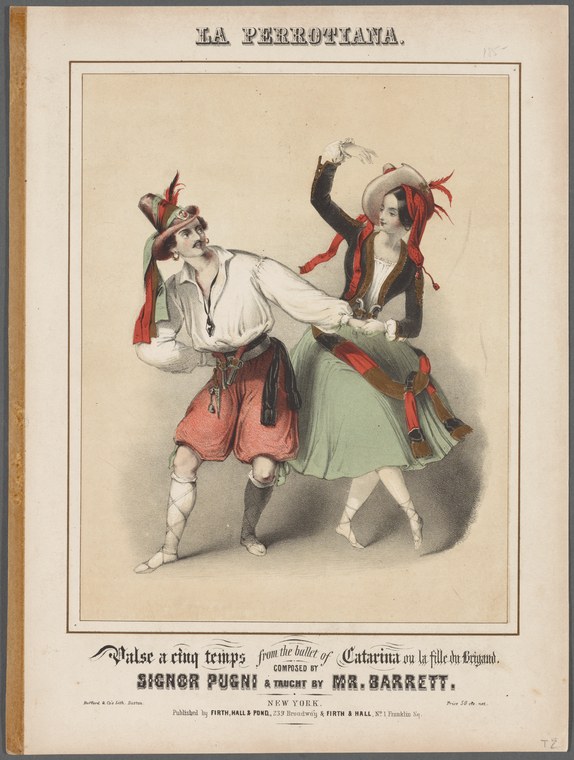
La Perrotiana, valse à cinq temps from the ballet of Catarina;: ou La fille du brigand
Unknown artist
- Collection:
- Prints depicting dance
- Source:
- New York Public Library
- Rights:
- Public domain — free to use, share and adapt.
- Recorded as:
- Public Domain
This print is one of the few surviving visual records of how a specific choreographic work looked in performance, freezing the moment and the partnering style of a Romantic ballet outside the European tradition. It shows the five-beat waltz—a technically and musically unusual form—as a viable stage novelty, and it documents the role of American theater producers and choreographers like Barrett in adapting and staging European ballets for American audiences.
What you are looking at
A hand-colored engraving depicting two dancers in Romantic-era costume against a plain background. On the left, a male dancer in a red tunic, white shirt with billowing sleeves, and a feathered cap leans backward in a dramatic arc, his body weight thrown into the pose. On the right, a female dancer in a pale green skirt and dark jacket with red ribbons woven through her hair and costume reaches upward with one arm, her body in profile. Both dancers are captured mid-movement, their limbs extended, suggesting a moment of theatrical interaction or dramatic partnership. The woman's skirt is voluminous but stops above the ankle, and both wear pale tights and soft shoes typical of early 19th-century stage dance. The composition emphasizes diagonal lines and asymmetrical balance, with the figures occupying the center and upper portions of the frame.
The dancing
The male dancer supports himself on his left leg while arching backward with arms spread, creating an exaggerated, almost acrobatic line. The female dancer stands more upright, weight forward, reaching upward and back toward her partner. Both bodies are in profile or three-quarter view, allowing the viewer to read the full extension of their limbs. Their proximity and the direction of their reach suggest partnered action, though they are not in a closed ballroom hold. The poses emphasize vertical extension and dynamic asymmetry rather than the formal frame of classical ballet.
The dance depicted
This is a Romantic-era theatrical dance, likely from the ballet *Catarina; ou La fille du brigand* (Catarina, or the Brigand's Daughter), a vehicle for the celebrated Italian dancer Carlotta Grisi. The work is titled as a *valse à cinq temps*—a five-beat waltz, an unusual metric variant that would have been a technical and stylistic novelty for the period. The costume and dramatic pose suggest this is a character dance or divertissement rather than classical ballet proper, capturing a moment of theatrical melodrama or romance that was typical of Romantic ballet plots set in exotic or historical settings. The print was danced and arranged by Mr. Barrett, a theatrical figure of the era whose choreographic or performance contribution is here documented.
How it was made
This is a hand-colored engraving, printed in New York by Firth, Hall & Pond and likely distributed as sheet music cover art or theatrical advertisement. The medium allowed for rapid reproduction and wide distribution of images of celebrated dancers and productions to the theater-going public. The color has been applied by hand after printing, which explains the slightly uneven finish and the vibrant accents of red, green, and flesh tone against the neutral background. This type of image was common ephemera of the mid-19th-century American theater, documenting both the choreography and the visual spectacle of stage performance.
About this work
This is a theatrical dance print documenting a moment from a Romantic ballet performed in America. The work records both the choreography and the visual presentation of a *valse à cinq temps*—an uncommon five-beat waltz variation—from the 1840s. It belongs in a dance gallery as evidence of how Romantic ballet was adapted for performance outside Europe, how choreography was disseminated through print culture, and how the dramatic, asymmetrical poses and partnering of Romantic dance differed from the formal geometry of Classical ballet. The engraving itself is a primary document of mid-19th-century American theater and its appetite for imported European ballet stars and new choreographic forms.
How to look at it
Attend to the asymmetry and the dramatic arch of the male dancer's body—this is not the controlled verticality of classical ballet but the exaggerated, almost acrobatic extension of Romantic character dance. Notice the female dancer's upward reach and the way both bodies are angled away from each other even as they interact, creating the impression of dynamic instability. The positioning suggests a moment of separation or contrast within the dance, not a unified line. The feathered cap and decorative ribbons were part of the exotic or folk costume fantasy typical of Romantic ballet narratives.
The artist
The engraver is not recorded in the catalogue. The print was published by Firth, Hall & Pond, a major American music publisher of the 1840s–50s, based in New York. They were known for producing illustrated sheet music covers and dance prints that advertised theatrical performances and made performance imagery available to a broader domestic market. The choreography is credited to Mr. Barrett, likely a choreographer or ballet master active in American theater of the period.
The period
This print dates to the height of Romantic ballet in Europe (1830s–1850s) and documents its circulation through America. The ballet *Catarina; ou La fille du brigand* premiered in Paris in 1846 with Carlotta Grisi and was quickly adapted for American stages. The five-beat waltz was a technical and musical experiment within Romantic dance; waltzes in standard triple meter were already standard in both ballroom and theater, but this variant offered novelty and complexity. The print shows how American impresarios and choreographers like Barrett were not passive recipients of European ballet but active adapters, creating new versions of imported works.
Where it lives
This print comes from the New York Public Library's collection of prints depicting dance. It was published in New York as sheet music cover art or theatrical advertisement, likely distributed to patrons and the public to promote the performance and the dancers. It is one of many similar prints that documented American performances of European ballets during the mid-19th century.
Dance in this work
Questions about this work
What is a valse à cinq temps?
A five-beat waltz, an unusual metric variant of the standard three-beat waltz. This version offered both musical and choreographic novelty to audiences accustomed to regular waltz rhythm. The five-beat pattern created an asymmetrical, syncopated feel that would have required trained dancers to execute cleanly and would have been presented as a showcase of technical skill.
Was this a real ballet or just a dance number?
*Catarina; ou La fille du brigand* was a full-length ballet that premiered in Paris in 1846 with the star Italian dancer Carlotta Grisi. This particular piece is a divertissement or character dance within that ballet—a standalone number showcasing the dancers' technique and the choreographer's creativity, much like a specialty act within a larger theatrical production.
Who was Mr. Barrett?
Mr. Barrett is credited as the arranger or choreographer of this version of the waltz. He was likely a ballet master or choreographer working in American theater during the 1840s–50s, but detailed biographical information about him is not available from this print alone. His name here documents his role in adapting European choreography for American stages.
Why would Americans care about a French ballet?
Romantic ballet, especially works starring celebrated European dancers like Carlotta Grisi, was a major attraction in mid-19th-century American cities. Imported European stars and choreography were prestigious cultural commodities, and American impresarios made money by licensing and adapting these works. This print is evidence of how eagerly American audiences consumed European theatrical dance.
More dance artwork





