37 works in this view — arrow keys or swipe to move between them.
Dance in Art
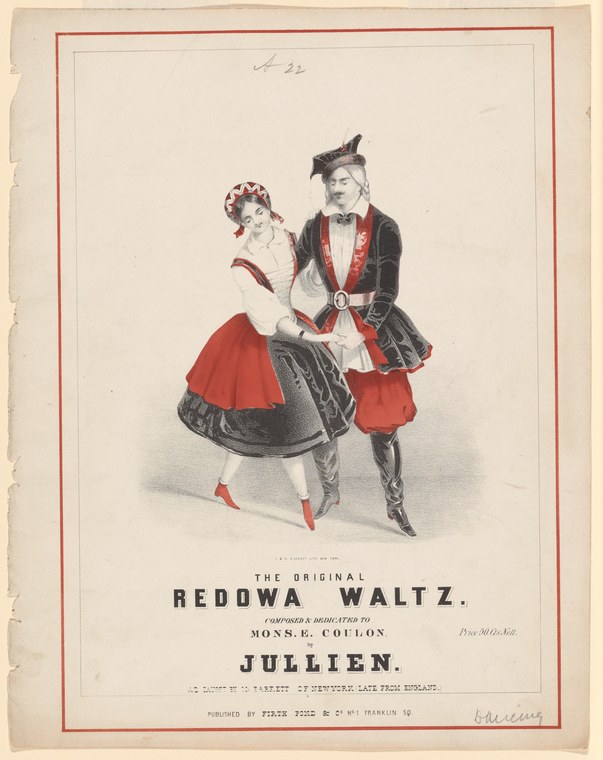
The original Redowa waltz
Unknown artist
- Medium:
- Lithograph
- Dance:
- Waltz
- Era:
- Early 1800s (Waltz Revolution)
- Source:
- New York Public Library
- Rights:
- Public domain — free to use, share and adapt.
- Recorded as:
- public_domain
The Redowa was a historically significant bridge between the waltz and the polka, and this image is one of the surviving visual records of how it was actually performed. For historians of ballroom dance, the positioning of the bodies—especially the backward lean and the rotary frame—provides concrete evidence of the technical requirements and aesthetic values of the dance. The lithographic medium itself matters: as a commercially published print, it tells us who danced the Redowa and how they learned it—through images as well as through instruction manuals and live demonstration.
What you are looking at
A colored lithograph shows a couple posed mid-dance in a moment of theatrical elegance. The woman wears a red skirt with black trim and a fitted white corseted bodice, her hair crowned with an ornate red feathered headdress. She leans back in a graceful arc, her body weight supported by her partner. The man wears a dark velvet jacket trimmed in red, red breeches, and a black tricorn hat; he stands upright, supporting the woman's backward lean with a confident hold. The background is plain and neutral, focusing all attention on the dancers' posture and costume. The composition captures the characteristic moment of the Redowa—a rotary couple dance—where the woman's body extension and the man's steady frame demonstrate the technical coordination required of the dance.
The dancing
The dancers occupy a closed or semi-closed hold typical of early nineteenth-century couple dancing, with the man's body vertical and the woman arched backward at a pronounced angle, her weight supported entirely by him. The woman's right arm extends outward in a flowing gesture; the man's posture is erect and controlling. Both figures stand on the balls of their feet, suggesting the light, bouncy action characteristic of the Redowa. The positioning—her extension backward, his stable frame—demonstrates the rotary action and the specific dynamic between partners in this dance.
The dance depicted
This is a representation of the Redowa, a Central European country dance that became fashionable in ballrooms during the 1840s–50s. The title declares it 'The Original Redowa Waltz,' suggesting this image documents either an early or notable version of the dance. The Redowa was a couple dance in rotary form, performed in 3/4 time with a characteristic bounce and turning action—somewhere between a waltz and a polka in character. The image shows the aesthetic of the dance as performed in the ballroom: formalized, elegant, and dependent on precise partnering and the woman's controlled extension. The dramatic backward lean would have been achieved through the couple's rotational momentum and the man's supporting frame.
How it was made
This is a hand-colored lithograph, a reproductive print technology that allowed multiple copies to be produced and circulated widely. The printing process—stone-based, allowing for fluid lines and broad color areas—is evident in the smooth outlines of the figures and the evenly distributed red and black inks. Lithography was the dominant commercial medium for dance and theatrical imagery in the mid-nineteenth century, making such prints accessible to the middle classes who danced these dances in their own ballrooms. The notation on the print ('Composed & Duly Left to Mons. E. Coulon') and the publisher's mark ('Piecer Pidge & Co, WM Franklin Sq') indicate this was a commercial product, likely sold as sheet music cover art or as a standalone print for ballroom enthusiasts.
About this work
This lithograph documents the Redowa, a ballroom couple dance that rose to prominence in Europe in the mid-nineteenth century. The image captures the characteristic posture and partnering of the dance at the moment of maximum extension—the woman arched backward, supported by her partner's frame—a pose that would have been achieved through the rotating action of the dance. The print is both a technical record of how the dance was performed and a fashion image documenting the costume and aesthetic of ballroom dancing in the 1840s–50s. As a lithograph with publication details intact, it is evidence of the commercial circulation of dance instruction and fashion imagery in the period.
How to look at it
Attend to the woman's backward lean and the precise angle at which her body is supported—this is not a casual or naturalistic pose, but the result of practiced technique and the rotational momentum of the dance. The man's vertical posture and the formal positioning of both figures' limbs reflect ballroom conventions of the period: control, balance, and geometric clarity. The costumes are also instructive: the woman's headdress and skirt, and the man's formal jacket and breeches, were standard ballroom dress, and the print functioned partly as a fashion image. The moment chosen—mid-extension—is the apotheosis of the movement, the point at which the dance's energy is most visible.
The artist
The print credits composition to 'Mons. E. Coulon,' likely Eugène Coulon, a prominent choreographer and dancing master active in London and Paris in the mid-nineteenth century. Coulon was known for teaching fashionable ballroom dances and for publishing instructional materials; this print is consistent with his practice of creating and documenting dances for commercial distribution. The lithographic technique and publisher's mark suggest this was a professional commercial operation, not a unique artwork, meaning Coulon's role may have been as choreographer or instructor rather than as the artist who drew the stone.
The period
The 1840s–50s were a pivotal moment for ballroom dancing in Europe. The waltz had become the dominant social dance of the aristocracy and upper middle classes, but new variations and related dances—the polka, the Redowa, the Schottische—emerged from Central European folk traditions and were rapidly absorbed into fashionable ballroom culture. Lithography had become the standard medium for publishing dance instruction and fashion imagery, making these dances visible and aspirational to a broad audience. The Redowa was part of this wave of novelty, and prints like this one were crucial tools for spreading knowledge of new steps and styles across national and social boundaries. The tight costume, the theatrical posture, and the professional quality of the image reflect the ballroom's emergence as a significant arena of public, codified performance in the nineteenth century.
Where it lives
This print is held by the New York Public Library. It is a commercial lithograph with publication information intact, indicating it was produced for sale and distribution rather than as a unique or limited work. Such prints were often bound into instruction manuals, published as sheet music covers, or sold separately as fashionable parlor decoration for dance enthusiasts.
Dance in this work
Questions about this work
What is the Redowa?
The Redowa was a ballroom couple dance in 3/4 time that emerged from Central European folk traditions and became fashionable in Europe in the 1840s–50s. It was performed in a closed hold with a characteristic rotary or turning action and a light, bouncy rhythm. The dance sat stylistically between a waltz and a polka, and like both, it was a status symbol of middle- and upper-class respectability.
How do we know this shows the Redowa and not another dance?
The title of the print explicitly states 'The Original Redowa Waltz.' The posture of the dancers—especially the woman's backward lean achieved through rotary momentum—is consistent with descriptions and other images of the Redowa. The couple hold and the formal ballroom costume also match the context in which the Redowa was performed.
What does the notation at the bottom mean?
The print credits the composition of the dance to 'Mons. E. Coulon,' likely Eugène Coulon, a London-based dancing master and choreographer. The publisher's mark 'Piecer Pidge & Co, WM Franklin Sq' indicates this was a commercial print made in London. Together, these credits show that the Redowa was a deliberately created and commercially promoted ballroom dance, not a folk dance simply adopted by the ballroom.
What is a lithograph and why does it matter?
Lithography is a printing technique using a stone and chemical processes to create multiple copies of an image. In the nineteenth century, it was the dominant medium for reproducing dance instruction images, fashion plates, and theatrical scenes. Because lithographs could be produced affordably in quantity, they were crucial tools for disseminating knowledge of new dances to ballrooms across Europe and America. This print, as a lithograph, is evidence of how dance was taught and circulated in the ballroom era.
More Waltz artwork