49 works in this view — arrow keys or swipe to move between them.
Dance in Art
Les sylphides
Unknown artist
- Collection:
- Prints depicting dance
- Source:
- New York Public Library
- Rights:
- Public domain — free to use, share and adapt.
- Recorded as:
- Public Domain
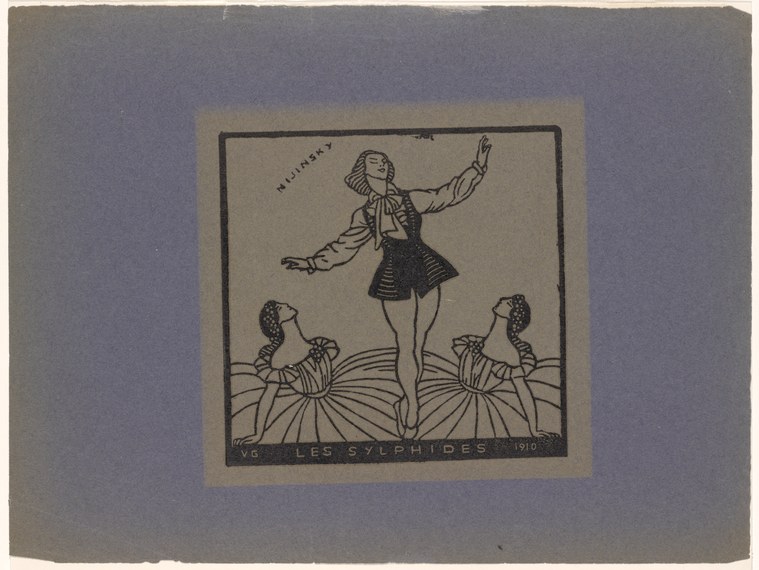
This engraving is one of the few visual documents of *Les Sylphides* from its formative years, showing how the ballet was understood and represented in real time by artists working in the Parisian avant-garde. It reveals the degree to which Fokine's choreography succeeded in materializing a fantasy—an artistic object that could be translated into and recognized through other media. For historians, it provides evidence of the work's rapid iconic status and of the visual languages available to artists attempting to capture modernist ballet movement.
What you are looking at
A wood engraving depicts three ethereal female figures in a sylvan setting. The central figure, dressed in a short tunic with draped sleeves, stands en relevé with one arm raised in an elegant gesture and the other extended, her body in a graceful contrapposto. She wears a close-fitting cap or headdress. Flanking her on either side are two seated or reclining figures with scaled or reptilian lower bodies—possibly representing undines or water nymphs—their upper bodies bare or lightly draped, their poses languid and supporting. The ground beneath them is rendered with radiating linear strokes suggesting flowers or stylized natural forms, creating a dreamlike, otherworldly atmosphere. The composition is contained within a dark rectangular border, and text reading "LES SYLPHIDES" appears at the base, with what appears to be a date or signature mark.
The dancing
The central dancer's posture is weightless and elevated, with the supporting leg extended and the free leg drawn up in a lifted position. Her arms are held high and open, suggesting the épaulement and upper-body carriage of classical ballet. The asymmetry of her pose—one arm raised, one extended—creates a sense of lyrical flow. The flanking figures are immobilized in recumbent poses, their bodies forming a symmetrical frame that emphasizes the soloist's verticality and the composition's stability despite its ethereal subject matter.
The dance depicted
This is almost certainly a design for or documentation of Michel Fokine's *Les Sylphides*, the groundbreaking 1909 ballet for the Ballets Russes that reimagined the Romantic ballet tradition through a contemporary neoclassical lens. The image captures the essence of the ballet's central vision: the solitary sylph in an impossible landscape, surrounded by supernatural beings. Fokine's choreography emphasized continuity of line, fluidity of arm movement, and a new relationship between the dancer's body and gravity—precisely what this engraving conveys through the protagonist's elongated silhouette and sustained relevé position. The work documents an early moment in the ballet's circulation as a celebrated modern classic.
How it was made
This is a wood engraving, a relief technique requiring the design to be incised into the end-grain surface of a hardwood block and then printed. The fine parallel lines visible throughout create tonal modeling and suggest the medium's characteristic precision and linear vocabulary. Wood engravings offered high-resolution detail, good durability, and could be printed alongside letterpress type, making them economical for reproduction in periodicals and illustrated books. This engraving's refined execution and the presence of text suggests it was made for publication, likely in a Parisian arts journal or theatre periodical during the early 20th century.
About this work
This wood engraving documents or celebrates a moment from Michel Fokine's *Les Sylphides*, the 1909 ballet that redefined Romantic ballet for modernist aesthetics. The image captures the work's central fantasy: a solitary dancer in an impossible landscape, supported by supernatural attendants. The engraving's delicate linear technique mirrors the ballet's emphasis on fluidity and weightlessness, translating kinetic movement into static form. It belongs in a dance archive not as a literal record of a performance but as evidence of how *Sylphides* captured the imagination of visual artists and how the ballet's imagery circulated through print culture in the early 20th century.
How to look at it
Attend to the dancer's relationship to the ground and to gravity. Notice how her raised arm and extended leg create a continuous line that reads as effortless despite the technical impossibility of the position. The engraving freezes a single moment, but the composition is designed to convey continuous motion—the fluidity that is *Sylphides*' defining characteristic. The two attendant figures create a stable base that allows the central figure to float; this compositional principle mirrors the ballet's choreographic strategy of using the ensemble to support and frame the soloist's otherworldly presence.
The period
By 1909, when *Les Sylphides* premiered, the Romantic ballet tradition was already a historical object, and modernist artists and impresarios were looking for ways to resurrect its formal vocabulary while stripping away its narrative apparatus. Fokine's achievement was to create a plotless ballet that captured the essential fantasy of Romanticism—weightlessness, supernatural encounter, the transcendence of the physical body—through pure movement and design. The Ballets Russes, under Sergei Diaghilev's direction, made such modernist reinterpretations of historical forms its central mission. This engraving was created during the period when *Sylphides* was becoming recognized as one of the century's most important choreographic works, even as many other Ballets Russes productions were far more overtly avant-garde.
Where it lives
The work is held in the New York Public Library's prints collection on dance, indicating its status as a documented artifact of early 20th-century ballet promotion and visual culture. Such engravings were typically commissioned for or reproduced in arts journals, theatre programs, or monographic publications celebrating important productions.
Dance in this work
Questions about this work
Is this a record of an actual performance?
No. This is a graphic interpretation made after the ballet's composition, likely for publication. It captures the essential image of *Sylphides*—the solitary dancer in an otherworldly setting—rather than documenting a specific stage event. Engravers and illustrators in this period often worked from descriptions, costume designs, and photographs to create these interpretive images.
Who created this engraving?
The artist is not recorded in the catalogue, which is not unusual for reproductive prints. The signature or initials visible at the bottom of the image might identify the engraver, but the catalogue does not provide this information.
Why does the central figure look so weightless?
That weightlessness is the whole point. *Sylphides* was Fokine's response to the Romantic ballet tradition, in which the dancer was meant to appear to transcend the body's physical nature. The engraving's linear technique—the radiating lines beneath the figure, the floating pose—translates that choreographic fantasy into visual form.
What are the creatures on either side?
They are most likely sylphs or spirits—supernatural beings from Romantic ballet tradition. In *Sylphides*, the ensemble creates an atmosphere of otherworldliness that isolates and elevates the soloist. These figures represent that ensemble function.
More dance artwork





