49 works in this view — arrow keys or swipe to move between them.
Dance in Art
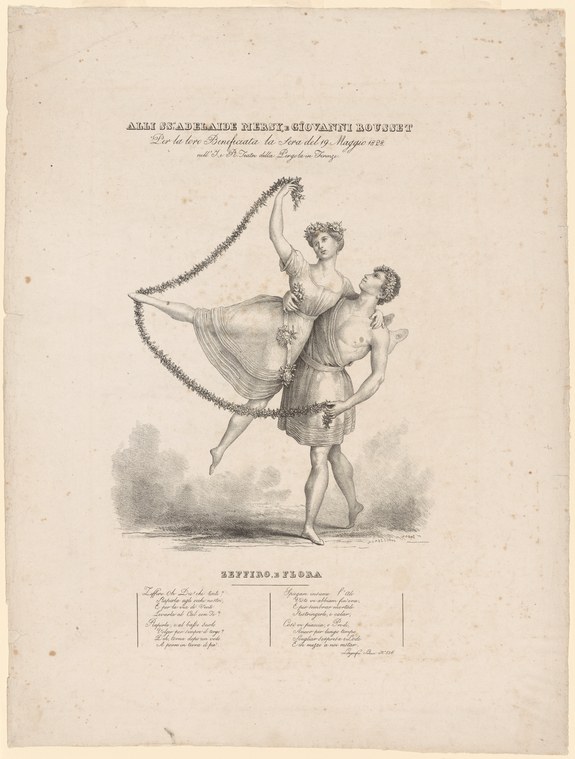
Flore et Zéphire.: Alli Ssti. Adelaide Mersy, e Giovanni Rousset per la lora beneficiata la sera del 19 Maggio 1828
Unknown artist
- Collection:
- Prints depicting dance
- Source:
- New York Public Library
- Rights:
- Public domain — free to use, share and adapt.
- Recorded as:
- Public Domain
Flore et Zéphire was one of the most celebrated ballets of its time, and this image preserves rare visual evidence of how its signature aerial effects were achieved through partnering technique rather than machinery alone. For historians of Romantic ballet and the development of male technique, this engraving documents the scale and virtuosity of supported lifts at a pivotal moment in ballet's evolution.
What you are looking at
This is an engraving commemorating a benefit performance of the ballet Flore et Zéphire (Flora and Zephyr) given by dancers Adelaide Mersy and Giovanni Rousset on 19 May 1828. The composition shows two figures in a moment of apparent weightlessness or flight: a woman in a long, loosely draped neoclassical dress with one arm raised and the other extended, her body arched backward in an attitude of abandon or surrender, is being supported or lifted by a muscular male dancer in brief classical drapery. He stands in a wide, stable stance with knees slightly bent, his torso angled to support her weight. The female figure's skirt floats and billows around her in elegant curves, emphasizing the sense of upward motion. The background is rendered in soft wash, keeping focus on the pair. Below the image are French verses celebrating the dancers' artistry. The print has the pale tone and soft edges characteristic of late 18th or early 19th-century reproductive engraving.
The dancing
The male dancer bears the entire weight of his partner in a classical supported lift or "adagio" position, with his legs providing the stable base and his arms cradling her body. The female dancer's frame is completely dependent and extended—her back arched, one leg likely extended (though partially hidden by drapery), her arms reaching upward and outward in an open, weightless pose. Their bodies form a diagonal composition that reads as dynamic vertical lift rather than horizontal partnering. The musculature and classical proportions of both figures reflect the neoclassical ideal; the male figure is notably powerful and idealized in the manner of classical sculpture.
The dance depicted
Flore et Zéphire was a famous romantic-era ballet about the god of the west wind and the goddess of flowers, first choreographed in London in 1796 and performed across Europe throughout the early 19th century. The ballet was celebrated for its aerial effects and flying machines that lifted dancers above the stage, creating illusions of weightlessness—a signature element of the work. This image captures the essence of that spectacle: the moment of suspension and weightlessness that defined the piece. The lifted position shown here is characteristic of the acrobatic "adagio" or supported lifts that were becoming more prominent in Romantic ballet, though the supernatural theme allowed for more extreme and sustained elevation than conventional partnering.
How it was made
This is a line engraving with applied wash or tint, a reproductive print technique common for commemorating theatrical performances in the early 19th century. The delicate line work creates the figures' contours while softer tonal areas suggest fabric texture and atmospheric space. Engraving was the standard method for circulating images of celebrated dancers and performances to a wide audience before photography; a print like this would have been sold to audiences who had attended the performance or heard of the dancers' fame, and would also appear in theatrical archives and collections. The technique allowed fine rendering of anatomical detail and fabric folds while keeping the image economical enough to produce in quantity.
About this work
This engraving is a theatrical souvenir documenting a celebrated performance of the ballet Flore et Zéphire in 1828, showing the moment of magical weightlessness that gave the work its fame and appeal. The image captures a virtuosic supported lift—a male dancer elevating his partner in a fully extended, arched position that reads as supernatural flight rather than grounded partnering. The work sits at the intersection of Romantic ballet's aesthetics (the ethereal, the weightless, the magical transformation) and the acrobatic technical vocabulary that was expanding the possibilities of male partnering in this era. It is a record of a specific performance by two celebrated artists, but also evidence of how the ballet looked in motion and why audiences found it enchanting.
How to look at it
Attend to the way the artist has frozen a single moment of dynamic action—the male dancer's deep plié and angled torso, the female dancer's complete extension and arched back—to convey the sense of lifting and flight rather than static display. The floating quality of her skirt and the diagonal line of her body create upward momentum even in a still image. The classical drapery and idealized anatomy reflect the aesthetic conventions of the period: ballet was understood through the lens of neoclassical art and sculpture, and this engraving uses that visual language to elevate the dancers to the status of classical heroes.
The period
The 1820s saw Romantic ballet ascending in Europe, with increasing emphasis on supernatural subjects, weightlessness, and the virtuosity of female dancers. Flore et Zéphire, first performed in 1796, remained in the active repertoire and was performed frequently by celebrated dancers. The work represented an earlier phase of Romanticism—still rooted in classical mythology and the fairy-tale fantastic—but its technical demands (especially the lifts and aerial illusions) had made it a vehicle for the most accomplished dancers. Giovanni Rousset was a notable Italian male dancer of the period; Adelaide Mersy was a celebrated French ballerina. Benefit performances like this one were common practice, allowing dancers to capitalize on their fame and draw audiences by programming popular works. The engraving itself reflects the standard method of theatrical publicity in this era, before lithography and photography displaced engraving in the mid-19th century.
Where it lives
The print is held in the New York Public Library's collection of dance-related prints. It is an engraved commemorative print issued shortly after the performance, likely sold to attendees and circulated among theater enthusiasts and collectors of dance imagery.
Dance in this work
Questions about this work
What is Flore et Zéphire?
A Romantic-era ballet based on classical mythology, first choreographed in London in 1796. It tells the story of Zephyr, the god of the west wind, and Flora, the goddess of flowers. The ballet was celebrated for its magical effects and the illusion of weightlessness, achieved through both stage machinery and virtuosic partnering.
How did dancers achieve the flying effect?
The ballet used both stage machinery (wires and flying apparatus) and advanced technique in male partnering. This image likely shows a moment that combined both: the male dancer's strength and control lifting the female dancer into an extended aerial position, while machinery may have assisted to create the full illusion of flight on stage.
Who were Mersy and Rousset?
Adelaide Mersy was a celebrated French ballerina of the 1820s; Giovanni Rousset was an Italian male dancer noted for his strength and technique. Benefit performances gave dancers the opportunity to choose repertoire and capitalize on their fame, and this performance of Flore et Zéphire on 19 May 1828 was a major event.
Why is this in an art collection?
Dance history was documented primarily through prints, engravings, and drawings in this period, as photography did not yet exist. Theatrical prints like this were both souvenirs for audiences and documentary evidence of how performances looked; they are now crucial primary sources for understanding the aesthetics and technique of early Romantic ballet.
More dance artwork





