49 works in this view — arrow keys or swipe to move between them.
Dance in Art
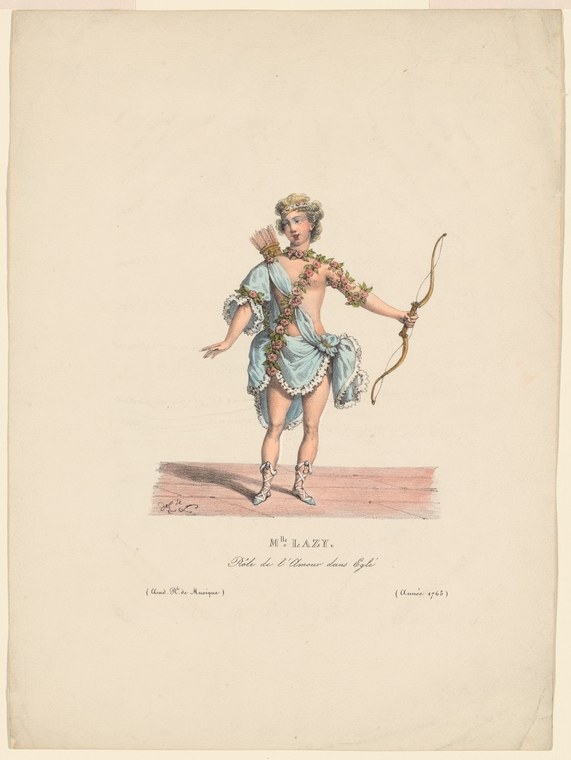
Mlle Lazy, rôle de l'Amour dans Eglé
Unknown artist
- Collection:
- Prints depicting dance
- Source:
- New York Public Library
- Rights:
- Public domain — free to use, share and adapt.
- Recorded as:
- Public Domain
This print is a rare named documentation of an 18th-century dancer and a specific role, offering concrete evidence of how allegorical and mythological characters were costumed and presented on the French stage. It demonstrates the tight integration of dance, opera, costume design, and celebrity portraiture in this period, and shows the formalized, classical aesthetic of theatrical dance before the emergence of Romantic ballet.
What you are looking at
A single female figure stands in a three-quarter pose against a pale ground, her weight shifted onto her right leg in a classical contrapposto stance. She wears a pale blue draped garment with puffy sleeves and a low waistline, trimmed with elaborate swags and loops of floral garland that loop across her torso and shoulders. Additional floral wreaths circle her neck and head. She holds a curved bow in her right hand, drawn upward, and her left arm extends gracefully outward, palm open, in a gesture of presentation or offering. Her blonde hair is dressed in the style of the early 18th century, caught up with ribbons. The figure's pose and attributes—the bow, the flowers, the elegant presentation—identify her as Cupid or Amor. This is a costume design or theatrical portrait, likely a print documenting a specific dancer or role in an operatic or court production.
The dancing
A single dancer in a classical three-quarter stance, the figure poised on the supporting leg with the working leg relaxed and the pelvis tilted in an attitude of ease and grace. The raised right arm holds the bow at a moderate height; the left arm extends horizontally in an open, welcoming gesture. The torso is gently twisted to present the full figure to the viewer. The pose demonstrates an understanding of aristocratic deportment and classical proportion—this is not street dance or folk movement, but the formalized, lifted carriage of court or theatrical dance of the period.
The dance depicted
This is a costume design or souvenir print documenting a specific theatrical performance, almost certainly from the Paris Opéra or another major court theatre. The inscription identifies the wearer as 'Mlle Lazy' in the role of 'l'Amour' (Cupid) in the work 'Eglé'—a pastoral opera or ballet-héroïque popular in 18th-century France. The pose and costume reflect the conventions of allegorical or mythological roles in French theatre of this period: elegant, decorative, presented frontally for maximum visibility and admiration. The figure is not captured mid-movement but in a formal presentation pose, which was standard for theatrical portrait engravings. This is dance as spectacle and costume design rather than action.
How it was made
This is a hand-colored engraving or possibly a lithograph, probably French, from the 18th or early 19th century. The fine linear work of the costume details and the delicate handling of the floral garlands suggest engraving; the soft wash of color applied to the background and the figure's dress suggest hand-coloring after printing. This technique was the standard for distributing theatrical celebrity images and costume documentation in this era—cheap enough to circulate widely, beautiful enough to frame or collect, and allowing for individual coloring variations. The existence of this print indicates that Mlle Lazy was a performer of sufficient prominence for her portrait to be distributed beyond the theatre itself.
About this work
This is a hand-colored theatrical portrait engraving, likely from the mid-18th century, documenting a specific production and performer. It shows Mlle Lazy in the allegorical role of Cupid (l'Amour) in 'Eglé,' a pastoral opera or ballet-héroïque of the French court or Opéra stage. The figure is posed in a formal, classicized stance that reflects both aristocratic deportment and the theatrical conventions of representing mythological and allegorical characters in 18th-century dance and opera. Rather than capturing movement, it serves as a record of costume design, casting, and the visual presentation of a named performer in a named role—a common form of theatrical ephemera that circulated in Paris and tells us much about what dance and costume looked like, and who performed it, in the age of the Baroque and early Rococo.
How to look at it
Note the formal, static quality of the pose: this is not a moment of dance action captured mid-movement, but a presentation pose designed to display both the costume and the figure of the performer to best advantage. This was the standard convention for theatrical portrait engravings of the period. Observe the symmetry and clarity of the composition, the careful rendering of the floral garlands and drapery, and the attention to the elegance of line and proportion—all elements of the classicizing aesthetic of French court dance and opera. The bow and the open-palmed gesture are attributes of Cupid, not narrative action; the print is a portrait and a costume document first, a dance record second.
The period
This print belongs to the rich tradition of 18th-century French theatrical portrait engravings, a period when the Opéra and court ballets were the primary venues for theatrical dance in Europe. The costume and style are consistent with the reign of Louis XV (1715–1774) or the decade or two following. Allegorical and mythological ballet was the dominant form of theatrical dance in this era; roles like Cupid, the Graces, and personified abstractions (Pleasure, Victory, etc.) were staples. Pastoral subjects—Eglé among them—were fashionable in both opera and ballet. The practice of commissioning and distributing colored engravings of celebrated performers in their roles was a form of celebrity marketing and theatrical documentation that helped shape public interest in dance and the personalities who performed it.
Where it lives
This print is housed in the New York Public Library's collection of prints depicting dance. It is a hand-colored engraving or lithograph, catalogued as French, date and artist unknown. Such prints were commonly produced for distribution to audiences, patrons, and collectors, and many survive in institutional collections.
Dance in this work
Questions about this work
Who was Mlle Lazy?
Mlle Lazy was a dancer active in French theatre in the 18th century, prominent enough to have her portrait engraved and distributed. Beyond this print and the notation of her role in 'Eglé,' little is recorded of her. The print is one of the primary documents of her career.
What is 'Eglé' and where was it performed?
Eglé is a pastoral work—either an opera, a ballet-héroïque, or a combination—that was performed in French court or Opéra theatres in the 18th century. Several works with this title exist in French musical archives from this period. The print does not specify the venue or date of the performance in which Mlle Lazy appeared.
Why is Cupid dressed in such elaborate, contemporary costume rather than classical drapery?
In 18th-century French theatre, allegorical and mythological characters were costumed in the fashionable dress of the period—silks, ribbons, floral garlands, and baroque ornament—rather than historically 'authentic' Greek or Roman garb. This allowed the audience to see contemporary beauty and elegance embodied in the role, and kept the spectacle current and visually rich.
More dance artwork





