49 works in this view — arrow keys or swipe to move between them.
Dance in Art · 2019
No dance
Unknown artist
- Medium:
- Source:
- New York Public Library
- Rights:
- Public domain — free to use, share and adapt.
- Recorded as:
- public_domain
This work documents the visual and sartorial language of a performance tradition (likely Japanese theater or court dance) at a specific moment, preserving the exact appearance of costume, ornament, and formal pose that would have been essential to the audience's recognition of the role or figure. For dancers and historians, it provides evidence of how the body was dressed, presented, and held as a statement of rank, role, and ceremonial function in pre-modern East Asian performance.
What you are looking at
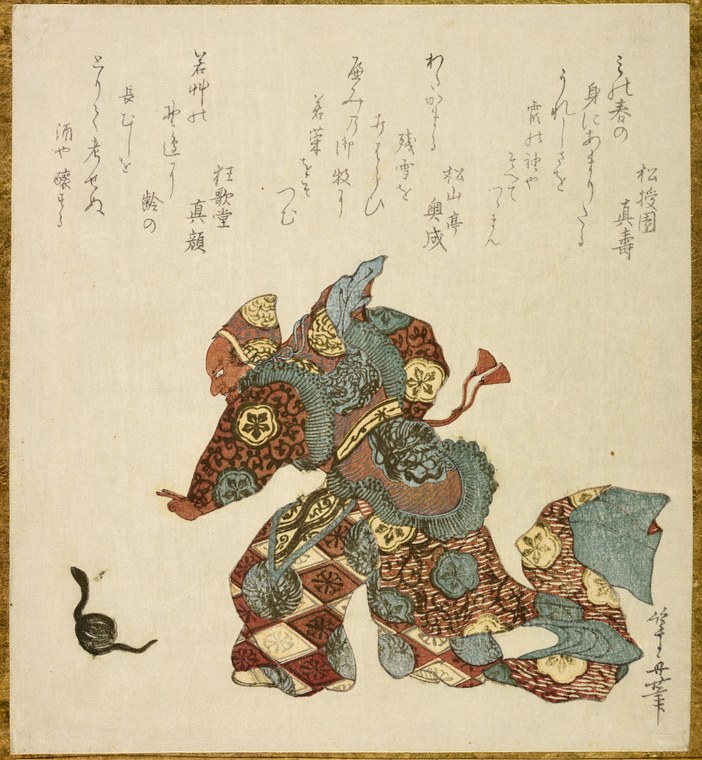
A single dancer dominates the composition in a formal frontal pose against a cream-colored background. The figure is elaborately dressed in layered garments of deep red, gold, and teal-blue, with patterned fabrics featuring geometric and ornamental designs. The costume includes a long outer robe with voluminous sleeves, inner layers visible at the openings, and decorative circular motifs (likely representing heraldic or auspicious symbols) appliquéd or embroidered across the chest and torso. The dancer wears what appears to be a tall headdress or hair ornament in blue. The figure's posture is upright and ceremonial rather than dynamic—arms are positioned with controlled gesture, one raised slightly, the stance stable and symmetrical. A small black serpent or snake motif appears in the lower left of the composition, possibly a deliberate compositional element. Handwritten East Asian characters (likely Japanese) are densely inscribed across the upper portion of the page in multiple vertical columns. The overall effect is of a single-figure portrait study emphasizing costume and formal bearing rather than movement.
The dancing
The body is still and symmetrically posed, with the weight evenly distributed on both feet in a stable stance. The arms are held with restrained grace—the upper arms close to the body, the lower arms and hands extended in a measured, deliberate gesture. The head is upright, the shoulders level. This is the posture of ceremonial presentation rather than active dancing; there is no suggestion of weight transfer, pivot, or traveling movement. The figure's presence is frontal and hieratic—the costume is the primary statement.
The dance depicted
If this depicts dance at all, it most likely represents either a formal Japanese court dance (such as Bugaku or Noh-related movement) or a figure from Kabuki theater. The elaborate costume, frontal presentation, and controlled posture are consistent with these traditions, where dancers perform in richly patterned, multi-layered dress and hold poses of ceremonial stillness as a core element of the performance. However, the work is fundamentally a costume and figure study rather than a capture of movement itself. The image emphasizes the visual splendor and formal dignity of the dressed body over kinetic action.
How it was made
This is a hand-colored woodblock print or similar relief-printing technique, recognizable from the characteristic flat color fields, clear outlines, and the way the gold and colored pigments sit on the cream-colored paper. The East Asian (likely Japanese) script and the technique together suggest a work created in Japan or within the East Asian woodblock print tradition, where such figure studies were used to document costume, theater roles, and ceremonial dress. The handwritten inscriptions appear to be annotations, possibly identifying the figure, the occasion, or the source text, indicating this was made for a educated audience familiar with written commentary.
About this work
This is a formal portrait of a single elaborately costumed figure in what is most likely a Japanese theatrical or court-dance context. The work emphasizes costume, heraldic symbolism, and formal bearing rather than the capture of movement, and may represent a specific role, character, or ceremonial figure. The handwritten East Asian script suggests the work was made as a documented study or record, possibly for archival or reference purposes within a theatrical or court tradition. The refined draftsmanship and hand-coloring indicate this was intended for an educated viewer familiar with the dress codes and symbolic systems of the tradition it records. While dance-adjacent—addressing costume and the decorated body within a performance context—the work does not actually depict dancing as an action.
How to look at it
Study the layering and geometric patterning of the costume—each circle and stripe serves a symbolic or decorative function. Note how the figure's stillness and frontal pose are themselves the point; this is not a moment of traveling movement but a formal display of the body as a canvas for cloth and ornament. The handwritten annotations above may identify the figure or role; treating this as documentation (rather than as pure aesthetic composition) may unlock the work's original meaning. The small serpent in the lower left deserves attention—it may be a signature, a symbolic element, or an editorial note.
The artist
Unknown. The hand-coloring and inscriptions suggest this was either made by or for someone within a court or theatrical milieu with access to woodblock-printing facilities and knowledge of costume symbolism. The work may be from a larger series of such studies.
The period
The costume style, the woodblock-print technique, and the East Asian script all indicate this work dates to the pre-modern or early-modern period in Japan, likely within the Edo period (1603–1868) or later, when Kabuki and Noh theater were flourishing and illustrated costume documentation became common. The formal heraldic quality of the dress suggests this may document a role within a court or temple context as well.
Where it lives
The work is held in the New York Public Library collection and appears to have been digitized as part of a broad collecting effort in East Asian visual culture. It is cataloged as a print, confirming the relief or woodblock-printing technique.
Dance in this work
Questions about this work
Is this figure actually dancing?
No. The figure is posed in a formal, static stance emphasizing costume and heraldic display. While the work is clearly situated within a performance or ceremonial context (likely Japanese theater or court dance), it captures a pose of stillness and presentation rather than the action of dance itself.
What is the small black snake or serpent in the lower left?
This is unclear without additional documentation. It may be the artist's seal or signature mark, a symbolic element related to the figure's role or identity, or a stray printing artifact. The ambiguity is worth noting for future research.
Why are there handwritten characters all over the top of this page?
These are likely Japanese annotations identifying the figure, the role, the source text or performance, or providing other contextual information. They suggest this was made as a reference or documentary study, possibly for use within a theater company, court, or other institution where such detailed records were kept.
What dance tradition does this belong to?
Based on the costume style, formal pose, and printing technique, this most likely documents either Kabuki theater, Noh theater, or Japanese court dance (Bugaku). Without translation of the inscriptions, the specific tradition cannot be confirmed, but the elaborate multi-layered dress and ceremonial bearing are consistent with all three.
More dance artwork