49 works in this view — arrow keys or swipe to move between them.
Dance in Art
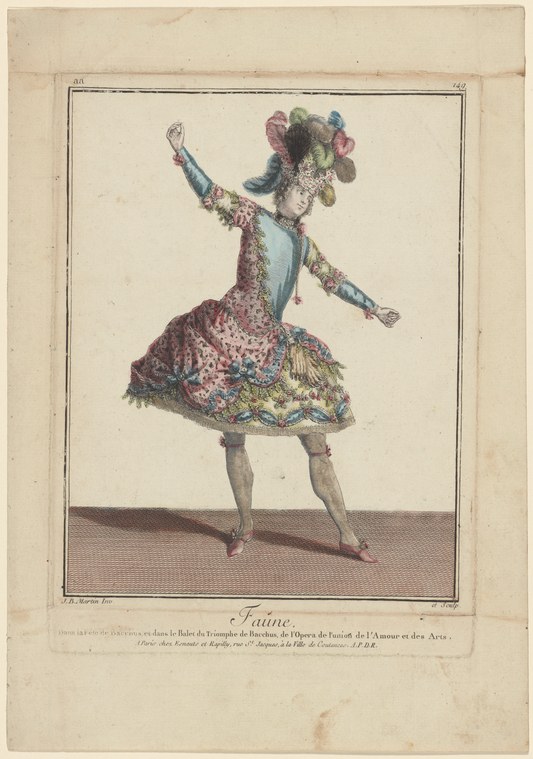
Faune. Dans la fête de Bacchus, et dans le Ballet du Triomphe de Bacchus, de l'opéra de l'union de l'amour et des arts
Unknown artist
- Collection:
- Prints depicting dance
- Source:
- New York Public Library
- Rights:
- Public domain — free to use, share and adapt.
- Recorded as:
- Public Domain
This print documents how Baroque court dancers used their trained bodies not primarily to generate movement but to hold and display elaborate costume in carefully composed poses. The image shows that even mythological comic characters (fauns, satyrs) were performed by trained balletic dancers, and reveals the visual hierarchy of the period: spectacular costume and ornament were as central to theatrical dance as movement itself. The inscription preserves the title and context of a specific work that would otherwise be lost.
What you are looking at
A single dancer in theatrical costume stands alone against a plain background, captured in a moment of dynamic performance. The figure wears an ornately decorated skirt in deep rose or burgundy, densely patterned with floral motifs and trimmed with what appears to be feathered or fringed edging that extends below the knee. The upper body is draped in pale blue fabric with decorative garland or floral swags looped across the chest and shoulders. The dancer's dark hair is crowned with an elaborate arrangement of feathers or plumes in multiple colors—pink, blue, green—creating a tall, fan-like headdress. The pose is one of exuberant display: one arm is raised high holding what may be a decorative object or fan, while the other extends outward; the legs are visible and positioned in a balletic stance with weight forward and one leg slightly advanced. The figure stands on a simple ground line rendered in perspective, establishing shallow stage space.
The dancing
A single standing figure in a balletic frame, with elongated limbs and an upright carriage characteristic of theatrical dance. One arm is raised above the head with the hand extended, while the other arm reaches across the body at chest height; the legs are extended in an open, forward-facing position suggesting motion or the suspension of movement. The pose has the controlled artificiality of a trained dancer rather than the naturalistic stance of an untrained figure. The body is highly ornamented rather than clothed, emphasizing display and spectacle.
The dance depicted
This appears to be a faun or satyr figure from a Baroque theatrical work, most likely from a court ballet or theatrical entertainment. The printed caption identifies this as 'Faune' and references 'la fête de Bacchus' (the festival of Bacchus) and a 'Ballet du Triomphe de Bacchus' from an opera on the theme of 'l'union de l'amour et des arts' (the union of love and the arts). Such mythological characters were stock roles in seventeenth-century French court ballet and theatrical dance. The flamboyant costume and exaggerated headdress, combined with the deliberately artificial pose, suggest a comic or grotesque version of the classical faun—a creature of revelry and sensuality appropriate to Bacchic themes. The visible balletic training in the figure's stance indicates this was performed by a trained dancer, likely male despite the delicate features rendered here.
How it was made
This is a hand-colored engraving or etching, executed with fine line work and rendered in pale tones with selective hand-coloring in watercolor or gouache (pink, blue, green, and burgundy). The technique is typical of seventeenth-century French theatrical costume prints intended for documentation and circulation among courtiers and artists. The engraved line provides crisp definition of the costume details—the patterning of the skirt, the arrangement of the headdress, the draping of the upper garment—while the hand-coloring adds life and specificity to the theatrical appearance. Such prints were collected and preserved as records of court spectacles and as reference material for artists and performers.
About this work
This is a documented costume study from a Baroque court ballet or operatic entertainment centered on Bacchic (Dionysian) themes, likely French and dating to the seventeenth century. The image preserves not the dance itself but a single moment of theatrical presentation—the pose a performer would hold to display the costume and character to the court audience. It belongs in a dance archive because it documents both the training and artifice of Baroque theatrical dance and the spectacular costume practice within which that dance was embedded. The figure's balletic stance shows that even comic or grotesque roles in court entertainment required trained dancers and were performed with formal technique.
How to look at it
The pose is not a moment of movement but a display pose—the dancer has paused or is being presented to the viewer much as one might present a work of art. Notice how the figure is frontal and symmetrical, with both the costume and the body arranged for maximum visibility. The raised arm and extended gaze suggest a moment of revelation or exhibition rather than an action within a narrative. The costume is so elaborate and weighted (especially the patterned skirt and tall headdress) that mobile dance steps would be difficult; the artist has chosen to show the figure in a controlled, statuesque pose that emphasizes decorum and spectacle over virtuosic movement. The inscription below is crucial: read it to understand that this is a specific, documented character from a named work, not a generic representation.
The period
This work dates to the era of French court ballet under Louis XIV (reigned 1643–1715), when such spectacles were central to court culture and royal propaganda. Mythological themes, especially Bacchic and erotic ones, were popular subjects in both court ballet and operatic entertainment. The opera-ballet, combining music, dance, and spectacular visual display, was reaching its height as a court form in the late seventeenth century. Such costume prints served multiple purposes: they documented court spectacles for those present, advertised the magnificence of the court to a wider audience, provided reference material for artists and performers, and preserved records of works that were ephemeral performances. The integration of trained dance with theatrical costume and mythological narrative was a defining feature of Baroque court culture across Europe, but particularly prominent in France.
Where it lives
This print is held in the New York Public Library's collection of prints depicting dance. It is a hand-colored engraving from the seventeenth century, of French origin, documenting a court ballet or operatic entertainment.
Dance in this work
Questions about this work
Is this a male or female dancer?
The faun was a mythological male creature of the satyr family, and the role would typically have been performed by a male dancer in Baroque court ballet. However, the print is rendered with delicate facial features and the costume is designed for visual spectacle rather than anatomical realism. Baroque court ballet often featured highly stylized and artificial presentations of gender.
What is the faun doing?
The dancer is posed to display the costume and character rather than to perform a specific action. This is a presentation pose—the moment a performer would hold while the audience took in the visual splendor of the costume, music, and setting. The raised arm and frontal stance are conventions of theatrical display rather than dance movement.
What was a Bacchic ballet?
Ballets celebrating Bacchus (Dionysus) and his festival were popular in seventeenth-century court entertainment. They provided an occasion for the display of elaborate costume, sensual and comic characters (nymphs, fauns, satyrs), music, and mythological narrative. Such works often carried double meanings, celebrating both the god's power and the court's magnificence and refinement.
Why is the costume so ornate?
Spectacular costume was central to court ballet. The visual grandeur of the performance—the colors, fabrics, ornaments, and sheer quantity of material—demonstrated both the resources of the court and the skill of the artists who designed and executed the work. A dancer's role was partly to carry and display this costume.
More dance artwork





