49 works in this view — arrow keys or swipe to move between them.
Dance in Art
De nieuwe tuin
Unknown artist
- Collection:
- Prints depicting dance
- Source:
- New York Public Library
- Rights:
- Public domain — free to use, share and adapt.
- Recorded as:
- Public Domain
Court ballet was the ancestor of modern theatrical dance, and this print is direct documentary evidence of its staging and social context. It shows that dance was not an isolated art form but integrated into a multimedia spectacle designed to honor the court and reinforce social order. The prominence of the seated audience—a full house of nobles—demonstrates that watching dance was a central court activity.
What you are looking at
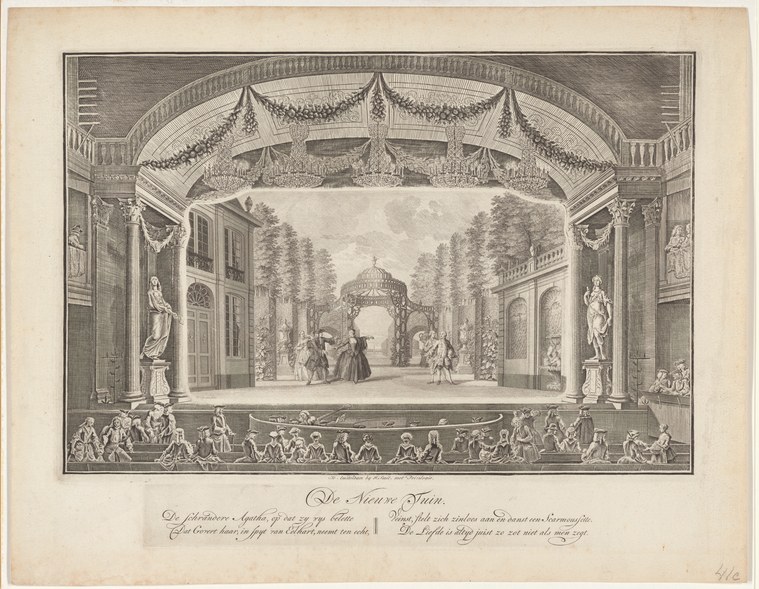
A theatrical garden scene viewed through a proscenium arch, framed by ornate drapery swags and classical columns. The stage depicts a formal Renaissance or baroque garden with tall cypress trees lining both sides, classical pavilions or grottos at left and right, and an ornamental domed structure or gazebo at center rear. In the middle distance, several figures in period dress move or stand in the garden space. The foreground shows an audience of spectators seated in rows facing the stage, their heads and shoulders visible from behind—a full house of well-dressed courtiers or nobility. The entire composition demonstrates theatrical perspective and the architectural sophistication of court entertainment spaces. The print shows careful attention to the layered depth of the performance: audience, proscenium frame, and staged action are all legible.
The dancing
At least six figures occupy the stage space, dispersed across the depth of the garden rather than massed at the front. Several wear long period gowns and appear to be walking or pausing in conversation; at least two figures in the center space seem to be dancing or moving together in a more animated fashion. The positioning suggests both formal promenade and paired dance. Without clearer detail, the exact hold and frame cannot be determined, but the figures appear upright and leisurely, consistent with courtly movement rather than vigorous ballet.
The dance depicted
This is almost certainly a depiction of court ballet or theatrical dance from the late Renaissance or early baroque period—likely a ballet de cour, the elaborate spoken and danced performances that dominated French and Italian court life in the sixteenth and seventeenth centuries. The garden setting, the mixture of standing, walking, and dancing figures, and the prominent audience all match the documented format of these entertainments, in which courtiers and nobles danced allegorical or mythological narratives in costume. The style of the figures and the architectural vocabulary point to the sixteenth or early seventeenth century. The precise dance forms cannot be identified from the print, but bourrées, pavanes, or other courtly dances are likely.
How it was made
This is an engraving or etching on paper, identifiable by the fine parallel line-work (hatching and cross-hatching) used to create tone and shadow, the crisp contour lines, and the tonal range from black to white typical of intaglio printing. The detailed architectural rendering and the careful recession of space suggest a skilled hand. The medium allowed wide circulation—multiple impressions could be struck from the plate—making this likely a documented record of an actual performance, published to commemorate or celebrate the event for a court audience and educated patrons. The Dutch title and provenance suggest this may have been published in the Low Countries, where court ballet documentation was actively collected.
About this work
This print documents a performance of court ballet, or ballet de cour, in a formal garden setting. The image captures the theatrical apparatus of early modern court entertainment: the framed stage space, the live audience in close quarters, the mixture of allegorical and courtly figures in period dress, and the architectural splendor of the designed garden. It is both a record of a real performance and an artistic composition showing how dance, music, spectacle, and social hierarchy merged in court life. For historians of dance, it offers crucial evidence of how these performances looked, how they were staged, and how they functioned as court ritual and entertainment.
How to look at it
Look first at the framing device: the proscenium arch and drapery establish this as a theatrical performance, not a casual garden gathering. Then follow the recession into space—the careful perspective lines that carry the eye from the foreground audience through the middle-distance dancers to the garden architecture beyond. Notice the mixture of poses: some figures are upright and processional, others seem to be in partnered movement. The artist has chosen a moment of varied activity rather than a frozen tableau, suggesting motion and narrative unfolding across the stage. The detail lavished on the architecture and the crowd of spectators tells us this was a significant, well-funded occasion.
The period
Court ballet, or ballet de cour, flourished in France and Italy from roughly the 1580s through the seventeenth century. These performances combined dance, music, poetry, and elaborate costume and scenery, often with allegorical or mythological narratives. They were sponsored by the crown and performed by courtiers, including royalty. The genre was documented extensively in prints, which helped disseminate the prestige of court culture across Europe. The architectural language of the garden—formal, classical, geometric—reflects Renaissance ideals of order and artifice. By the time this print was made, court ballet was the dominant theatrical form in European courts, though it would eventually evolve into the ballet d'action and modern ballet.
Where it lives
The work is held in the New York Public Library's Prints collection, which documents theatrical and social history through visual records. The Dutch title ('De nieuwe tuin') and the style of the engraving suggest it was published in the Low Countries, possibly as a record of a performance at a continental court or as a circulating image of court spectacle for an educated audience.
Dance in this work
Questions about this work
Was this a real performance, or an artist's fantasy?
Almost certainly a real performance. Court ballet prints typically documented specific events—masques, ballets de cour, or court celebrations—and were published to commemorate them and circulate their prestige. The specificity of the title, the architectural detail, and the careful staging all suggest this is a record, not an invention. The engraving technique allowed multiple copies to be made and distributed to other courts and patrons.
Who performed in court ballet?
Court ballet was performed by courtiers and nobles, including members of the royal family. It was not a profession but an obligation and honor for those close to the crown. The mix of skill levels and social rank meant these were not always polished performances by modern standards, but they were highly valued as displays of courtly accomplishment and loyalty. The prominence of the audience in this print shows how central spectatorship was to the social meaning of the event.
What dances would have been performed?
The specific forms are hard to identify from a print alone, but court ballet drew on the courtly dances of the period: pavanes, galliards, courantes, and branles. Unlike later ballet, court ballet was not primarily about virtuosity or lifted movement, but about grace, proportion, and courtly bearing. The garden setting suggests that walking, processional movement, and leisurely group formations were part of the choreography.
Why was the garden such a popular setting?
The formal Renaissance garden symbolized order, cultivation, and princely power. As a theatrical setting, it allowed for elaborate perspective scenery, multiple levels and areas for movement, and an association between the performance and the patron's wealth and taste. Gardens were also real spaces where court performances sometimes took place, blurring the line between theater and lived courtly life.
More dance artwork





