49 works in this view — arrow keys or swipe to move between them.
Dance in Art
Armide
Unknown artist
- Collection:
- Prints depicting dance
- Source:
- New York Public Library
- Rights:
- Public domain — free to use, share and adapt.
- Recorded as:
- Public Domain
This is a primary historical document of court ballet at its height, showing how a major baroque theatrical work integrated dance, narrative, and visual spectacle. For dancers and historians, it is evidence of how the body was positioned, dressed, and framed in elite theatrical performance when ballet was still inseparable from opera and court ceremony. The engraving also demonstrates an early modern method of dance documentation—the circulated print—that allowed performances to reach and influence audiences far beyond their original venue.
What you are looking at
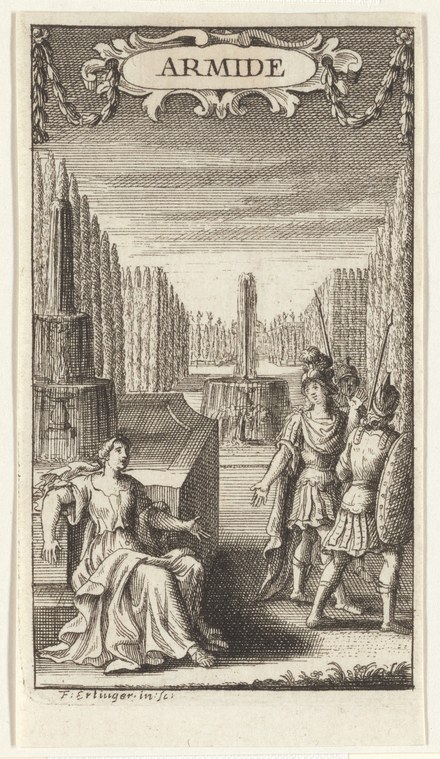
This engraving depicts a scene from Lully's opera-ballet *Armide*, likely from the late 17th or early 18th century. The composition is divided into two spatial zones: in the foreground left, a richly dressed woman reclines in an attitude of repose or reverie, her elaborate gown and jewelry marking her as a figure of rank. To the right, a standing figure in classical military dress—possibly Renaud or another male character—gestures toward her, while attendants in the middle distance suggest a court or palace setting. Tall columned arcades define the architectural space, their ordered repetition creating depth and formality. The lighting is created through dense parallel hatching, giving the scene a theatrical atmosphere appropriate to operatic spectacle. The composition emphasizes the psychological moment of encounter rather than active dance, though the figures occupy poses and spatial relationships that suggest the choreographic syntax of the court ballet tradition.
The dancing
The reclining female figure occupies a languid, supported pose with her weight distributed across cushioned furniture, her upper body slightly elevated and turned toward the approaching visitor. The standing male figure is shown in a classical contrapposto, one leg engaged and the other supporting, his arm raised in a gesture of address or revelation. His posture is vertical and formal, the inverse of her recumbent attitude. A third attendant figure stands slightly apart, creating spatial hierarchy and narrative distance. None of the figures are shown in the midst of active footwork or balletic lift; instead, the artist has chosen poses of stillness and gestural exchange, which was integral to court ballet's emphasis on eloquence of position and decorum.
The dance depicted
The work illustrates *Armide*, Lully's tragédie lyrique first performed in 1686, one of the most celebrated operatic works of the ancien régime. *Armide* is not a pure dance work, but a staged spectacle in which court ballet formed one component of an elaborate multimedia performance combining sung recitative, instrumental music, scenic machinery, and choreographed episodes. The scene shown here represents a narrative or transformative moment rather than a formal dance, suggesting the work's emphasis on dramatic tableau and courtly decorum. The female figure's pose and setting recall the iconography of enchantment and luxury central to the opera's plot, in which Armida (a sorceress) encounters and is drawn to Renaud (a crusader). The work belongs to the world of court ballet and operatic spectacle, not ballroom or theatrical dance as later defined.
How it was made
This is an engraving, created through incised lines on a metal plate (likely copper) and printed in black on paper; the signature "Erlinger in Francf." appears in the lower left, indicating a Frankfurt engraver. The technique of engraving was ideal for circulating images of theatrical spectacles to a educated, elite readership across Europe, allowing expensive and ephemeral court productions to reach audiences who could never witness them in person. The dense hatching and fine parallel lines typical of engraving create tonal gradation and atmospheric effect, while the technique's precision suited the architectural detail and refined costume rendering. The presence of a printed title cartouche and engraver's mark indicate this was a commercial print, likely bound into a larger collection or sold individually as a memento of the performance or publication.
About this work
This engraving documents one of the most significant court ballets of the French baroque, Lully's *Armide* (1686). It belongs to a tradition of printed dance documentation in which theatrical performances were captured and disseminated as engravings—a crucial record of how court spectacle looked to contemporaries. The work shows a moment of narrative and visual stillness rather than active choreography, reflecting the baroque court ballet's integration of dance, gesture, decor, and storytelling. As a printed image, it exemplifies how dance was both ephemeral spectacle and circulated cultural commodity, existing in the engraving as a permanent record of a fleeting court event.
The image is valuable because it records the visual culture and costume conventions of the operatic tradition in which ballet played an essential role, and because it demonstrates how dance imagery reached audiences beyond the court itself. The engraving preserves evidence of staging, architectural scenery, and the poses and deportment valued in a performance tradition now known only through texts, musical scores, and images like this one.
How to look at it
Attend first to the spatial and postural relationship between the two main figures: the artist has chosen a moment of psychological encounter rather than choreographic action, emphasizing the stillness, formality, and decorum of court spectacle. The elaborate dress—the woman's jeweled gown and the man's classical cuirass—is itself spectacle; note how the engraver has rendered fabric, ornament, and fabric weight with great care. The columned architecture frames the action and creates a sense of stage space as a formal, ordered environment. The artist's choice of hatching and tone suggests the lighting effects and atmospheric depth of theatrical scenery, indicating that this engraving was intended to convey not just narrative content but the visual splendor of the original performance.
The artist
The engraver is identified as working in Frankfurt ("in Francf."), suggesting a German or Frankfurt-based printmaking workshop of the late 17th or early 18th century. The signature indicates the print was a commercial product, likely created after the work's premiere to capitalize on its fame. The engraver's name is not widely recorded in surviving scholarship, reflecting the often-anonymous status of reproductive engravers, but the technical refinement and attention to theatrical detail suggest a sophisticated workshop with experience in operatic and court spectacle imagery.
The period
Lully's *Armide* (1686) was created during the reign of Louis XIV at the height of the Sun King's power and the classical French baroque. The opera-ballet form was a distinctly French creation, combining Italian operatic influence with the French court ballet tradition that had flourished since Catherine de Medici's time. By 1686, ballet was no longer primarily an aristocratic participatory art but increasingly a professional theatrical spectacle, though court dancers still performed alongside professional dancers from the Académie Royale de Danse (founded 1661). The engraving belongs to a late 17th-century boom in printed theatrical documentation, a consequence of both the professionalization and commercialization of theater and the increasing prestige of the French court's cultural productions throughout Europe.
Where it lives
The work is held in the New York Public Library's collection of prints depicting dance. It is catalogued within a thematic collection rather than through artist name or accession number, reflecting how theatrical prints of this era were often collected and bound together by subject or type rather than by printmaker. The NYPL's dance prints collection includes numerous images documenting European court and operatic performance.
Dance in this work
Questions about this work
Is this an actual scene from the performance, or was it invented by the engraver?
Likely some of both. Engravings of operatic scenes were based on the actual production—the engraver would have attended or received descriptions—but composed and idealized for print. The poses and spatial arrangement show the conventions of court spectacle, but the specific moment may be a creative synthesis rather than a literal transcription of a single performed instant.
Why is she reclining while he stands?
The contrast expresses narrative and hierarchical meaning. In *Armide*, the sorceress Armida is portrayed as enchanted and vulnerable when she encounters Renaud; her reclined pose expresses a state of aesthetic surrender or magical thrall, while his vertical, gestural stance shows agency and command. This postural contrast was a language of baroque court ballet.
Was this performance attended by the King?
*Armide* was a major production and would certainly have been performed before Louis XIV, who was a serious patron and occasional dancer himself. However, this specific image documents the work itself rather than its audience or a particular royal viewing.
How many dancers performed this role originally?
Court ballet roles in operas like *Armide* would have been danced by professional dancers from the Académie Royale, typically one principal dancer per major role, sometimes with a corps de ballet for ensemble scenes. The attendants visible in this engraving would have been among these professional dancers.
More dance artwork





