49 works in this view — arrow keys or swipe to move between them.
Dance in Art
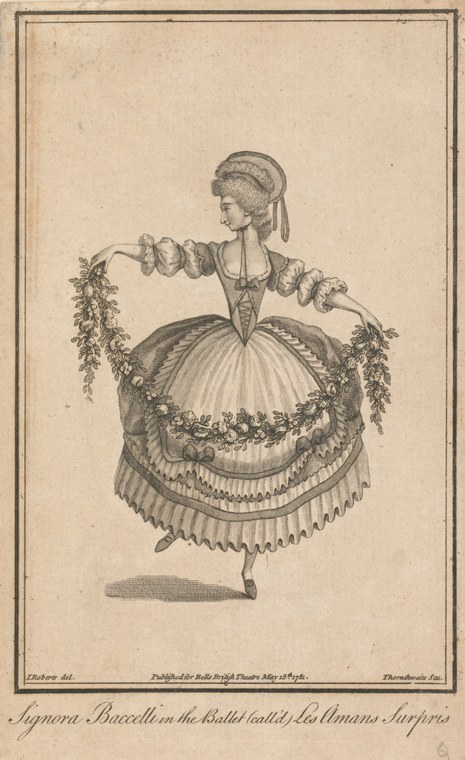
Signora Baccelli in the ballet (call'd) Les amans surpris
Unknown artist
- Collection:
- Prints depicting dance
- Source:
- New York Public Library
- Rights:
- Public domain — free to use, share and adapt.
- Recorded as:
- Public Domain
Baccelli was a figure of genuine historical importance in late 18th-century dance, known for combining Italian virtuosity with English theatrical taste. This engraving is one of the primary visual documents of how she was actually presented on stage—not in action, but as a composed, decorated presence—and it reveals the enormous gap between the costume and body ideal of that moment and what a modern ballet dancer would recognize as dance.
What you are looking at
A single female dancer occupies the center of the composition, caught mid-performance in a moment of theatrical display. She wears an elaborate gown with a high, pointed bodice and a dramatically voluminous skirt composed of deeply pleated or gathered layers of fabric. Over her shoulders she drapes two strands of garland or flowered swags that extend diagonally across her body and toward the ground, creating a sense of movement and decorative abundance. Her headdress is a tall, wrapped turban or coiffure secured with what appears to be a long trailing ribbon or scarf. She stands in a classical contrapposto pose with her weight shifted to one leg, her body angled to the viewer's right, and her expression in profile showing a composed, aristocratic demeanor. The engraving is rendered against a plain background with minimal setting detail—only a shadow beneath her feet suggests spatial grounding. The print is finely detailed with careful cross-hatching to suggest fabric texture and volume, particularly in the rendering of the elaborate skirt.
The dancing
The dancer is alone in the frame, positioned in a three-quarter view. Her posture is upright and controlled, the weight clearly shifted onto her back leg in a supported stance that would allow for balance while wearing the voluminous costume. Her arms are extended, one at shoulder height grasping or presenting the garland swags; the other is positioned lower, aiding the balance and framing of the body. The pose is fundamentally still and displayful rather than kinetically mobile—this is a moment of presentation rather than active traveling or jumping. The costume itself—the rigid bodice and enormous skirt—would severely restrict leg movement and require the dancer to work primarily from the torso and arms.
The dance depicted
The title identifies this as Signora Baccelli performing in a ballet called 'Les amans surpris' (The Surprised Lovers). Baccelli was a celebrated Italian dancer who performed in London in the late 18th century, and this work likely documents her performance in a comedic or pastoral ballet of that era. The costume, pose, and framing are consistent with late 18th-century theatrical ballet for women—a form that emphasized verticality, elegance, and a controlled presentation of the body within elaborate dress. The garlands suggest a pastoral or allegorical theme, common in ballet de cour and its successors. The dance depicted here is more about courtly display and dramatic presence than virtuosic footwork; the enormous skirt would have permitted only small, precise steps and turns close to the body.
How it was made
This is an engraving, as indicated by the fine parallel lines (hatching and cross-hatching) used to create tone, shadow, and the illusion of textile texture and volume. The technique allowed for precise detail in the costume and face, and the image carries a signature-like attribution line reading 'Bodero del' (drawn by Bodero) and 'Thomasassin fecit' (engraved by Thomasassin) at the bottom margin. Engravings of this type were commercial prints, likely sold individually or in series to a fashionable London audience eager for images of celebrated performers. The formal framing with a decorative border and the inclusion of the dancer's name and the ballet title below suggest this was a published commemorative print, a standard way of circulating knowledge of stage performances before photography.
About this work
This is a late 18th-century engraving documenting a performance by Signora Baccelli, one of the most celebrated dancers of her time, in a theatrical ballet titled 'Les amans surpris.' The print captures the moment not as dynamic action but as a portrait of an elegant performer in costume—a convention that tells us much about what late 18th-century ballet audiences valued: the beauty of the costumed body, aristocratic carriage, and the display of wealth and refinement through dress. The work belongs to a significant tradition of dance imagery that served as visual record and promotion for theatrical performances in an era before photography or film, allowing dancers to achieve a kind of visual immortality and reaching audiences beyond the theater itself.
How to look at it
Notice the stillness of the pose and the way the body is framed by costume rather than revealed by it. The engraver has lavished attention on the texture and volume of the skirt, using fine hatching to suggest the weight and quality of the fabric—this was as much a portrait of dress as of the dancer. The garlands draped across the body create diagonal lines that give the otherwise frontal pose a sense of gentle movement, and the lifted heel and shifted weight suggest the kind of small, precise weight transfers that would have been the basis of the actual dancing. The face is calm and composed, neither ecstatic nor engaged in dramatic pantomime—this is how late 18th-century audiences wanted to see their ballet dancers: elegant, refined, and in command.
The artist
The engraving is credited to Bodero (draughtsman) and Thomasassin (engraver). Both were working in London in the late 18th century in the commercial print trade, producing theatrical and portrait engravings for a fashionable, literate clientele. Thomasassin in particular was known for fine detail work in costume and textile rendering. This type of collaborative attribution—a draughtsman working from life or prior design and a skilled engraver translating that into print—was standard practice in theatrical portraiture of the period.
The period
This print dates to the era when ballet was transitioning from its origins in court spectacle toward a more professionalized theatrical form, though still bound by rigid conventions of costume and comportment. The late 18th century saw the rise of the ballerina as a celebrated public figure; dancers like Baccelli achieved celebrity status comparable to opera singers. The enormous skirt was the fashion in stage costume at this time—a far cry from the tutu that would emerge in the Romantic era a generation later. The pastoral and comedic subjects of ballets like 'Les amans surpris' reflected Enlightenment taste for wit and elegance rather than the tragic grandeur of earlier ballet de cour.
Where it lives
The print is held in the New York Public Library's Prints collection, part of a broader archive of dance imagery spanning from the Renaissance to the present. It belongs to a significant subset of 18th- and 19th-century theatrical engravings documenting performers and roles, many of which survive in only a handful of copies.
Dance in this work
Questions about this work
Who was Signora Baccelli?
Baccelli was an Italian dancer who achieved major celebrity in London in the 1780s-90s. She was known for technical skill, beauty, and the ability to move between serious and comic roles. She represents a transitional figure between the older world of court dance and the modern theatrical ballet world, and she was a frequent subject of engravings and paintings.
What does the title 'Les amans surpris' refer to?
The title translates as 'The Surprised Lovers' and likely refers to the plot of the ballet—a short comedic or pastoral piece centered on a pair of lovers caught in some awkward or delightful moment. The garlands in Baccelli's costume suggest a pastoral setting. Very few details of specific 18th-century ballet plots survive, so the exact narrative content is now largely lost.
Why is the skirt so enormous?
The enormous pleated or gathered skirt was the fashion for women's stage costume in the late 18th century. It was made of lightweight silk or muslin and required skill to manage—dancers had to control it through body movement and careful footwork. It also functioned as a display of luxury and craftsmanship, signaling wealth and status. Within a generation, the skirt would become shorter and higher on the leg, allowing for more visible footwork.
Is this engraving accurate to how the dance was actually performed?
The pose is likely accurate to a moment in the performance—a moment of presentation or display rather than active traveling. However, engravings of dancers were rarely neutral documents; they were promotional images that emphasized beauty, elegance, and the quality of the costume. The actual performance would have involved much more small-scale movement, turning, and footwork than this single moment suggests.
More dance artwork





