49 works in this view — arrow keys or swipe to move between them.
Dance in Art
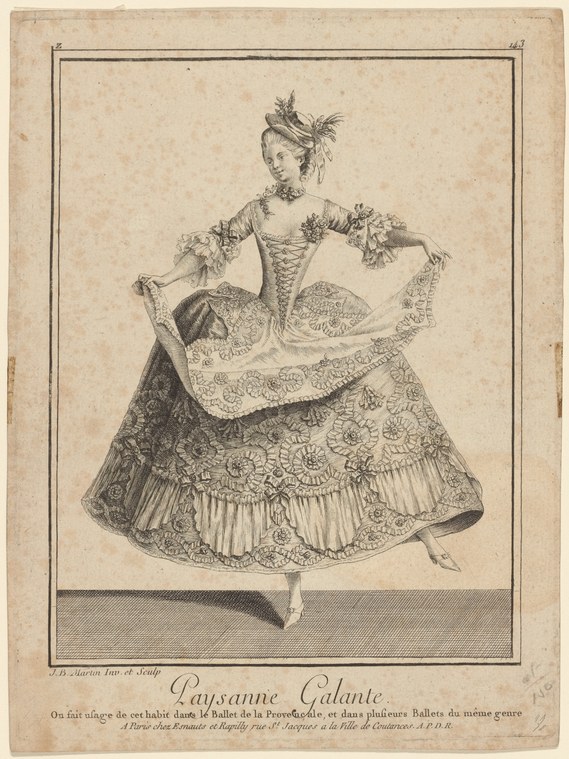
Paysanne galante: On fait usage de cet habit dans le Ballet de la Provençale et dans plusieurs ballets du même genre
Unknown artist
- Collection:
- Prints depicting dance
- Source:
- New York Public Library
- Rights:
- Public domain — free to use, share and adapt.
- Recorded as:
- Public Domain
Costume prints like this are among the few direct visual records of how 18th-century theatrical dance appeared and how it was promoted to the public. They show that these dances were understood as visual spectacles in which costume, posture, and decoration were inseparable from movement itself—changing how we interpret descriptions of 'steps' or 'figures' from written sources of the period.
What you are looking at
A single female dancer is shown in a three-quarter view against a plain background, captured mid-movement with her body turned to display the full volume and decoration of her costume. She wears an elaborate dress with a deeply boned bodice adorned with floral embellishments at the neckline and sleeves, paired with a voluminous skirt featuring dense floral patterning and pleated details along the hem. The skirt is lifted and gathered in both hands, creating a dynamic arc that frames her body and reveals the construction of the garment. Her posture is elegant and controlled, with her weight appearing to shift forward, and she wears her hair styled high with feathered ornaments. The engraving's fine hatching creates subtle modeling across the figure while maintaining crisp definition of the costume's textures and patterns, suggesting movement and liveliness despite the stillness of the printed medium.
The dancing
The dancer stands in a poised, slightly asymmetrical stance with her torso turned and her arms raised to frame the skirt. Her legs are fully extended beneath the bodice, with her weight balanced. The gesture is fundamentally theatrical and presentational rather than depicting rapid movement—her arms are engaged in displaying the costume rather than performing a functional step pattern. The posture suggests the controlled elegance expected of court or stage performers of the period, with an emphasis on the geometry and volume of dress.
The dance depicted
This is a costume study for a theatrical dance, specifically identified in the inscription as a 'paysanne galante' (gallant peasant style) used in the ballet *La Provençale* and similar pastoral ballets. The term indicates a stylized rustic aesthetic popular in 18th-century court and theatrical dance—not an actual peasant dance but an aristocratic interpretation of rural subjects. The image shows not movement itself but the display of a costume designed for such performance, allowing viewers to understand the visual spectacle these dances created. The lifting of the skirt is both a practical gesture for movement and a deliberate display of the garment's construction and ornamentation.
How it was made
This is an engraving, executed with fine lines and careful cross-hatching to render the textures of fabric, lace, and embroidery. The technique allowed for precise reproduction and wide circulation—engravings of dance costumes were distributed as prints for performers, audiences, and collectors interested in theatrical fashion and choreography. The image exists at the intersection of costume documentation and promotional art, intended to circulate knowledge of new works and performers among educated audiences across Europe.
About this work
This engraving is a costume design print, one of a category of theatrical ephemera that documented dance through dress rather than through narrative or movement. The *Paysanne galante* represents the 18th-century taste for pastoral themes in court ballet—a convention that wrapped aristocratic bodies in a fantasy of rural simplicity while preserving all courtly elegance in posture and decoration. The work belongs in a dance collection because it is primary evidence for how these dances looked to their audiences: dancers were seen first through their costumes, and the movements were designed to display them. Without such prints, the visual reality of 18th-century theatrical dance would be nearly invisible.
How to look at it
Observe how the artist has frozen the moment of display rather than action—the raised skirt is held, not caught mid-swing, allowing full visibility of the garment's construction. The engraver's priority is clarity of texture: the fine lines distinguish between lace, embroidery, pleating, and plain silk, making this as much a technical drawing as an artistic representation. Notice how the figure's pose emphasizes the costume's silhouette and volume; the body itself is secondary to the frame and volume created by the dress.
The period
This print dates from the early-to-mid 18th century, when ballet was transitioning from court spectacle to professional theatrical entertainment. Pastoral themes ('paysanne,' 'provençale') were fashionable, reflecting Enlightenment interest in idealized nature and rural life among urban, aristocratic audiences. The engraved costume print was an established format by this period—a commercial and informational medium that allowed choreographers and dancers to circulate images of new works and establish their reputations across Europe. These prints also functioned as fashion documents, as aristocratic audiences often imitated theatrical dress in their own clothing.
Where it lives
This print is held in the New York Public Library's collection of prints depicting dance. It is listed in their catalogue with the attribution note 'S.H. Marion inv. et sculp.' visible in the image, indicating the artist both designed and engraved the work.
Dance in this work
Questions about this work
Is this a record of an actual dance or a costume fantasy?
Both. 'Paysanne galante' was a real theatrical genre performed in 18th-century ballets, but it was an aristocratic fantasy of rural life, not a representation of actual peasant dance. The costume and pose shown here are historically accurate to how such dances were performed and costumed on stage, but the 'peasant' identity was theatrical convention. The print documents what audiences actually saw.
Who would have owned or seen this print?
Engravings like this circulated among performers, theatre professionals, aristocratic patrons, and educated collectors interested in dance and theatre. They functioned as both promotional images (advertising new ballets) and fashion references. Performers might use them as costume guides, and audiences might use them as souvenirs or inspiration for their own dress.
What does the pose tell us about how this dance was performed?
The controlled, presentational posture—weight balanced, torso turned for display, arms lifted—indicates that these dances prioritized elegance, visibility, and grace over rapid footwork or athletic movement. The lifted skirt suggests that the dancer used the volume of the costume as part of the visual effect, deliberately displaying the garment as part of the dance itself. This was characteristic of 18th-century court and early theatrical ballet.
More dance artwork





