49 works in this view — arrow keys or swipe to move between them.
Dance in Art
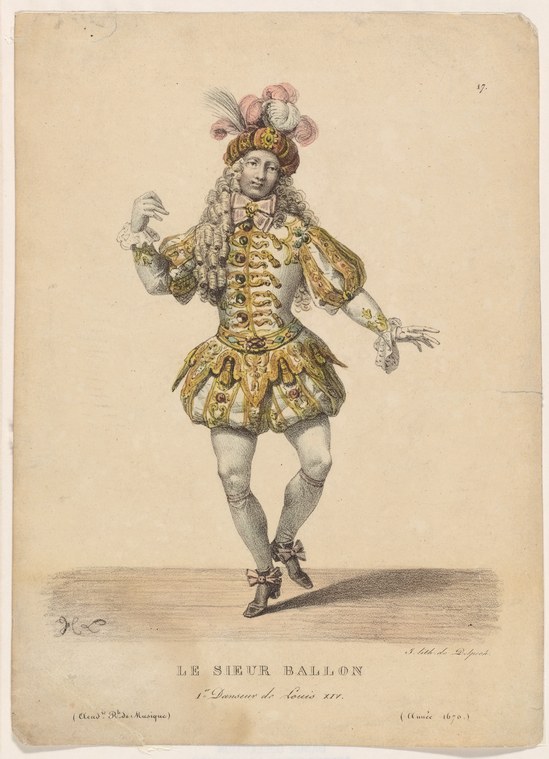
Le Sieur Ballon, 1er danseur de Louis XIV
Unknown artist
- Collection:
- Prints depicting dance
- Source:
- New York Public Library
- Rights:
- Public domain — free to use, share and adapt.
- Recorded as:
- Public Domain
Ballon was one of the most celebrated dancers of his era, lauded for his ability to appear suspended in air—a quality so prized that 'ballon' became the French term for this floating quality in elevated movements. This engraving is one of the few surviving visual records of how early professional ballet looked, what its practitioners wore, and how their bodies were positioned and trained. For historians and dancers, it is a rare glimpse into the physical reality of the art form before the codification of technique and the rise of the ballerina.
What you are looking at
A single male dancer fills the composition in a frontal, energetic pose against a plain background. He wears an ornate costume of the French court: a fitted jacket with elaborate gold embroidery and jeweled buttons, voluminous breeches, and white stockinged legs terminating in heeled shoes. A large pink feathered plume crowns his head, and decorative ribbons or bows ornament his costume. His left leg is raised sharply in front, knee bent, while his right leg supports his weight with a slight bend; his arms are held wide and somewhat raised, one hand open and expressive. The pose conveys arrested motion—a leap or jump caught mid-air, or a step executed with virtuosic control. The engraving is delicately colored by hand, the gold of the embroidery catching light against the pale background. A line of baseline marks the stage or dancing ground beneath his feet.
The dancing
The single dancer's weight is momentarily on one leg while the other drives upward and forward—a characteristic ballet position suggesting elevation and control. His arms are held expressively away from his body, palms open, the frame neither cramped nor slouched. The heeled shoe and the upright carriage of his torso are consistent with aristocratic dance training of the late 17th century. His proportions are naturalistic and his musculature suggested through the engraving, indicating the artist understood the physical demands of professional dancing.
The dance depicted
This is a French court ballet dancer of the Louis XIV era, most likely from a printed series of character studies or role types used in court spectacles. The inscription identifies him as 'Le Sieur Ballon,' the celebrated first dancer of Louis XIV's reign, famous for his elevation and brilliance. The raised leg, the heeled shoe, and the controlled demeanor suggest the fundamental techniques of early ballet—turnout, raised carriage, and the illusion of effortless flight. The costume is pure spectacle: court dress elaborated into theatrical magnificence, consistent with the *ballet de cour* tradition in which nobility and professional dancers performed in allegorical narratives.
How it was made
This is a hand-colored engraving, a technique that allowed precise linework defining the dancer's anatomy and costume detail, with watercolor or gouache applied afterward to bring the fabric and feathers to life. Engraving was the dominant medium for reproducing dance images in the 17th and early 18th centuries, enabling wide distribution to courtiers and scholars across Europe. The delicate parallel lines describing musculature and the fine hatching of shadow suggest a skilled printmaker who understood both the medium's technical demands and the glamorous subject.
About this work
A portrait engraving of the renowned dancer Ballon, first dancer of Louis XIV, captured in an arrested moment of elevation during a court ballet. The work is a primary document of early French ballet technique and aesthetics, showing the formal costume, the heeled shoe, the balletic frame, and the aristocratic deportment that defined the art form at the court of the Sun King. It belongs in a gallery of dance because it freezes not merely a pose but a transformative moment—the illusion of weightlessness that was the supreme achievement of the dancer's craft, rendered visible through the printmaker's technique.
How to look at it
Notice the moment of maximum elevation: the raised leg, the lifted chest, the arms spread wide. This is not a relaxed pose but a demonstration of virtuosity—the dancer suspended at the apex of a leap or performing a deliberately controlled, showy step. The enormous plume and embroidered coat are not merely costume but evidence of spectacle as a central value; the dancer's body is framed as a jewel. Compare the heeled shoe, the turned-out leg, and the upright carriage to later images of ballet dancers: the fundamentals were already in place.
The period
This engraving dates from the era of Louis XIV's court (mid-to-late 17th century), when ballet was transitioning from a courtly pastime for nobility to a professional theatrical art. The *ballet de cour* was a multimedia spectacle combining dance, music, poetry, and elaborate costume and machinery, performed at Versailles and other royal venues. Ballon's fame coincided with the establishment of the Académie Royale de Danse (1661), which sought to codify and elevate the art of dance. The clothing, the heeled shoes, and the theatrical abundance of the costume reflect both the aesthetic values of the absolutist court and the growing prestige of the professional dancer.
Where it lives
The work is held in the New York Public Library's collection of prints depicting dance, part of their broader holdings on the history of performance and costume. It is one of a larger corpus of engraved dancers' portraits and character studies produced in France during the 17th and 18th centuries, many of which documented specific roles or performers from court ballets.
Dance in this work
Questions about this work
Who was Ballon?
Jean-Baptiste Ballon (sometimes spelled Ballot) was the most celebrated dancer of the court of Louis XIV in the late 17th century. He was particularly renowned for his extraordinary ability to jump high and appear to float—a quality so associated with him that the French word 'ballon' (meaning 'balloon' or 'float') became the technical term for this balletic quality. He performed in many of the grand court ballets and was respected as a master of the art.
What is this costume?
It is an elaboration of courtly dress for the stage. The fitted jacket, breeches, and stockings follow aristocratic fashion of the period, but the gold embroidery, the abundant jeweled buttons, and especially the enormous feathered plume are theatrical amplifications. In court ballet, both noble amateurs and professional dancers wore costumes that transformed them into allegorical or mythological figures, and the costume was as important to the spectacle as the movement itself.
What is he doing?
He is captured mid-leap or mid-step, demonstrating elevation and control—the hallmark of his fame. His raised leg, open arms, and weight poised on one bent leg suggest either the apex of a jump or a deliberately showy step executed with balletic precision. The pose is designed to show off the technical achievement and the grace that distinguished a great dancer.
Why was this image made?
Engraved portraits of famous dancers served multiple purposes: they documented the performers and roles of celebrated court ballets, they circulated the glamour of the court beyond Versailles, and they may have served as references for costume makers and dancers. Prints of dancers were collected by courtiers and scholars as records of performance and taste.
More dance artwork





