49 works in this view — arrow keys or swipe to move between them.
Dance in Art
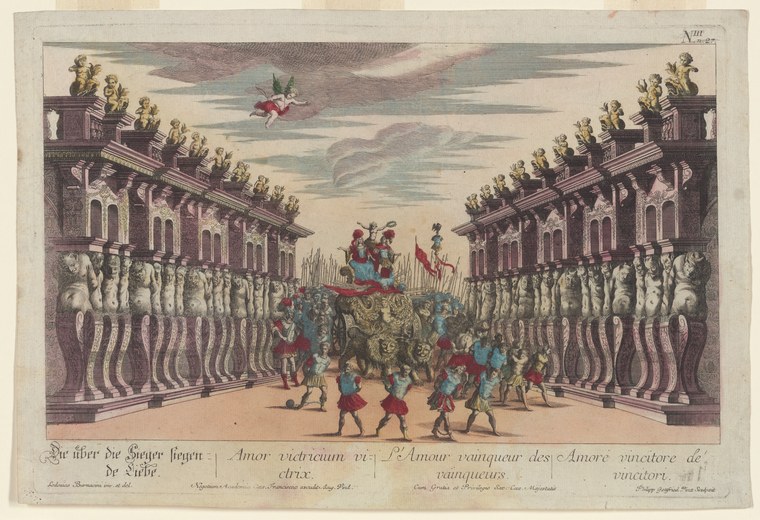
Die über die Sieger siegende Liebe
Unknown artist
- Collection:
- Prints depicting dance
- Source:
- New York Public Library
- Rights:
- Public domain — free to use, share and adapt.
- Recorded as:
- Public Domain
Court pageants and allegorical processions were a primary context for choreographed movement and the early development of theatrical dance in Europe; understanding how they were documented and imagined is essential to the history of dance as a courtly and political art. This engraving preserves visual testimony to the scale, architectural framing, costume, and allegorical intelligence that animated these spectacles, and to the role of the printed image in disseminating courtly culture across a dispersed European elite.
What you are looking at
A palatial garden or courtyard, flanked by monumental colonnades supporting entablatures crowned with urns and statuary, recedes in classical perspective. The paving is a light stone; the architecture is rendered in purple and gray in the manner of a hand-colored engraving. At the center, an elevated sedan chair or litter borne by attendants carries two figures in rich costume—a woman in red and blue, a man in corresponding dress. They are attended by a retinue of elaborately dressed courtiers and servants, some in the foreground in animated postures. The sky above is rendered in washes of gray and purple cloud. Two cherubs or putti ride in the heavens center-top, one trailing garlands or wreaths. The whole scene is ordered and ceremonial, yet animated: figures gesture, stride, and relate to the central pair with obvious deference. The engraving is a dense composition of court pageantry.
The dancing
The attendant figures in the foreground are rendered in varied postures—some striding with deliberate bearing, others gesturing toward the litter or each other. Bodies are upright and formally postured in the manner of court ceremony; no figure reclines or slouches. The attendants flank and follow the central litter in hierarchical arrangement. Arms are extended in gestures of presentation or reverence. The overall framing suggests a procession or formal rite rather than social dancing, yet the multiplicity of posed figures and their varied attitudes suggest orchestrated movement.
The dance depicted
This is not a scene of social or theatrical dance in the modern sense, but rather a court pageant or triumph—a form of organized ceremonial movement prevalent in Renaissance and Baroque court life. The elevation of the central couple, the architectural grandeur, the attendant retinue, and the celestial witnessing (the putti) all point to the *ballet de cour* or court spectacle tradition, in which elaborate processions, symbolic tableaux, and allegorical enactments formed the spectacular and dance-adjacent heart of courtly life. The title—*Die über die Sieger siegende Liebe* (Love Conquering the Victors)—suggests an allegorical narrative: Amor (Love, represented by the putti) triumphs over martial or civic victory. The figures in the procession are dancing or moving in a ritually prescribed manner, but the work is documenting a court ceremony rather than a ballroom dance or ballet proper.
How it was made
This is a hand-colored engraving, a print medium that allowed mass circulation of images of court spectacles to an educated and courtly audience across Europe. The technique is evident in the finework of the architectural detail, the linear hatching for shadow, and the layered hand-coloring in watercolor or gouache. Engravings of court festivals and pageants were a principal vehicle for disseminating knowledge of courtly magnificence and allegorical invention to those who did not attend; they were a form of courtly propaganda and cultural documentation. The scale and detail suggest a commemorative work documenting an actual event or a designed spectacle.
About this work
This engraving documents or envisions a court triumph or allegorical pageant, a ceremonial form central to Renaissance and Baroque court culture in which elaborately dressed figures process, gesture, and perform ritual movement in hierarchical formation. The title references Love's victory, suggesting the allegorical content; the putti in the heavens underscore the cosmic or divine dimension of the spectacle. The work belongs to a vast European tradition of court festival imagery that bridged dance, theatre, architecture, and visual art into unified spectacles of power and meaning. The print was likely made to celebrate or commemorate an actual court event, or to propose a design for one, circulating among courtiers and artists as a model of magnificence and invention.
How to look at it
Attend first to the geometry: the eye is drawn from the foreground attendants in varied postures through the colonnade toward the elevated central pair, whose lift and centrality is the hierarchical keystone of the composition. Note how the attendants' gestures and stances are carefully varied and choreographed—not frozen accident, but posed relationship. The putti overhead and the architectural grandeur are not mere decoration but part of the allegorical meaning: the heavens sanction and witness the earthly triumph. The hand-coloring, now faded, originally emphasized the richness of costume and the three-dimensionality of the space. Look at the title as a guide: *Love conquering* suggests that the movement and arrangement below is a visual argument, not mere illustration.
The period
This work belongs to a rich tradition of court festival imagery from the 16th and 17th centuries, particularly strong in German-speaking territories and the courts of the Holy Roman Empire. In the Renaissance and Baroque periods, elaborate court pageants combining dance, music, theatre, architecture, and allegory were central to courtly life and the display of sovereign power. The cult of Neoplatonic love and its literary and visual expression—often through allegorical triumphs in which Love conquers other forces—was a dominant theme in courtly art and spectacle from the 16th century onward. Engravings and etchings documenting these events or proposing designs for them were commissioned and circulated among courts, artists, and the educated nobility, serving as models for imitation and sources of prestige.
Where it lives
The work is held in the New York Public Library's collection of prints depicting dance. It is catalogued by title and medium only; artist, date, and place of origin are not recorded in the available metadata.
Dance in this work
Questions about this work
Is this a dance or a procession?
It is both. Court pageants combined ceremonial procession, allegorical tableau, and choreographed movement into unified spectacles. The distinction between dance and ritual procession was not sharp in Renaissance and Baroque court culture. The attendants and the couple are moving in a prescribed, rhythmic, and visually significant manner—which is to say, they are dancing in the courtly sense, even if not in ballroom or theatrical ballet style.
What does the title mean?
*Die über die Sieger siegende Liebe* translates as 'Love Conquering the Victors.' This is an allegorical conceit: the central couple, elevated and attended, are triumphing through or over Love (represented by the putti above). The pageant is a visual argument that love conquers even the victorious, a theme drawn from Neoplatonic courtly ideology.
Who performed this?
Court spectacles of this kind involved courtiers, nobles, and professional performers. The elevated central pair may be the patron/patroness or principal allegorical figures; the attendants and servants would be courtiers, professional dancers, and attendants. Without attribution or archival evidence, we cannot name specific performers, but the costume and formation suggest people of rank and trained in court ceremony.
Why would anyone engrave and distribute this image?
Court festival engravings served multiple purposes: to commemorate an actual event for those who attended and could not; to broadcast the magnificence and invention of a court to other courts and the educated elite; to preserve a design for future imitation or elaboration; and to demonstrate the patron's resources, taste, and political-allegorical ambitions. Prints were a primary medium of courtly cultural exchange.
More dance artwork





