49 works in this view — arrow keys or swipe to move between them.
Dance in Art
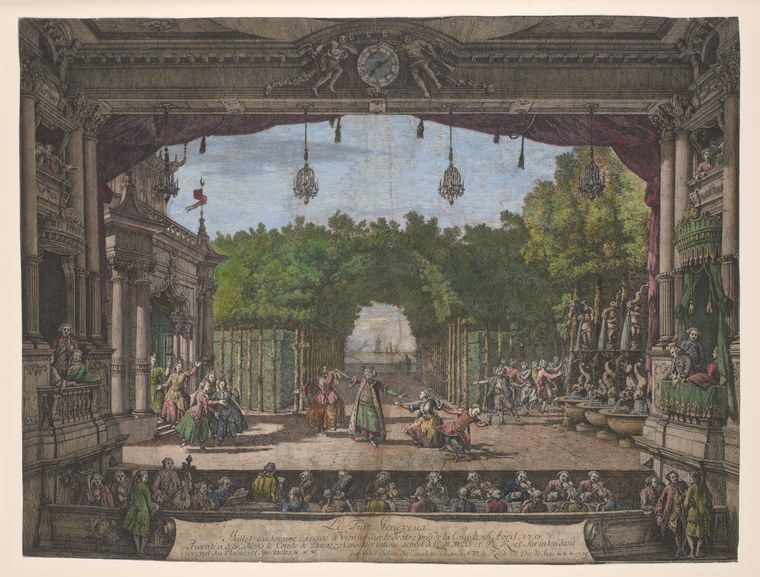
Le turc genereux, ballet pantomime executé à Vienne sur le teatre près de la cour le 26 avril, 1758
Unknown artist
- Collection:
- Prints depicting dance
- Source:
- New York Public Library
- Rights:
- Public domain — free to use, share and adapt.
- Recorded as:
- Public Domain
Ballet pantomime is now largely forgotten, displaced by the pure-dance ideals of later Romantic and modern ballet. This engraving is one of the few detailed visual records we have of how these narrative-theatrical works actually looked on stage, what the dancers wore, and how they were framed for an aristocratic audience. It shows that the dancers of this era were expected to act, mime, and narrate as much as to dance in the virtuosic sense—a dimension of eighteenth-century dance practice that survives in the ballet d'action but is easily lost in written records.
What you are looking at
This is a hand-colored engraving depicting a theatrical performance of a ballet pantomime in an ornate eighteenth-century court theater. The composition is framed by an elaborate proscenium arch with heavy drapery in deep burgundy, from which hang decorated pendant ornaments. The stage itself opens onto a pastoral landscape with tall trees receding into the distance and classical architectural elements—a colonnade or garden loggia—visible at the center. The performance space is populated with numerous figures: dancers occupy the stage floor in various poses and groupings, while spectators crowd the galleries on either side and fill the foreground, arranged in a dense audience of elaborately dressed courtiers and attendants. The lighting suggests theatrical illumination with warm tones on the figures and cooler blues in the distant landscape. The entire scene is rendered with the linear precision characteristic of engraving, with fine parallel hatching defining form and shadow. At the base of the composition is a dedication or inscription in French, identifying this as "Le turc genereux, ballet pantomime executé à Vienne," performed in Vienna on 26 April 1758.
The dancing
The dancers on stage are rendered in smaller scale but remain identifiable through their gestures and spatial arrangement. Several figures appear to be in narrative poses—some standing, others in attitudes of supplication or greeting that suggest pantomimic action rather than formalized steps. The precision of the engraving allows fine detail in costume but limits the visible articulation of the feet; the dancers wear the full-skirted dress and heeled shoes typical of eighteenth-century court dance. The spectators in the galleries and foreground are drawn with attentive poses, many leaning forward or gesturing toward the stage, creating frames within the frame and emphasizing the theatrical event's social importance.
The dance depicted
This is a ballet pantomime, a theatrical form combining danced sequences with narrative action and gesture, highly popular in Vienna and across European courts in the mid-eighteenth century. The title "Le turc genereux" (The Generous Turk) indicates a comedic or sentimental narrative drawing on the Oriental exoticism fashionable in that era. Pantomime ballets of this period typically blended court dance vocabulary—minuets, gavottes, and other Baroque forms—with broader gestural storytelling, allowing the narrative to unfold through a mix of steps and character acting. The performance at the imperial theater in Vienna on this specific date suggests a work created for the court audience and probably featuring both professional dancers and courtly amateurs.
How it was made
This is a hand-colored engraving, a technique that allowed multiple copies to circulate to other courts and patrons interested in theatrical spectacle. The line engraving was created by incising the image into a metal plate; the hand-coloring was applied afterward to each impression, which is why subtle variations exist between surviving copies. This production method meant the work could reach a geographically dispersed educated audience—dancers, choreographers, patrons, and curious nobility across Europe. The precision of the engraved line captures architectural detail and costume with remarkable clarity, while the hand-coloring adds immediacy and theatrical atmosphere. Such prints were valuable documents of court performance, often commissioned to commemorate significant productions or to serve as records for distant courts.
About this work
This is a documentary engraving of a court ballet pantomime performed in Vienna in 1758, one of the central European forms of theatrical dance in the Enlightenment era. It records not only a specific performance but a whole apparatus of theater—the social function of spectatorship, the architecture of the court stage, the hierarchy of the audience, and the costuming conventions of mid-eighteenth-century dance. The work sits at the intersection of dance history, theater history, and social history, showing how narrative pantomime existed as a major form before the Romantic ballet. For scholars of eighteenth-century dance, it provides evidence of how court spectacles combined virtuosity with storytelling and how performances were documented and circulated among the elite networks of European courts.
How to look at it
Look at the nested frames of this composition: the theatrical proscenium arch frames the stage, which contains the dancers, which opens onto a landscape. This framing strategy draws the eye through multiple layers of attention and emphasizes the constructed, presented nature of the spectacle. Notice how the dancers are rendered smaller than the near-foreground spectators—this is not a mistake but a deliberate perspective that privileges the audience experience, showing us the social space of theater as much as the dancers themselves. Observe the precision with which costumes are rendered—the fullness of the women's skirts, the heeled shoes, the men's coats—as these are crucial evidence for understanding how the body moved in these garments. The inscription at the base is integral; read it as part of the image, not separate from it, as it anchors the work to a specific moment and place.
The period
The mid-eighteenth century was the height of the court ballet as a social and artistic institution across Europe, particularly in Vienna, the seat of the Habsburg emperors. Pantomime ballet—blending spoken or sung recitative with danced narrative—was a major theatrical form, distinct from both pure court dances like the minuet and the emerging genre of ballet d'action that would dominate the Romantic era. Vienna was a center of theatrical innovation under the Habsburgs; court performances were occasions for diplomacy and cultural display. The fashion for Oriental subjects—here "the generous Turk"—reflects the period's fascination with exotic narratives and the imagined Near East. This production also coincides with the early career of figures like Gasparo Angiolini, who was developing ballet pantomime in Vienna during these decades, though we cannot confirm a connection to this specific work without further research.
Where it lives
This engraving is held in the New York Public Library's collection of prints depicting dance, indicating it entered an institutional collection as a historical document of performance. The survival of the work in a major research library reflects its value to later historians and its circulation among educated European audiences in the eighteenth century.
Dance in this work
Questions about this work
Is this a ballet or a pantomime?
It is both: a ballet pantomime, a theatrical hybrid form popular in eighteenth-century court culture. Dancers performed steps and choreographed sequences, but they also acted out a narrative through gesture and mime. The title and the subject matter—a story titled "The Generous Turk"—indicate that storytelling was central to the work, not incidental.
What does the title tell us about the dance?
The title suggests a comedy or sentimental tale, likely set in an exotic locale, built on the period's fascination with Turkish and Oriental subjects. Such works typically featured romantic or comedic plots involving misunderstanding, generosity, or unexpected resolution, all acted out through a combination of formal dances and pantomime.
Why are the dancers so small in this image?
The composition privileges the social space of spectatorship—the theater as a place where the aristocracy gathered to see and be seen. By rendering the audience large and close and the dancers relatively distant, the artist emphasizes that watching the ballet was as much a social event as a dance performance. This reflects the actual function of court ballet in eighteenth-century Vienna.
How do we know this performance actually happened?
The inscription on the engraving states the date, location, and title explicitly. Vienna had an active court theater, and such commemorative engravings were created to record significant performances for circulation to other courts and collectors. The specificity of the date and venue suggests this was a documented historical event, though we would need archival research to verify performers and other details.
More dance artwork





