49 works in this view — arrow keys or swipe to move between them.
Dance in Art
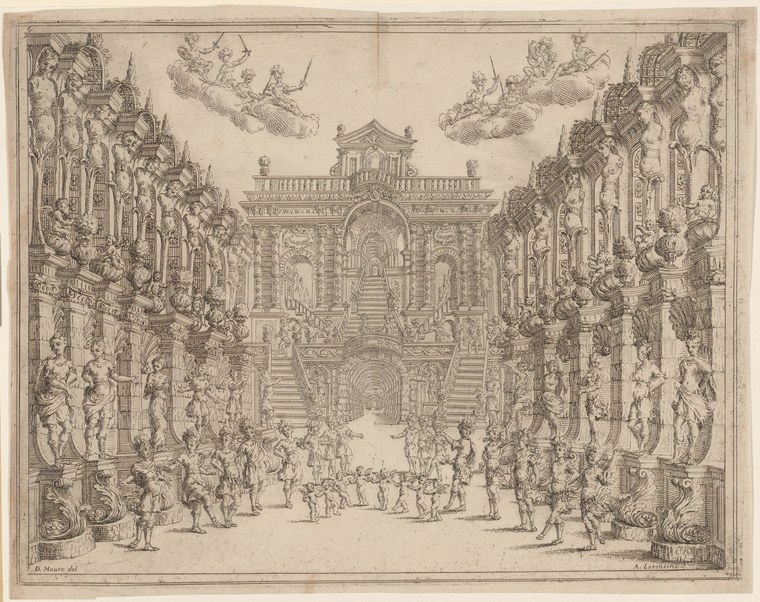
Set design for Il favore de gli dei, [1690]
Unknown artist
- Collection:
- Prints depicting dance
- Source:
- New York Public Library
- Rights:
- Public domain — free to use, share and adapt.
- Recorded as:
- Public Domain
Court ballet was the dominant theatrical form of the 17th century, and engravings like this are among the most reliable sources for how these spectacles were staged and conceived visually. The work demonstrates that court ballet was not merely a dance form but a total artwork combining dance, music, architecture, and allegory in service of courtly ideology—a foundation for much that would follow in European theater. For those studying Renaissance or Baroque dance, set design, or the history of spectacular entertainment, this image is irreplaceable documentation of a lost practice.
What you are looking at
A grand theatrical interior unfolds in strict linear perspective: a vast columned hall stretches toward a distant pavilion or palace facade, its central entrance framed by a monumental arch. The space is defined by paired columns running the full depth on either side, their capitals and entablatures rendered in precise architectural detail. Figures populate the floor—dancers, attendants, and courtiers—arranged in loose groups and processional lines. Many occupy the foreground and middle ground; others populate the distant palace steps. The architectural vocabulary is unmistakably late Renaissance or early Baroque: rusticated stone, pediments, balustrades, and classical proportions dominate. Above, allegorical or celestial figures drift among clouds in the upper portion, suggesting divine approval or mythological intervention. The entire composition reads as a fête or court spectacle—the sort of staged event combining architecture, choreography, music, and visual spectacle that characterized early modern court entertainment.
The dancing
The dancers visible in the foreground and middle distance adopt formal, controlled postures typical of court dance. Several appear in profile or three-quarter view, their bodies held upright with extended limbs. Some stand in what appear to be processional lines; others gesture toward companions or the central architecture. The figures are rendered small relative to the vast setting, emphasizing the grandeur of the space and the ceremonial formality of the occasion. Dress is consistently formal—long gowns for women, fitted jackets and hose for men—consistent with late 16th or early 17th century court fashion. The figures do not show the explosive energy of folk or martial dance; instead they embody restraint, order, and hierarchical arrangement.
The dance depicted
This is almost certainly a design for a court ballet—the theatrical form that dominated European courts, especially France and Italy, in the late Renaissance and Baroque periods. The inscription 'Il favore de gli dei' ('The Favor of the Gods') is Italian and consistent with the elaborate allegorical ballet-spectacles created for ducal courts. The image shows the stage design rather than the dance in action: the architecture provides the symbolic and physical stage for choreographed movement. Court ballet of this era combined speech, song, instrumental music, and dance within a unified allegorical or mythological narrative. The formal postures visible suggest the restrained, turned-out technique characteristic of Renaissance courtly dance—not folk forms or folk-derived styles, but the dance of aristocratic elites following the precepts of dance masters like Cesare Negri or Fabritio Caroso. The heavenly figures above suggest the typical court ballet conceit of divine or mythological blessing of the ruler and court.
How it was made
This is a printed engraving, made from a copperplate or wood block. The fine parallel lines (hatching) used to create tone and shadow, the precision of the architectural perspective, and the legible inscription are all hallmarks of Renaissance and Baroque engraving. The work demonstrates the technical mastery required to render complex perspective and architectural detail; the artist has used line weight and density to create spatial recession—finer lines for distant elements, bolder strokes for foreground. Engravings of this type circulated widely in print form and served multiple purposes: as records of court spectacles, as inspiration for future events, as display pieces for collectors, and as documentation of court ceremony for posterity. The circulation of engravings allowed designs for court ballets to be shared across courts and republished, influencing the aesthetics of spectacle across Europe.
About this work
This engraving documents a design for 'Il favore de gli dei' ('The Favor of the Gods'), a court ballet conceived for an Italian ducal court in or around 1690. Rather than depicting the dance in motion, it shows the architectural stage and spatial arrangement that framed the spectacle—a vast classical hall whose geometry and perspective embody the order and magnificence of the court itself. The work belongs to the tradition of court ballet design prints that were created throughout the 17th century to record, promote, and circulate these elaborate multimedia entertainments. The figures scattered across the floor indicate dancers, musicians, and courtiers; the composition as a whole reveals the inseparable unity of architecture, dance, and political ceremony that characterized court spectacle of the period. For historians and dancers interested in how court ballet functioned as an art form and as an instrument of ducal power, this print offers rare evidence of how the stage was conceived and how dance was embedded in a larger theatrical and architectural vision.
How to look at it
Trace the orthogonal lines that recede toward the vanishing point at the distant palace; this spatial construction was not accidental but fundamental to how court ballet was staged and experienced. Notice how the figures are distributed across this space—neither clustered nor randomized, but arranged to allow the eye to move through the composition and register both individual courtiers and the larger ceremonial procession. Look at the attitude of the figures: upright, formal, often in profile—this is not the aesthetic of folk movement or athletic display but of courtly restraint and dignity. The presence of allegorical figures in clouds above suggests that the earthly spectacle below was understood as having cosmic significance—a visual embodiment of the principle that the court was divinely ordained. The architectural frame is as much a subject as the dancers; it suggests that the stage itself was a work of art equal in importance to the choreography.
The artist
The engraver is not recorded. However, the work bears all the marks of professional theatrical design and printmaking practiced in Italian courts in the late 17th century. Such designs were often created collaboratively by architects, scenographers, and engravers; the precision and sophistication of the perspective and architectural rendering suggest a practiced hand trained in both theatrical design and the demanding technical requirements of engraving. The work likely originated in a court workshop or was commissioned to document an actual performance or planned spectacle.
The period
Court ballet flourished throughout the 17th century, particularly in France (where it became codified and eventually evolved into theatrical ballet) and in the Italian ducal courts. By 1690, when this work appears to date, court ballet in its pure form was already declining in France, where it had been gradually superseded by the newly founded Académie Royale de Danse (1661) and the emergence of professional theatrical ballet. In Italy, however, elaborate court spectacles remained an important expression of ducal authority and magnificence. The allegorical content—divine favor for the court—reflects the persistent Baroque conviction that courtly ceremony and spectacle embodied and reinforced the cosmic and social order. The precision of perspective and classical architectural vocabulary evident in the design reflects the Baroque synthesis of Renaissance humanism with contemporary court aesthetics.
Where it lives
The work is held in the Prints collection of the New York Public Library, catalogued as a print depicting dance. Its original purpose and first location are not recorded; it may have been created to commemorate an actual performance or as a design proposal for a planned spectacle.
Dance in this work
Questions about this work
What is court ballet and why does it matter?
Court ballet was a form of theatrical entertainment that flourished in European courts from the 16th to 17th centuries, combining choreographed dance, music, singing, elaborate costumes, and allegorical narrative. It was not a professional art form—participants were aristocrats and courtiers—but it served crucial political and ceremonial functions, displaying the wealth, taste, and divinely sanctioned authority of the ruler. Court ballet is the direct ancestor of modern theatrical ballet; its techniques, vocabulary, and aesthetic principles shaped everything that followed.
Who danced in court ballets?
Court ballets were performed by members of the aristocracy and court—primarily nobility, courtiers, and occasionally professional musicians and dancers hired to augment the spectacle. The participation of nobles was essential; it demonstrated their grace, education, and alignment with the court's ideology. Women increasingly danced in court ballets as the form evolved, though they remained fewer in number than men. The dances themselves were formally choreographed and taught by professional dance masters.
How do we know what court ballet looked like if there are no videos?
We rely on several types of evidence: surviving dance manuals (like those by Cesare Negri and Fabritio Caroso) that describe steps and figures; engravings and paintings like this one that show the stage, costumes, and spatial arrangement; written descriptions and librettos that document the narrative and music; and the evolution of ballet technique itself, which preserves elements inherited from court dance. Engravings of stage designs are particularly valuable because they show how the spectacle was conceived as a unified visual and spatial experience.
Why is the architecture so important in this image?
The architecture is not merely a backdrop; it is integral to the meaning and experience of court ballet. The classical orders, precise perspective, and monumental scale embody the values of reason, order, and cosmic harmony that the court claimed to uphold. The dancers moved through and in relation to this architectural frame; the geometry of the stage was as choreographed as the steps. This unity of dance and architecture was one of the defining characteristics of the form.
More dance artwork





