49 works in this view — arrow keys or swipe to move between them.
Dance in Art
Les bayadères: valses pour le piano, en deux suite[s?]
Unknown artist
- Collection:
- Prints depicting dance
- Source:
- New York Public Library
- Rights:
- Public domain — free to use, share and adapt.
- Recorded as:
- Public Domain
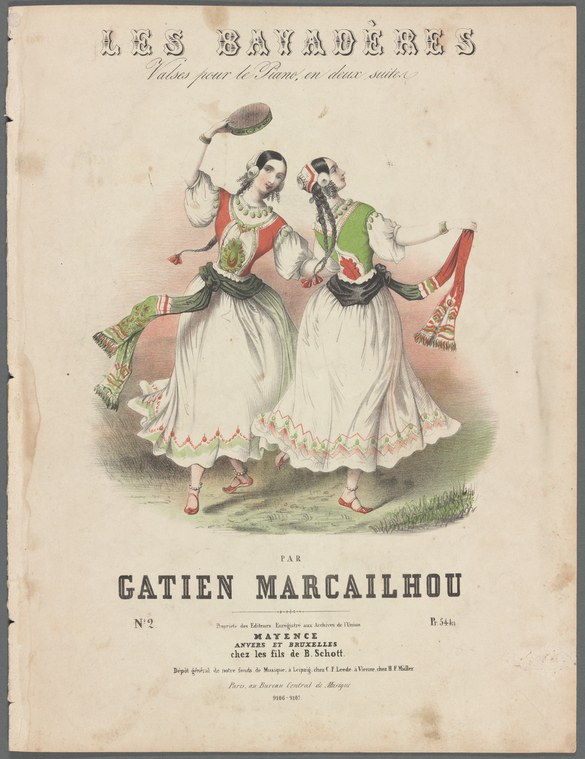
This print documents the popularity of orientalist dance fantasy in the Romantic era and shows how theatrical dance was packaged for home consumption through both sheet music and visual souvenirs. The image reveals period attitudes toward "exotic" dance, the centrality of spectacle and costume to Romantic ballet's appeal, and the technology through which dance ephemera circulated to audiences beyond the theatre.
What you are looking at
Two female dancers in elaborate Romantic-era costume dominate this hand-colored engraving. Both wear full white muslin skirts with scalloped hems trimmed in red, fitted bodices in contrasting colors (one red, one green), and decorative elements including jeweled ornaments at the neckline and waist. Their hair is styled up with ornaments. The figure on the left raises a wooden racket or battledore above her head in an emphatic gesture, while her companion gestures expressively outward. Both dancers wear pink pointe shoes. The setting is minimal—a simple ground line with faint green shading and a neutral background—which focuses attention entirely on the performers and their dynamic poses. The composition captures a moment of energetic action, with the dancers' bodies leaning into their movements and their costumes creating strong vertical and diagonal lines.
The dancing
Both dancers stand upright on what appear to be pointe shoes, their weight distributed across the balls of their feet. Their arms are raised and extended—the left figure holds her racket aloft, the right figure extends her arm in an open, welcoming gesture. The dancers face different directions, creating a sense of playful interaction or pursuit. Their torsos are engaged but not in a formal ballroom hold; instead they move as independent figures sharing compositional space. The raised arms and active posture suggest lightness and elevation typical of early Romantic ballet technique.
The dance depicted
This print depicts a scene from *Les Bayadères* (The Bayadere Maidens), a popular romantic-era ballet or dance entertainment. The title suggests an orientalist fantasy of Indian temple dancers (*bayadères* or *bayaderas* were European imaginings of Indian dancing girls), a common subject in 19th-century theatrical dance. The racket or battledore gesture is unusual for ballet proper and suggests this may depict a comedic or novelty dance scene—possibly a divertissement or intermission entertainment rather than classical ballet. The pointe shoes and the ethereal white skirts place this firmly in the Romantic ballet vocabulary of the 1830s–1850s, when such exoticized scenes were fashionable theatrical fare.
How it was made
This is a hand-colored lithographic or engraved print, identified by its fine linear work and the addition of watercolor or gouache for the costumes and flesh tones. The printing technique allowed mass production and wide circulation; such prints were sold to middle-class audiences as souvenirs of popular theatrical productions. The hand-coloring—done after printing and often by workshop assistants—gives each impression slight variations. The technique was well-suited to capturing the flatness of stage action and the decorative impact of costume, prioritizing visual appeal over anatomical depth.
About this work
This is a souvenir print of a popular 19th-century theatrical dance scene, most likely from the 1830s–1850s, when Romantic ballet and orientalist fantasies dominated European stages. The print advertises a piano arrangement of music from *Les Bayadères* for home performance, suggesting that both the dance and its music were fashionable enough for domestic consumption. The image captures a specific moment of stage action—two dancers in a playful, energetic scene—and serves as both a record of a theatrical spectacle and a commercial product for a broadening audience of dance enthusiasts. The exotic costume, the pointe shoes, and the dynamic pose place this work squarely within the visual culture of Romantic ballet, a period when ballet moved toward weightlessness, fantasy, and distant lands as sources of theatrical magic.
How to look at it
Observe the raised pointe work and the lightness of the poses—these signal the technical and aesthetic ideals of Romantic ballet. Notice the artist's choice to freeze the dancers mid-gesture in a moment of apparent levity or flirtation, not in a formal pose; this captures the theatrical energy of the scene rather than a held position. The costume detail—the fitted bodice, the full gathered skirt, the ornaments—is rendered with precision and hand-colored with attention to rich, harmonious tones; this was part of how dance spectacle was sold to the public. The emptiness of the background keeps the eye on the performers and emphasizes the stage as a space of fantasy.
The artist
The print is credited to Catien Marcailhou, a French engraver and print publisher active in the mid-19th century. The imprint notes publication in Mayence (Mainz), suggesting distribution through German-speaking territories as well as France. No further biographical information is available in the record.
The period
This print belongs to the height of the Romantic ballet era (c. 1830–1860), when audiences craved ethereal, supernatural, and exoticized narratives. Orientalism—a European fascination with imagined versions of India, Egypt, and the Middle East—provided both subject matter and costume design for ballets and theatrical dances. Marie Taglioni, Fanny Elssler, and other celebrated dancers of the period performed in such works, and their images were widely reproduced and sold. The pointe shoe, visible here, had become the technical marker of elite ballet and romantic virtuosity. Simultaneously, the popularization of piano reduction arrangements allowed middle-class households to recreate theatrical music at home, further extending the reach and cultural prestige of stage dance.
Where it lives
This print is held in the New York Public Library's collection of prints depicting dance. It is a commercial print product, likely one of many issued to promote the ballet or dance entertainment and to capitalize on its popularity.
Dance in this work
Questions about this work
What are the dancers holding?
The left dancer holds what appears to be a battledore or wooden racket, raised above her head. This is an unusual prop in classical ballet and suggests a comedic or novelty dance scene, possibly a divertissement (entertainment between acts) rather than the main ballet narrative. The gesture may reference a parlor game or folk dance, adding a playful dimension to the theatrical spectacle.
What does 'bayadères' mean?
Bayadères (or bayaderas) is the French term for temple dancers of India, as imagined and romanticized by European audiences. In 19th-century dance and theatre, bayadère dancers were typically portrayed in elaborate exoticized costumes and settings, reflecting European fascination with the Orient. The imagery was more about European fantasy than historical accuracy.
Why is this a print of music, not a dance painting?
This print was produced as a cover or advertisement for a piano reduction of the ballet's score, allowing middle-class households to recreate the music at home. Such prints served dual purposes: they promoted the theatrical production and generated sales of sheet music, extending the cultural reach and commercial life of successful ballets.
What shoes are the dancers wearing?
Both dancers wear pink pointe shoes, the specialized ballet shoes with reinforced toes that allow dancers to rise onto the tips of their feet. Pointe work was a defining technical innovation of Romantic ballet and a marker of elite training and virtuosity.
More dance artwork





