49 works in this view — arrow keys or swipe to move between them.
Dance in Art
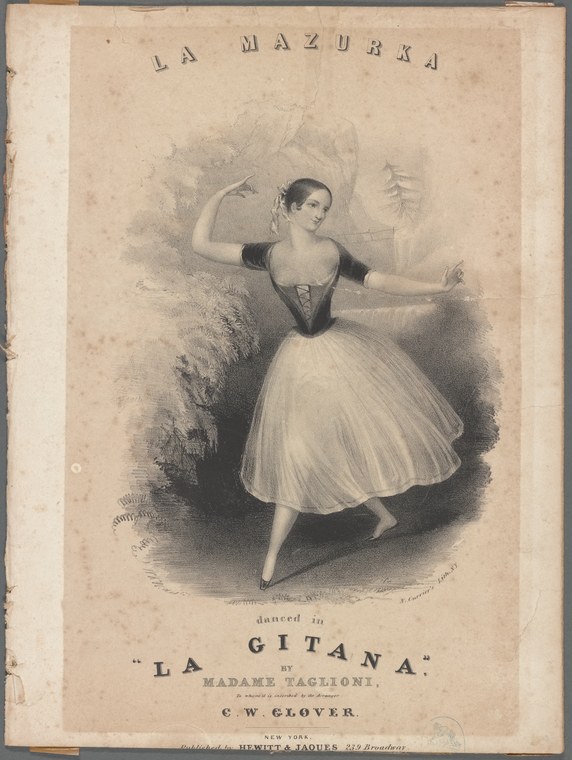
La mazurka danced in La Gitana, by Madame Taglioni
Unknown artist
- Collection:
- Prints depicting dance
- Source:
- New York Public Library
- Rights:
- Public domain — free to use, share and adapt.
- Recorded as:
- Public Domain
Taglioni was the defining ballerina of the Romantic era, and this print documents how folk dances were integrated into the ballet canon. It shows us not the virtuosity of multiple pirouettes or leaps, but the elevation of a simple folk form into a vehicle for the refined posture and épaulement that defined elite ballet practice—a transformation central to Romantic aesthetics.
What you are looking at
A woman in Romantic-era theatrical dress stands in a contemplative pose against a loosely sketched rocky or wooded background. She wears a fitted dark bodice and a voluminous white tulle skirt that extends to mid-calf, the silhouette characteristic of 1830s–1840s ballet. Her posture suggests a moment of stillness or transition rather than active movement: her right arm is raised to shoulder height with a gentle curve, her left arm extended to the side, and her body turns slightly in contrapposto. The composition is tightly cropped around the figure, isolating her against minimal setting details rendered in soft gray wash. The overall tone is intimate and contemplative—this is a portrait of a dancer as much as a record of choreography.
The dancing
A single female dancer occupies the frame in what appears to be a preparatory or transitional pose rather than a moment of active step. The raised right arm and extended left arm suggest an épaulement characteristic of classical ballet, with the arms held in a soft, rounded frame. Her weight appears to shift to one leg in a way that suggests plié or a sustained balance position. The silhouette and stance imply familiarity with turned-out positions and the carriage expected of professional ballet technique of the period. No male partner is present; this is a study of the woman dancer alone.
The dance depicted
The work documents a mazurka as performed by the legendary Romantic ballerina Maria Taglioni in the theatrical vehicle *La Gitana* (The Gypsy). The mazurka, a Polish folk dance that had recently become a fashionable drawing-room dance and a staple of romantic ballet, was often inserted as a solo or ensemble number within longer theatrical works. Taglioni's version here appears to capture a moment of épaulement and postural suspension rather than the characteristic bouncy traveling steps of the mazurka. The image gives us a record of how the dance was adapted for the concert stage, where dramatic pause and balletic refinement superseded the folk idiom.
How it was made
This is a lithograph or lithographic print, executed in soft gray and black tones with delicate modeling of form through careful tonal gradation. The technique allows for the fine rendering of the tulle skirt's volume and translucence, as well as the subtle play of light across the bodice and face. Lithography's capacity for rich half-tones and its relatively rapid reproduction made it ideal for theatrical publicity and souvenir prints, meaning this image likely circulated widely among ballet audiences in major cities. The image bears the printer's imprint of Hepworth & Jacques of New York at the foot, establishing it as a commercial print for the American market.
About this work
This is a commemorative theatrical print documenting Taglioni's performance of the mazurka in *La Gitana*, published in New York by Hepworth & Jacques. It captures not a moment of choreographic action but rather a pose of refined stillness—the épaulement and carriage of classical ballet technique applied to a folk-derived dance form. As such, it belongs to the Romantic ballet tradition of the 1830s–1840s, when European ballerinas of Taglioni's rank were being celebrated through lithographic prints for audiences in North America as well as Europe. The work is both a record of a specific performance and a testament to the star system that drove theatrical dance at the time.
How to look at it
Attend to the posture: the soft, rounded arms, the subtle turn of the torso, the sense of suspension rather than momentum. The artist has chosen a moment of stillness and composure rather than a step. Compare this to what you might see in a print of an earlier baroque or earlier neoclassical dance—the emphasis here is on the emotional and postural grace of the Romantic dancer, not on the intricate footwork or rapid movement. The minimal background and close framing turn this into a portrait of Taglioni as much as a dance record.
The artist
The print is credited to C. W. Glover as lithographer. No additional information on Glover's practice or biography is recorded, though the Hepworth & Jacques imprint suggests a commercial print shop operating in New York in the 1830s–1840s that specialized in theatrical subjects.
The period
This print dates to the height of Romantic ballet (c. 1830–1850), when European ballerinas, especially from France and Denmark, toured extensively to America. Taglioni's visit to the United States in 1839–1840 was a landmark cultural event, and prints like this one capitalized on her fame and the public's appetite for ballet imagery. The mazurka itself had recently become fashionable in European salons and was being incorporated into ballet scores as a dance of local or peasant character. At the same time, lithography had become the dominant medium for theatrical publicity and souvenir prints, making images of celebrated dancers widely accessible.
Where it lives
This lithograph is held in the New York Public Library's Prints depicting dance collection. It was published by Hepworth & Jacques of New York and likely distributed as a theatrical souvenir or publicity print during or shortly after Taglioni's American tour.
Dance in this work
Questions about this work
Who was Maria Taglioni?
Taglioni (1804–1884) was a Swedish-born ballerina who dominated European ballet in the 1830s and 1840s and is considered one of the greatest dancers of the Romantic era. She was celebrated for her ethereal technique, particularly her use of the pointe shoe, and for her dramatic presence. Her tours of Europe and America made her an international celebrity and helped establish ballet as a major theatrical art form.
What is *La Gitana*?
*La Gitana* (The Gypsy) was a theatrical work choreographed for Taglioni, incorporating elements of Spanish and gypsy themes. The mazurka was inserted as a solo dance within the larger narrative, a common practice in Romantic ballet where folk or character dances were integrated into dramatic works.
What is a mazurka?
The mazurka is a Polish folk dance in triple meter, marked by a characteristic syncopated rhythm and bouncy traveling steps. It became fashionable in European drawing rooms and concert halls in the early 19th century, and composers like Chopin elevated it to an art form. Ballet choreographers adapted it for the stage, often treating it as a character dance performed by soloists or ensembles.
Why is she standing still?
The artist has captured a moment of pause or transition in the dance, not the active step. In Romantic ballet, such moments of stillness and careful posture were as important as movement—they allowed the dancer to display refined carriage and to establish the emotional or dramatic tone of the piece. This reflects the aesthetic values of the period.
More dance artwork





