49 works in this view — arrow keys or swipe to move between them.
Dance in Art
Caricature
Unknown artist
- Collection:
- Prints depicting dance
- Source:
- New York Public Library
- Rights:
- Public domain — free to use, share and adapt.
- Recorded as:
- Public Domain
This print is evidence of how Regency-era theatrical culture represented feminine movement and beauty, and how that representation was circulated to a broad audience through the medium of hand-colored engraving. It shows the intersection of dance, fashion, and visual culture at a moment when women's bodily grace was a subject of both artistic attention and commercial interest.
What you are looking at
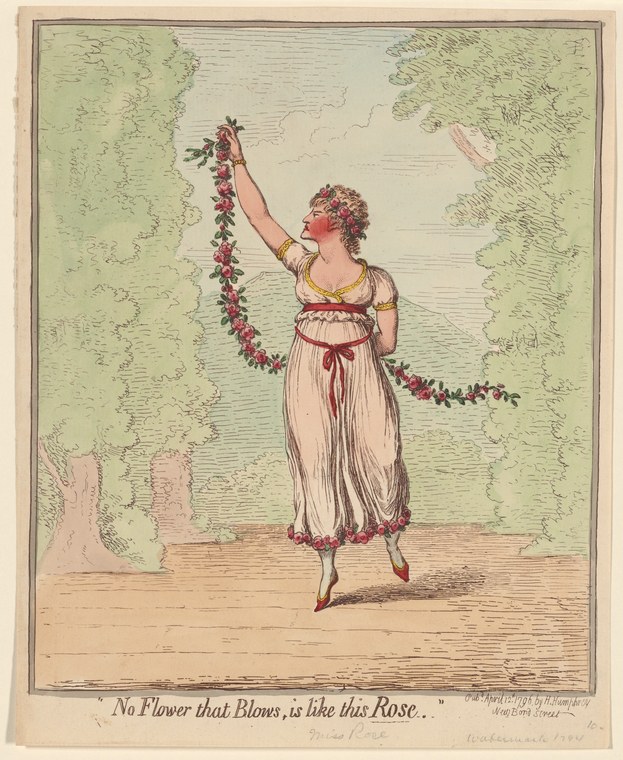
A young woman in a high-waisted neoclassical dress stands in a garden between two tall hedges or topiary, her body caught in an active pose. She holds aloft in her right hand a garland of flowers—roses, it appears—strung as a long swag that drapes down toward the ground on her left side. Her left hand grasps the lower portion of this floral strand. Her posture is upright and energetic, weight shifted slightly as though in motion. The setting is an orderly garden with clipped hedges rendered in hatching and horizontal lines to suggest depth. The inscription below reads "No Flower that Blows, is like this Rose."
The print employs hand coloring: the woman's dress is tinted pale pink or cream with a yellow bodice and red or pink ribbons at the waist and trim, her curled hair adorned with flowers. The background foliage is green, the ground warm brown, creating a pleasant pastoral interior view. The composition is upright and symmetrical, with the woman centered and the hedges framing her like wings of a stage. The technique is fine line engraving with careful cross-hatching for shadow and volume.
The dancing
The figure is a single dancer or performer, not partnered. Her stance suggests a lightness and an active moment—the body is not static but poised as though stepping or turning. The raised arm holding the garland lifts from the shoulder with a relaxed curve, the opposite arm angled to manage the swag of flowers. Her torso is upright, her weight appears centered or shifting forward, and her legs beneath the high-waisted dress are straight but not stiff, suggesting either a gliding motion or the moment between steps. The pose suggests the fluidity and grace expected of a Regency-era performer or society dancer rather than the formality of stage ballet.
The dance depicted
This appears to represent a theatrical or social dance moment from the Regency era, most likely the early 19th century. The pose and costume—the high waistline, the neoclassical silhouette, the garden setting—align with the aesthetics of Regency dance culture, where women performed graceful, decorative dances often with properties. The raised arm and the active posture suggest a Regency-era solo or pantomimic piece, possibly incorporating flowers as a narrative or decorative element. The inscription, a play on words, suggests this is not a named dance step but rather a performance or image celebrating feminine grace and floral beauty—the woman herself is being compared to the rose. This falls within the theatrical or entertainment dances of the Regency period rather than a specific ballroom or folk form.
How it was made
This is a hand-colored engraving, recognizable by the fine parallel lines (hatching) used to build form and shadow, the precise linear definition, and the even application of color in distinct areas without gradient. Engravings of this type were produced by hand-engraving a copper plate, then inking and printing to paper; hand coloring was applied afterward, often by women or apprentices following a guide. This technique allowed for wide circulation at relatively modest cost, making such images accessible to a middle-class audience interested in theatrical, dance, and fashion subjects. The delicacy of the line work and the quality of the coloring suggest a professionally produced print, likely from a London workshop or publisher.
About this work
This hand-colored engraving depicts a Regency-era performer or fashionable woman in an active, graceful pose holding a long garland of roses in a garden setting. The print marries theatrical imagery with a witty inscription, presenting the female figure as herself a kind of flower—beautiful, ornamental, and the subject of admiration. The work belongs to a rich tradition of theatrical and fashion prints from the early 19th century that documented both stage performance and the ideals of feminine elegance and movement of the period.
The work exemplifies how dance and beauty were visually represented in popular prints of the Regency era—not as technical instruction or narrative documentation, but as a celebration of grace, poise, and the decorative use of the female body in performance and society. The garden setting and the flowers reinforce this aesthetic rather than grounding the image in a specific dramatic context.
How to look at it
Attend to the position of the woman's raised arm and the arc of her body: these convey motion and lightness, not the rigid geometric lines of a formal ballroom dance. Notice how the garland creates a diagonal line across the composition, drawing the eye and also suggesting an active moment—perhaps a pirouette or a gliding step. The garden setting, with its orderly hedges, frames the figure theatrically, as if she is performing on a stage rather than simply strolling. The inscription below is key: it is a pun or compliment, suggesting that the image is as much about beauty and flattery as about dance technique.
The period
The Regency period (roughly 1811–1820 in Britain, but extending more loosely to encompass early 19th-century neoclassicism) saw a flourishing of theatrical prints and fashion imagery. Women dancers and performers, from professionals on the London stage to society women at dances, were frequently depicted in popular prints that merged entertainment, fashion, and instruction. The neoclassical style—evident in the high waistline, the simple drapery, and the garden setting—reflected contemporary taste influenced by Greco-Roman aesthetics and Jane Austen-era aesthetics. Theatrical dances of the period incorporated properties, narrative pantomime, and solo performance by women, often in naturalistic or garden settings rather than in strict classical forms. Hand-colored engravings were a major vehicle for circulating images of performers, dancers, and fashionable society to the urban middle class.
Where it lives
The print is held by the New York Public Library in a collection devoted to prints depicting dance. No artist, date, or publisher information is recorded in the catalogue.
Dance in this work
Questions about this work
Is this a real dance or a made-up pose?
It appears to be a theatrical or performance pose rather than the formal steps of a named dance like a cotillion or quadrille. The raised arm, the garden setting, and the property (the garland) suggest a solo theatrical piece or a fashionable woman posed to display grace and beauty. It is closer to pantomime or decorative dance performance than to ballroom technique.
Who danced this and when?
The costume and style strongly suggest the Regency era, roughly 1800–1820. The woman could be either a professional actress-dancer or a society woman posed as one for the purposes of the print. Such images were popular in London and circulated widely among the middle class interested in theater and fashion.
Why the rose and the inscription?
The rose is both a literal property in the performance and a symbol—the woman holding the rose is herself being compared to a rose, praised for her beauty and grace. The inscription 'No Flower that Blows, is like this Rose' is a compliment that works on two levels, flattering both the rose (the property) and the woman (the performer).
More dance artwork





