49 works in this view — arrow keys or swipe to move between them.
Dance in Art · 2014
Buffalo dance.
Unknown artist
- Medium:
- Source:
- New York Public Library
- Rights:
- Public domain — free to use, share and adapt.
- Recorded as:
- public_domain
This work is a crucial record of Great Plains ceremonial dance practice from a period when such dances faced suppression under colonial policy. The specificity of the visual detail — the body positions, the use of staffs or sticks, the ornamental regalia — provides evidence of dance form that might otherwise be lost to written description alone. For dancers and choreographers, the image is a window into an Indigenous movement vocabulary that continues to inform contemporary Native American performance practice.
What you are looking at
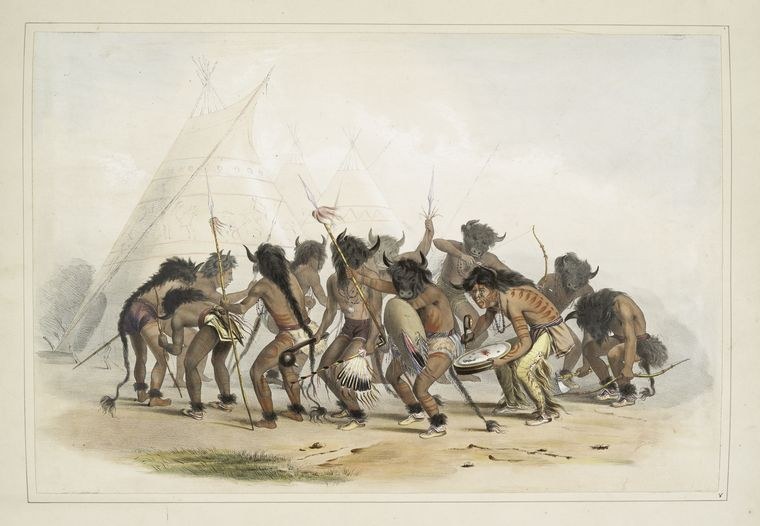
A group of approximately twelve Indigenous male figures stands in a circle or semi-circle on sandy ground before a conical tent-like structure (likely a tipi) visible in the background. The men are largely unclothed or partially clothed, wearing minimal garments, body ornaments, and what appear to be feathered headdresses or horned crowns. Their bodies are adorned with decorative elements — bands, possibly body paint or tattoos. They hold long sticks or staffs, some raised high in the air. The composition suggests active, energetic movement: several figures are bent forward or leaning, with legs positioned as if in mid-stride or mid-leap. The artist has rendered the scene with hand-tinted watercolor or similar media over an engraved or lithographed base, creating warm flesh tones contrasting with darker ornaments and the pale sky. The light is diffuse and overcast, casting no sharp shadows.
The dancing
The dancers occupy varied positions across the ground plane, suggesting fluid, successive moments of movement rather than a static pose. Several have one leg extended or raised, implying forward propulsion or jumping. The torsos are upright but mobile, with arms extended outward and upward in broad, expansive gestures. The stance is wide-legged and grounded, with weight distributed across the feet rather than concentrated. There is no visible partnering or hand-holding; the dancers occupy shared space as individuals within a group formation, each body oriented toward the center or performing similar actions simultaneously.
The dance depicted
This depicts a buffalo dance, a ceremonial dance practice among Great Plains Indigenous peoples, though the specific nation is not identified in the record. Buffalo dances held sacred and practical significance: they were performed as part of hunting preparation, spiritual ceremony, and cultural transmission. The painting captures the energetic, athletic quality of the form — the high kicks, extended arms, and forward-leaning torsos visible here are characteristic of plains dance vocabularies that emphasize strong, grounded movement with upward extension. The circle formation and simultaneous repetition of movement by multiple dancers are typical of communal ceremonial practice. The choice to depict the dancers at peak exertion — mid-leap, mid-gesture — conveys the vigor and sacred intensity of the practice.
How it was made
This is a hand-tinted print, most likely a hand-colored engraving or lithograph based on the fine linear detail visible in the figures and landscape, combined with subsequent watercolor or gouache coloring. The technique was standard for early-to-mid nineteenth-century ethnographic illustration and allowed for wide circulation among an educated audience interested in natural history and Indigenous cultures. The combination of precise line work with selective color creates a documentary effect while emphasizing the dancers' ornaments and flesh tones. This was a commercial medium designed for reproduction and distribution through books, periodicals, and print collections — a form of knowledge-making about Indigenous peoples intended for European and Euro-American consumption.
About this work
This print documents a buffalo dance among Great Plains Indigenous peoples, rendered in the ethnographic illustration style typical of the nineteenth century. It captures the moment of peak exertion in a ceremonial dance, with dancers arranged in a circle, their bodies in vigorous motion, adorned with ornaments and headdresses. The work is a visual record of Indigenous ceremonial practice, though created and circulated within colonial frameworks of representation. It belongs in a gallery of dance imagery because it shows both the formal properties of plains dance practice — the grouping, the extended limbs, the grounded stance — and the moment an artist chose to freeze: not a moment of repose but of collective, coordinated exertion.
How to look at it
Notice how the artist has frozen the dancers at the apex of movement: several bodies are airborne or deeply flexed, creating a sense of momentum and energy. The repetition of similar poses across multiple figures suggests this is a dance performed in unison or near-unison by a group, reinforcing the ceremonial and communal nature of the practice. Look at the relationship between the dancers and the landscape: they occupy the foreground prominently, with the tipi and sky taking secondary roles, signaling that the human action is the primary subject. The hand-tinting adds warmth and presence to the flesh tones while making ornaments and regalia stand out, directing the eye to the embodied specificity of the dancers.
The period
This print dates from an era of intensified European and Euro-American documentation of Indigenous peoples, driven by scientific curiosity, colonial expansion, and the displacement of Native nations from their territories. In the early to mid-nineteenth century, as the buffalo herds were decimated and the Great Plains were seized, such dances faced active suppression: the U.S. government banned many Indigenous ceremonies, including the Sun Dance and other communal rituals, viewing them as obstacles to assimilation. Visual documentation — whether through paintings, prints, or photographs — served multiple functions: as scientific record, as ethnographic curiosity, and paradoxically, as a form of preservation as Indigenous cultures were actively being disrupted and destroyed. The aestheticization of Indigenous dance in such prints often obscured the violence of the colonial context in which they were made.
Where it lives
The work is held in the New York Public Library collection. It is a print from a body of nineteenth-century ethnographic imagery documenting Indigenous American peoples and practices, likely created for circulation in illustrated books, periodicals, or print collections aimed at educated European and American audiences.
Dance in this work
Questions about this work
What is a buffalo dance?
A buffalo dance was a ceremonial dance practice among Great Plains Indigenous nations, performed for hunting preparation, spiritual purpose, and cultural transmission. It often involved a circle of male dancers moving in unison with vigorous, grounded movement and extended arm gestures, sometimes using staffs or other implements. The dance honored the buffalo and invoked spiritual power. Many such dances were suppressed under U.S. government policy in the nineteenth century.
Why are these dancers unclothed?
The minimal clothing shown reflects the actual practice of many Great Plains ceremonial dances, performed without the heavy cloth garments used in daily life. This allowed for freedom of movement and the visibility of body ornaments, paint, and regalia that held spiritual significance. However, it is also possible that the artist, working within nineteenth-century ethnographic conventions, selectively depicted Indigenous bodies with minimal dress to emphasize perceived 'naturalness' or 'primitivism' — a representational choice that should be understood as shaped by colonial viewing practices, not necessarily as documentary accuracy.
Who created this print?
The artist is not recorded in the catalogue. The work is a hand-tinted engraving or lithograph from the nineteenth century, likely created as part of a larger project of ethnographic documentation and illustration. Such prints were often produced collaboratively, with multiple artists involved in engraving, hand-coloring, and publication.
More dance artwork