49 works in this view — arrow keys or swipe to move between them.
Dance in Art
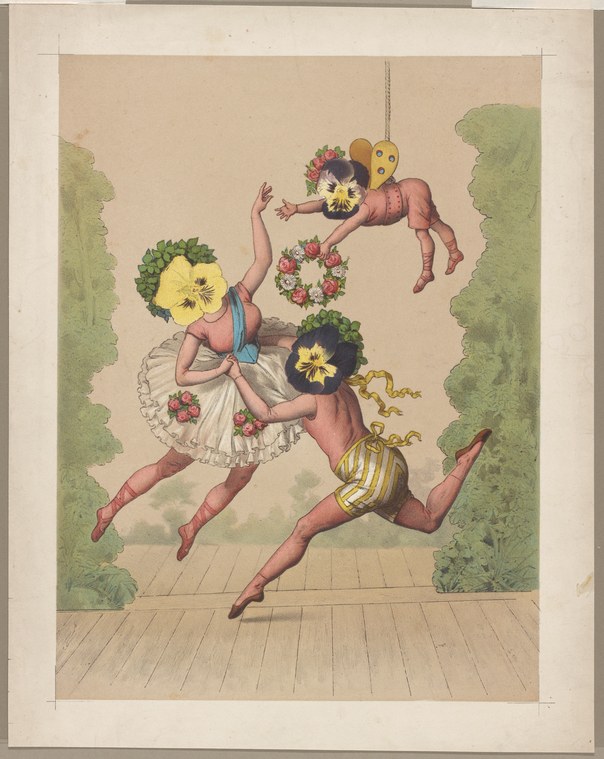
Three flower-faced dancers
Unknown artist
- Collection:
- Prints depicting dance
- Source:
- New York Public Library
- Rights:
- Public domain — free to use, share and adapt.
- Recorded as:
- Public Domain
This print documents the visual language through which ballet was understood and consumed by non-specialist audiences in the late 19th century: as spectacle, decoration, and fantasy rather than as a serious art form. The image also provides material evidence of how theatrical innovation—here, the flying apparatus that allowed the suspended figure—was marketed and celebrated in popular culture. For dance historians, it reveals the aesthetics of Romantic ballet as it reached the drawing room and the gift shop.
What you are looking at
Three androgynous figures with oversized flower heads dominate a wooden stage set against a backdrop of clipped green hedges. The central figure, wearing a salmon-pink bodice with a white apron and ruffled skirt, executes a dynamic leap or suspended jump with one leg extended and arms raised in celebration. Flanking this figure are two smaller companions: one overhead to the left wearing yellow pansy petals with pink limbs, suspended by rope as if flying, and one at ground level to the right in a gold-wrapped lower garment, caught mid-stride. All three have exaggerated, mask-like flower faces rendered in yellows, pinks, and greens. The central dancer holds a wreath of small pink blooms aloft. The wooden floorboards recede in perspective; the hedges create a formal garden enclosure. The overall effect is theatrical and whimsical, suggesting a fantastical floral pantomime or decorative pageant from the late 19th or early 20th century.
The dancing
The three dancers occupy different vertical planes, creating a compositional rhythm. The central figure executes a balletic jump with the supporting leg slightly bent, free leg extended, and arms lifted in an open, celebratory frame—a pose consistent with Romantic or theatrical ballet vocabulary. The leftmost suspended figure maintains an inverted or weightless position, arms gesturing downward in play. The third figure on the ground assumes a walking or running stride with forward momentum. All three bodies are lithe, elongated, and rendered without anatomical rigour, suggesting stylised theatrical rather than naturalistic movement. The composition emphasizes verticality and playful suspension rather than partnered or grounded contact.
The dance depicted
This work depicts theatrical dance, most likely Romantic ballet or a theatrical pantomime aimed at a popular audience. The flower-headed characters, the supernatural lightness of the suspended figure, the garden setting, and the celebratory leap recall the aesthetic of mid-to-late Romantic ballet (c. 1830s–1890s), when sylph and fairy characters were central to the repertory. The image may represent a specific production—possibly a flower or carnival scene from a ballet such as *The Nutcracker*, *A Midsummer Night's Dream*, or another narrative work with botanical themes—or it may be a generic theatrical decoration intended to evoke the mood of dancing flowers. The technique visible in the central figure's jump is consistent with classical ballet training of the period, though the overall composition is decorative rather than documentary.
How it was made
This appears to be a hand-coloured engraving or lithograph, executed in the refined decorative style typical of late 19th-century theatrical prints. The precise line work, the careful delineation of the figures, and the use of watercolour or gouache for the flower petals and costumes suggest a reproductive print intended for a middle-class audience. The composition's emphasis on flat pattern, elegant silhouette, and saturated colour indicates publication as an art print, book illustration, or theatrical souvenir. Such works were often produced in small to moderate editions and distributed through print shops, gift shops, or theatrical programmes.
About this work
This is a whimsical theatrical print depicting three flower-headed dancers in a fantastical garden stage setting. It belongs to the tradition of late Romantic and decorative theatrical imagery, at a moment when ballet was shifting from narrative spectacle toward ornamental design. The work captures the aesthetic of ballet as entertainment for cultivated urban audiences: theatrical, colourful, and fanciful. The suspension of the left-hand figure suggests technical innovation in stage machinery, while the classical vocabulary of the central leap roots the image in ballet practice. Though the record attributes neither artist nor date, the style and subject matter place it squarely within the world of late 19th-century European theatrical culture, when dance imagery was a staple of decorative and commercial art.
How to look at it
Look first at the vertical composition: the artist has layered the three figures to create a sense of weightless, playful movement, with the central leap as the apex. The suspension of the leftmost figure is the key to understanding the print's interest in theatrical illusion and stage machinery. Observe the contrast between the carefully drawn costumes—the apron, the wrapping, the defined limbs—and the fantastical flower heads, which signal that this is not naturalistic representation but imaginative theatre. The formal garden setting creates a stage picture distinct from nature; the hedges are props. The print celebrates the idea of transformation through costume and position.
The period
This print was created during the final decades of the Romantic era in ballet (c. 1870s–1890s), a period marked by the consolidation of classical technique, the rise of the prima ballerina system, and the increasing commercialisation of dance through prints, photographs, and theatrical merchandise. By this time, ballet had become a stable feature of urban theatrical life across Europe and North America, and images of dancers were standard commodities. Simultaneously, the Arts and Crafts and Art Nouveau movements were celebrating nature, plant forms, and decorative artifice—a context that makes the flower-headed conceit particularly apt. The work reflects the intersection of high theatrical practice and popular visual culture.
Where it lives
This work is part of the New York Public Library's collection of theatrical prints, a holding dedicated to dance and performance imagery. The collection comprises primarily commercial prints, engravings, lithographs, and photographs from the 18th century onward, many of them either unsigned or attributed only to publishers rather than artists.
Dance in this work
Questions about this work
Is this from a specific ballet?
The catalogue record does not identify a source, and the image alone does not definitively point to a known work. The flower-headed characters and garden setting are consistent with Romantic ballet aesthetics, and the composition may represent a scene from a narrative ballet such as *The Nutcracker* or a now-lost production. Alternatively, it may be a generic theatrical decoration or commercial fantasy with no specific narrative source.
How was the figure on the left made to appear to float?
This was almost certainly achieved through stage machinery—a system of wires or a flying apparatus controlled from above the stage. By the late 19th century, flying effects were a standard feature of European theatrical production, particularly in ballet and pantomime. The print celebrates this technical innovation by featuring it prominently.
What type of print is this?
Based on the style and execution, this is most likely a hand-coloured engraving or lithograph from the late 19th century. Such prints were produced in moderate quantities and sold as theatrical souvenirs, gift items, or book illustrations. The precise technique and refined colour work suggest it was aimed at a cultivated middle-class audience rather than the cheapest end of the mass market.
What can this tell me about how ballet was understood at this time?
This print shows ballet as a source of fantasy, spectacle, and decorative beauty—entertainment designed to delight through visual transformation and technical innovation rather than to convey serious emotion or narrative complexity. The work reflects the late 19th-century tendency to view ballet as an ornamental art, a tendency that would shift only in the early 20th century with modernist interventions.
More dance artwork





