49 works in this view — arrow keys or swipe to move between them.
Dance in Art
Historical and ethnic costumes
Unknown artist
- Collection:
- Prints depicting dance
- Source:
- New York Public Library
- Rights:
- Public domain — free to use, share and adapt.
- Recorded as:
- Public Domain
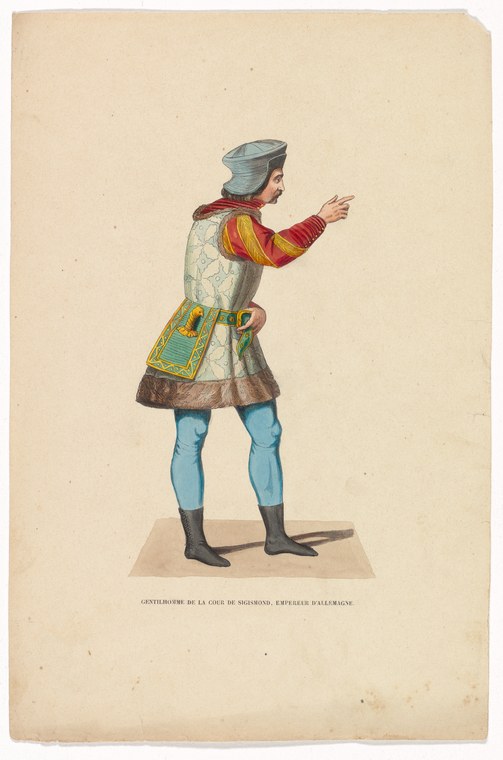
This image is essential evidence for how Renaissance and early modern courts understood and displayed dance knowledge. Rather than showing dancers mid-step, it presents the master or the courtier as the locus of dance authority—the person who knew the rules and could teach or demonstrate them. The extended arm and formal posture tell us something important about how dance was conceived in this period: as a learned, teachable accomplishment embedded in courtly decorum, not as spontaneous movement.
What you are looking at
A single figure in three-quarter profile stands against a plain cream background, posed as if mid-gesture or mid-instruction. The figure wears a distinctive outfit: a pale blue coat or tunic with ornate gold and jeweled embellishments at the chest and waist, a deep burgundy or wine-colored underjacket with contrasting yellow-gold trim, and light blue stockings with dark shoes. A gray-blue cap or helmet sits atop the head. The figure's right arm extends outward in a gesture suggesting direction or invitation, while the body is upright and formal. The pose and costume suggest a figure of authority or a dance master rather than a dancer in motion. The hand-coloring is delicate and precise, with fine detail in the embroidered patterns of the coat.
The dancing
One male figure stands in contrapposto, weight balanced and upright. The extended right arm reaches outward with palm open—a teaching or demonstrative gesture rather than a movement within a dance step. The body is frontal and composed, with no weight shift or dynamic action visible. The figure's posture is that of someone presenting, directing, or explaining rather than dancing.
The dance depicted
The costume and pose identify this as a figure from the court dances of the Renaissance or early modern period, likely a dance master or courtier. The caption in French (difficult to read fully but beginning with 'Gentilhomme de la cour...') confirms a courtly context. The gesture—the extended arm and open palm—is characteristic of how dance masters in printed manuals of the 16th and 17th centuries were depicted demonstrating position or direction to students. This is not a depiction of dance in performance but rather of the instruction or courtly display of dance knowledge.
How it was made
This is a hand-colored engraving or etching, evident from the fine line work defining the figure's features, the texture of the coat, and the careful parallel hatching visible in shadows and folds. The coloring is applied after printing, with translucent washes of blue, gold, burgundy, and flesh tone. The technique allowed for wide circulation of images of courtly dress and deportment; such prints were used as models for behavior and costume and were collected by people of status across Europe. The medium implies this is from a series or pattern book rather than a one-off commission.
About this work
This is a colored engraving of a gentleman of the Renaissance or early modern court, depicted not as a dancer but as a figure of courtly knowledge and authority—likely a dance master. The print belongs to a tradition of instructional and aspirational imagery that used the figure of the well-dressed, well-mannered courtier as a model for behavior and etiquette. Such prints circulated widely among educated people and served both as documentation of court dress and as visual instruction in propriety and gesture. The work sits at the intersection of dance history and courtly culture: it records both what a court figure wore and how he held himself as a marker of rank and knowledge.
How to look at it
Look at the extended arm and open palm: this is the gesture of instruction or demonstration, not of dancing. Note the formal, upright posture and the stillness of the figure—there is no suggestion of movement through space or the dynamic weight shifts of an actual dance step. The ornate costume, with its precise embroidery and jeweled details, signals rank and authority. The cap or helmet is a marker of identity or office. A viewer should understand that this is a representation of mastery and courtly knowledge, frozen in a pose that teaches as much by what it omits (the sweep and energy of actual dance) as by what it shows.
The period
This print belongs to the 16th or 17th century tradition of costume and comportment books, which documented and codified the appearance and behavior of European courts. During the Renaissance and early modern period, dance was central to court life and courtly education; young nobles were expected to master specific dances and to move with studied grace. Printed images of courtiers and dance masters served as models for imitation and instruction, circulating knowledge of correct dress, posture, and gesture across a literate elite. The hand-coloring and fine engraving technique indicate a high-value object intended for a cultivated audience.
Where it lives
The work is held in the New York Public Library's collection of prints depicting dance, cataloged under the broad heading 'Historical and ethnic costumes.' It is an example of the type of printed image that documented and disseminated knowledge of court dress and deportment across Europe.
Dance in this work
Questions about this work
Is this a dancer?
Not quite. This is a figure of authority—most likely a dance master or a courtier of high status—shown in a teaching or demonstrative pose rather than in the act of dancing. The extended arm and formal stance are the gestures of someone imparting knowledge, not performing a step.
What does the costume tell us?
The ornate coat, jeweled embellishments, fine stockings, and cap indicate a figure of rank and education in a Renaissance or early modern court. Such precise and costly dress was a visible marker of status and access to courtly circles. The costume was as much a kind of dance or display as any formal movement.
Why are these prints important?
Prints like this one documented how Renaissance courts dressed, moved, and displayed knowledge. They circulated among educated people across Europe and served as models for behavior and style. They tell us what counted as desirable, dignified movement—and what movement was thought to belong to people of power and learning.
More dance artwork





