49 works in this view — arrow keys or swipe to move between them.
Dance in Art
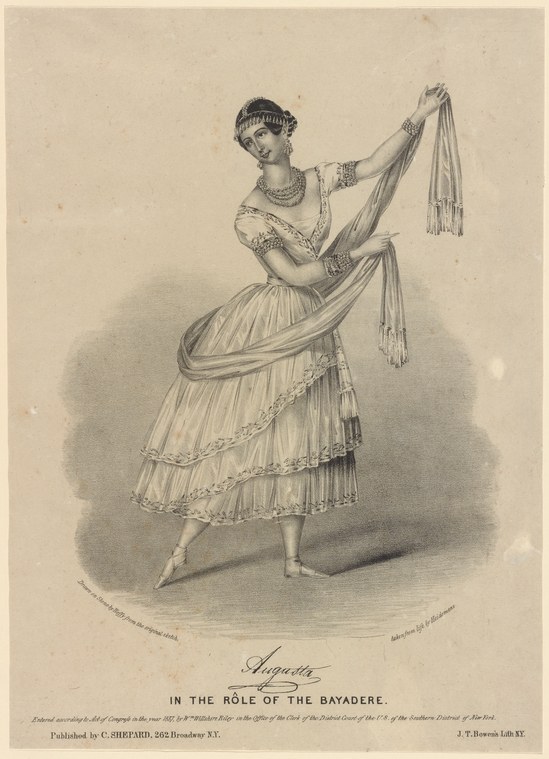
Augusta [facsimile signature] in the rôle of the bayadere
Unknown artist
- Collection:
- Prints depicting dance
- Source:
- New York Public Library
- Rights:
- Public domain — free to use, share and adapt.
- Recorded as:
- Public Domain
This work is a primary document of Romantic-era ballet performance and of the bayadere character type that appears in celebrated ballets from La Bayadere (1877) backwards. It shows how a European dancer inhabited an 'exotic' role and what aesthetic and costume choices that entailed. For historians of dance, such prints are among the only visual records of how these roles were danced in the nineteenth century before photography and film.
What you are looking at
A woman in Romantic-era theatrical dress stands in a graceful contrapposto pose against a plain background, her weight shifted onto her right leg. She wears a fitted bodice with short puffed sleeves and a long skirt of multiple layers with scalloped hems, rendered with careful attention to the fall and transparency of the fabric. Around her neck is a jeweled collar, and her dark hair is crowned with a tiara or ornamental headpiece. Her left arm is raised and extends diagonally upward, holding what appears to be a shawl or lightweight drapery that billows away from her body in graceful folds. Her right arm rests lower, also holding the fabric. The drapery she manipulates seems to be the focal point of the composition—it is rendered with particular delicacy, suggesting it is an essential prop or costume element. The figure is lit from the left, creating soft modeling on her face and body. The overall effect is one of poised elegance and controlled grace.
The dancing
A single female dancer is shown in a standing position with a slight contrapposto shift; her right leg is planted while her left is slightly relaxed. Her torso faces the viewer directly while her head turns gently to her left. The raised left arm creates an open, expansive frame; the right arm is lower and bent. Both arms support and manipulate the drapery, which appears to be the primary focus of the movement quality—the handling of fabric is delicate and studied, suggesting this is a virtuosic element of the dance rather than incidental costume. The pose is self-contained, stationary, and emphasizes line and the visual beauty of the silhouette rather than dynamic movement or traveling steps.
The dance depicted
The inscription identifies this as 'Augusta in the rôle of the Bayadere,' and the costume and pose are consistent with European Romantic-era ballet of the 1830s–1850s. The bayadere (or bayadeère) was a stock character in Romantic ballet—an exotic, sensual dancer, typically Indian in an orientalist fantasy. This image shows a theatrical interpretation of that role, with the drapery work suggesting either a scarf dance or the display of fabric as part of a solo variation. The pose is not a literal bayadere movement but rather a French theatrical interpretation of exoticism, emphasizing the elegance and refinement of the European ballerina in a 'foreign' role. Without additional context it is difficult to determine whether this represents a specific ballet or a generalized character type.
How it was made
This is a lithograph or engraving (technique not recorded in the catalogue) rendered in black ink on cream paper, with careful use of stipple and line to create modeling and shadow. The signature-line at the bottom suggests this was a commercial theatrical print, likely published for sale as a record of a celebrated performance or dancer. The delicate handling of the drapery and the attention to the texture of fabric indicate a skilled reproductive printmaker working from a drawing or painting. The technique allowed for wide distribution and afforded both the dancer and the artist publicity; such prints circulated among theater-goers and collectors of theatrical imagery. The medium and quality of the work suggest this was a professional, published portrait rather than a sketch.
About this work
This is a lithographic or engraved theatrical portrait of a named dancer, Augusta, in the character role of a bayadere—a stock figure in European Romantic ballet. The work dates to the 1830s–1850s, when such roles were fashionable and when the mechanical reproduction of theatrical imagery had become economically viable and culturally important. The print documents not only the appearance of the dancer but also the costume conventions, pose conventions, and aesthetic ideals of Romantic ballet. It is a record of a moment in dance history when European audiences were fascinated by orientalist fantasy and when individual dancers were becoming celebrities whose likenesses were commodified and collected.
How to look at it
Focus on the handling of the drapery—the way the fabric is rendered and held suggests this was a key technical and aesthetic element of the performance. Notice the contrast between the solidity of the dancer's body and the delicate, almost ethereal rendering of the cloth. The pose is deliberately statuesque and composed rather than caught in dynamic motion; this reflects the Romantic aesthetic preference for visual beauty and poetry over virtuosic footwork. The orientalist costume elements (the tiara, the jewelry, the lightweight fabrics) are rendered with anthropological interest, lending an air of authenticity to a fantasy character.
The artist
The artist is not recorded. The publisher is listed as C. Shiperd, 565 Broadway, N.Y., and J. T. Bosworth, 130 N.Y., suggesting this was a commercial print house in New York. The engraving or lithography was likely executed by a professional reproductive artist working from a portrait drawing or daguerreotype; the signature line visible at the bottom of the image may indicate the name of the draughtsperson or lithographer, but it is not clearly legible in the catalogue record.
The period
The Romantic period in ballet (c. 1830–1860) saw a shift toward narrative ballets, the elevation of the ballerina to the central figure, and the aestheticization of the exotic and the supernatural. The bayadere—a Hindu dancing girl, in European fantasy—was one of several orientalist character types that fascinated audiences. The 1830s and 1840s were also the golden age of theatrical lithography and engraving in New York and Europe; celebrity portraits of dancers were mass-produced and sold in print shops and theaters, establishing the dancer as a public figure and commodity. The existence of this print speaks to Augusta's renown and to the market for theatrical imagery in mid-nineteenth-century America.
Where it lives
The print is held in the New York Public Library's Prints collection, which documents theater, dance, and visual culture in New York from the nineteenth century onward. The publisher's address (Broadway) dates it to the period when the theatrical print industry in New York was flourishing, likely the 1840s–1850s.
Dance in this work
Questions about this work
Who was Augusta and what was the Bayadere role?
Augusta was a dancer active in mid-nineteenth-century America, likely performing in New York. The bayadere (bayadeère) was a character type in European Romantic ballet, representing an Indian temple dancer in an orientalist fantasy. The role was sensual, exotic, and often featured solo variations showcasing the ballerina's technical skill and grace. Without more information, we cannot identify which specific Augusta this was or whether she danced in a particular ballet of this name.
How does this reflect attitudes toward dance and 'exoticism' in the 1830s–1850s?
The bayadere and similar roles embodied European Romantic-era fascination with distant cultures, filtered through fantasy and colonialism. The character was understood as erotic and transgressive by nineteenth-century standards—a woman who danced for public pleasure—while the European ballerina in the role remained respectable through her refinement and the artistic context of theater. The elaborate costume and the emphasis on graceful fabric work also served to domesticate and aestheticize what was imagined as a foreign practice.
What does the pose tell us about how this role was danced?
The stationary, composed pose suggests the role emphasized visual beauty and the handling of costume elements—here, clearly the drapery—rather than rapid footwork or large traveling movements. This is consistent with Romantic ballet's aesthetic, which valued poetry, stillness, and the line of the body over dramatic action. The pose is designed to be looked at and appreciated rather than to convey narrative or emotional intensity.
More dance artwork





