49 works in this view — arrow keys or swipe to move between them.
Dance in Art
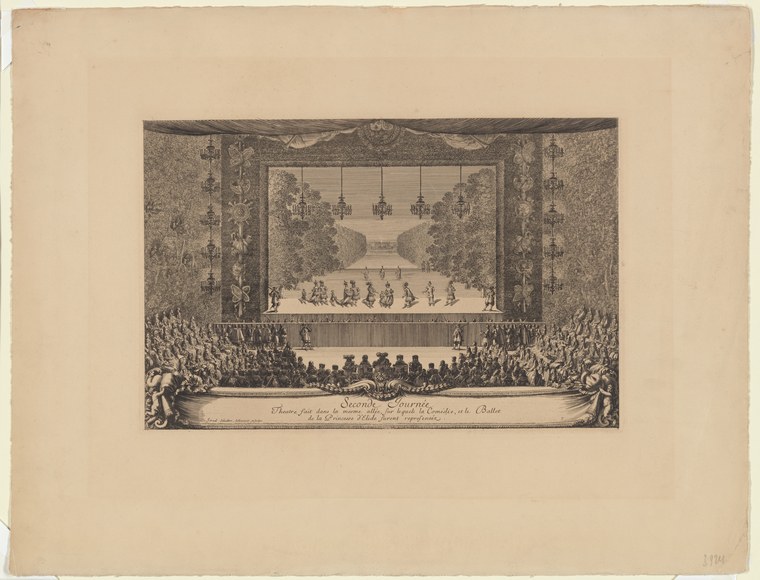
Theatre fait dans la mesme allée, sur le quel la comédie, et le ballet de La princesse d'Elide furent representéz
Unknown artist
- Collection:
- Prints depicting dance
- Source:
- New York Public Library
- Rights:
- Public domain — free to use, share and adapt.
- Recorded as:
- Public Domain
Court ballet was a foundational form in European dance history, but few visual records of actual stagings survive with this level of architectural and spatial detail. This engraving documents the theatrical apparatus, sightlines, and audience configuration of a major court performance, showing how dance and spectacle were integrated into royal ceremony. For historians of 17th-century French court culture, theater design, and the origins of ballet, the image is documentary evidence of considerable value.
What you are looking at
This is a bird's-eye view of an ornate theatrical interior during a court performance. The stage occupies the upper third, a shallow platform framed by tall proscenium columns and a painted backdrop depicting a formal garden or palace grounds in linear perspective. Hanging chandeliers illuminate the scene. The stage is occupied by a line of figures in what appears to be court dress, arranged in a formal procession or ballet formation. The orchestra pit or musicians' gallery runs along the front edge of the stage. The auditorium fills the lower two-thirds of the composition, packed densely with spectators in period dress seated on multiple levels—a standing crowd in the pit, seated galleries above. The decorative border and architectural framing suggests this is a formal document or commemorative print recording a specific court occasion.
The dancing
The stage figures are small at this scale but appear to stand in an upright, formal posture aligned in rows or a procession, consistent with court etiquette rather than vigorous dancing. Their alignment suggests a choreographed arrangement for display rather than active locomotion. The spectators in the auditorium are rendered as dense silhouettes, emphasizing the scale of the gathering rather than individual movement or expression. No dancers are shown in dynamic poses or clear partnering holds.
The dance depicted
The title identifies this as a performance of the ballet and comedy *La Princesse d'Élide*, a work by Molière and Lully performed at the French court in 1664. The composition suggests a court ballet (*ballet de cour*) rather than theatrical ballet in the modern sense—a court occasion in which nobility and courtiers participated in choreographed processions, entries, and allegorical scenes. The formal, processional arrangement on stage and the emphasis on the assembled court as spectacle rather than as an audience of passive witnesses is characteristic of mid-17th-century French court performance, where the act of assembling and the hierarchical display were themselves the subject. Without clearer detail of footwork or partnering, the specific dance vocabulary cannot be determined from the image.
How it was made
This is an engraving (establishing the medium from the image, as the record does not state it). The fine parallel lines, cross-hatching, and linear perspective are consistent with hand-engraved copper-plate work of the 17th century. Engravings allowed for wide distribution of theatrical documentation among the educated elite who could afford prints; this would have served as a commemorative record and a means of circulating knowledge of the court spectacle to those not present. The bird's-eye viewpoint and architectural framing suggest a formal documentary intent, similar to prints recording royal ceremonies and festivities from this period.
About this work
This is a commemorative engraving of *La Princesse d'Élide*, a court ballet-comedy performed at the French court in 1664. It documents not a moment of dancing but the social and spatial fact of the event—the geometry of the theater, the assembly of the court, and the display of spectacle on stage. Court ballet was not primarily a virtuosic dance form for trained dancers, but a hierarchical social ritual in which nobles participated in choreographed processions and symbolic actions, observed by the assembled court. This print is one of a class of 17th-century theatrical engravings that served to commemorate royal entertainment and circulate knowledge of court culture in print form. It is a rare surviving visual record of how court ballet was staged, arranged, and socially framed.
How to look at it
Examine the architecture: the engraver has rendered the theater as a microcosm of courtly order, with the stage framed as a formal ceremonial space and the auditorium as a hierarchical assembly of witnesses. Notice the emphasis on geometry and symmetry—the proscenium columns, the parallel lines of the perspective, the regular distribution of spectators. The stage figures are intentionally small and formal, inviting you to read the scene as a spectacle of order and assembly rather than as a display of virtuosic movement. The engraving's vantage point is that of a court official documenting a state occasion, not a theater-goer watching individual performers.
The period
This work dates to 1664 or shortly after, during the reign of Louis XIV, when court ballet (*ballet de cour*) was at its height as a form of royal entertainment and courtly participation. *La Princesse d'Élide* was a royal fête performance combining comedy (by Molière) and ballet music (by Lully), genres that were often integrated in court spectacles of this period. The 1660s saw the professionalization of dance and the establishment of formal institutions (the Académie Royale de Danse was founded in 1661), though court ballet itself remained an arena for noble participation. Engravings documenting these festivities were commissioned and published as records of royal splendor and as gifts to diplomats and distant courts.
Where it lives
The work is held in the New York Public Library's collection of dance-related prints. It is a commemorative engraving likely produced in France in the 1660s and circulated among courtiers and collectors of royal ceremonial prints. Such works were typically bound into albums or collected as documentation of court festivities.
Dance in this work
Questions about this work
Was *La Princesse d'Élide* a ballet or a play?
Both. It was a court spectacle combining comedy (a written play by Molière) with ballet entries and musical interludes (by Lully). In the 17th-century French court, ballet and theater were often woven together in fêtes and celebrations, with dance and dialogue interspersed.
Who danced in court ballets?
Nobility and courtiers, not professional dancers. Participation in court ballet was a mark of status and courtly accomplishment. The spectacle lay partly in the sight of the king, princes, and great nobles performing together in hierarchical formation.
How can I tell this is an engraving and not a painting?
The medium is evident from the technique: parallel lines and cross-hatching create tone and shadow, a hallmark of engraved copper plate. The fine detail and the even, linear handling of architectural elements are also characteristic of engraving rather than painting.
Why is the stage so small and formal?
This reflects the design of 17th-century court theaters, which were often intimate, built into palace rooms or courtyards. The shallow stage and proscenium framing emphasize spectacle and hierarchical display rather than extended movement. The stage was a platform for display, not a deep acting or dancing space.
More dance artwork





