49 works in this view — arrow keys or swipe to move between them.
Dance in Art
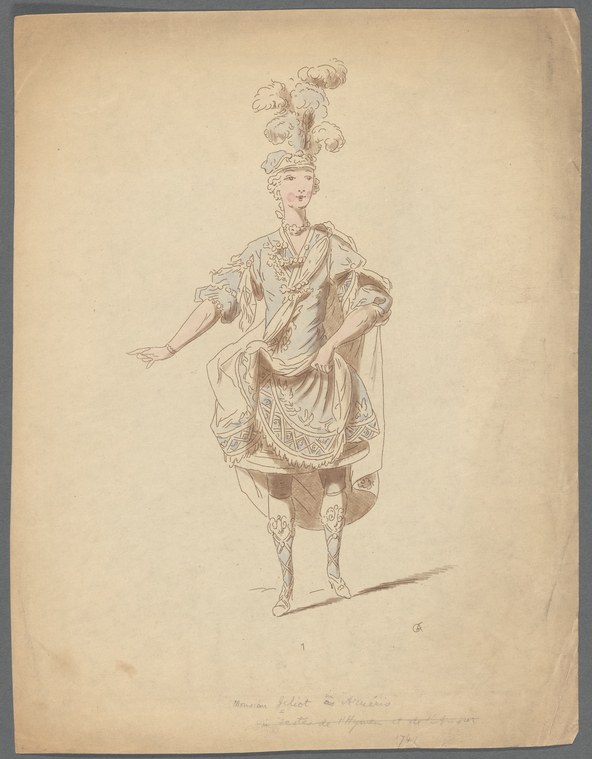
Monsieur Jeliot in "Aruéris", 1741
Unknown artist
- Collection:
- Prints depicting dance
- Source:
- New York Public Library
- Rights:
- Public domain — free to use, share and adapt.
- Recorded as:
- Public Domain
This drawing is one of the few surviving records that names a specific performer and identifies a specific work in eighteenth-century French theatrical dance. It documents not a generic 'court dance' but a particular design and production choice—the enormous feathered headdress and its positioning—that would have been distinctive and memorable. For historians of dance costume, baroque theatrical convention, and the social world of French dance professionals, Jeliot's appearance in this role is a concrete anchor point.
What you are looking at
A single male dancer in theatrical costume stands alone against a plain background, caught mid-performance. He wears a richly decorated coat or tunic in the French court style, with elaborate embroidery or trim visible on the chest and sleeves, paired with knee-length breeches and stockinged legs. His left arm extends outward in a gesture of address or presentation, while his right hangs at his side. His posture is upright and commanding, with weight apparently on the back foot. Most striking is his headdress: an extraordinarily tall construction of feathers or plumes rises vertically from his head, creating an almost architectural silhouette that extends well above his natural height. This ornament dominates the composition and marks him as a performer of high status or playing a fantastic character. The drawing technique is delicate and linear, rendered in sepia or brown ink with light wash, creating soft shadows that suggest volume in the fabric and musculature.
The dancing
A single male dancer in a formal, aristocratic stance. His weight is carried back on his right leg while his left knee is slightly flexed forward. His left arm is raised and extended at roughly shoulder height, palm open in a gesture of presentation or courtly address. His torso is upright and dignified. The pose suggests a moment of introduction or formal greeting rather than vigorous movement—the arm gesture is controlled and measured, consistent with the formal deportment expected in court dance. His gaze appears directed outward toward an audience or interlocutor.
The dance depicted
This is a professional dancer identified in the title as Monsieur Jeliot, performing in a work titled "Aruéris" in 1741. The costume and posture indicate a theatrical performance at the French court or in the opéra-ballet tradition of the early eighteenth century. The extreme height of the feathered headdress suggests a character role—possibly a god, mythological figure, or allegorical personage—rather than a human courtier. The formal, presentational quality of the pose is consistent with the entrée or formal opening of a baroque dance suite, where a character would be introduced with dignity and display. The theatrical costuming and the singular focus on a named performer indicate this is a record of a specific historical performance, likely part of a larger production.
How it was made
This is a drawing executed in brown or sepia ink with wash, characteristic of eighteenth-century theatrical design and performance documentation. The line-work is precise and economical, capturing the essential forms of the costume and figure with minimal modeling. The wash provides soft spatial recession and suggests the weight of fabrics. This technique was standard for recording the designs and principal performers in French court and operatic productions, and such drawings circulated among patrons and collectors as records of celebrated performances. The quality and finish suggest this was a professional or near-professional work, not a casual sketch.
About this work
This is a documentary drawing of an identifiable performer in a specific theatrical role at a named moment in eighteenth-century French dance history. Monsieur Jeliot was an established dancer of the French court tradition, and this record of his appearance in "Aruéris" preserves the visual design of a single character role—down to the precise height and configuration of his headdress and the cut of his coat. The drawing demonstrates the baroque convention of the formal, presentational entrance: the performer stands in a pose of courtly dignity, neither in rapid motion nor at rest, but in the controlled, legible stance required to display costume and establish character. The surviving inscription identifies both dancer and work, making this a rare piece of documentary evidence about mid-eighteenth-century French theatrical dance practice and the aesthetic conventions governing how such performances were visualized and remembered.
How to look at it
Attend first to the headdress, which is not accessory but the dominant visual statement. Its height and geometry are the primary markers of Jeliot's role: he is not human, or not merely human. Observe the stance: the open-palm gesture and the back-weighted posture create a moment of formal presentation, a frozen instant of introduction rather than kinetic motion. The precision with which the coat and stockings are rendered tells you this is a costume record, not a character study—the drawing exists to show what Jeliot wore and how he presented himself on the stage. The inscribed identification at the base places this firmly in the tradition of performance documentation.
The artist
The artist is not recorded. The quality and precision of the drawing, and the inscribed identification of the work, suggest either a professional theatrical designer or a skilled draftsperson attached to the court apparatus. Such documentary drawings were often made by artists whose names were not preserved, either because they were employed as anonymous functionaries or because the drawings were valued as records of performance rather than as artworks in their own right.
The period
In 1741, French theatrical dance was dominated by the opéra-ballet and the ballet de cour, traditions that blended music, spectacle, and formally trained dancers in mythological or allegorical narratives. The early eighteenth century was the height of the professional dancing master's influence at court; named dancers like Jeliot were celebrities whose appearances in titled roles were recorded and circulated. The headdress tradition visible here—fantastical constructions of feathers and ornament—was a legacy of the baroque ballet de cour and remained a standard tool for visual distinction of character roles in theatrical dance well into the eighteenth century. The drawing style and the choice to document Jeliot's appearance suggest a professional theatrical culture that understood documentation and visual record as valuable.
Where it lives
This drawing is held in the New York Public Library's Prints collection as part of a series documenting dance and theatrical performance. Such collections preserve the visual record of stage design and celebrated performers from the seventeenth and eighteenth centuries, and this work is one of many such records from the French theatrical tradition.
Dance in this work
Questions about this work
Who was Monsieur Jeliot?
Jeliot was a professional dancer active in the French court tradition in the early eighteenth century. Beyond his identification in this drawing, little is documented, which is typical for even celebrated dancers of the period. This image is one of the principal surviving records of his appearance.
What is 'Aruéris'?
The title suggests a mythological or allegorical work in the French baroque theatrical tradition—possibly an opéra-ballet or ballet de cour. The record provides no further details about the work's full title, composer, or narrative content.
Why is the headdress so tall?
In baroque and rococo theatrical dance, fantastical headdresses were standard tools for marking character roles and creating visual spectacle. The height and ornament served to make the performer legible from a distance and to distinguish supernatural or allegorical characters from human ones. Feathered constructions were especially common for gods, mythological figures, and celestial beings.
Is Jeliot dancing here?
The pose suggests a formal entrance or presentational moment rather than active dancing. The upright stance, controlled gesture, and frontality are consistent with the choreographic convention of the formal entrée, where a character is introduced with dignity before dance proper begins. The drawing captures a legible theatrical moment rather than kinetic movement.
More dance artwork





